

wanderer in the desert of mysteries
Joined April 2022
- Tweets3K
- Following940
- Followers339
- Likes5.3K





Kingkong retweeted

The fact you attach any significance to that trivia just reveals your ignorance of archaeology.
The Frankfurt silver and the gold bracteate from Vindelev are both dated roughly by grave good typology. They are not evidence that Christianity preceded Germanic paganism and you would have to be a literal retard to think they are.
Neither artefact represents the start of anything. The silver comes from one of the numerous middle eastern migrants in the Roman empire who worshipped Semitic cults - such as Jewish messianism. Germanics did not use silver and lead curse tablets or Greek script, instead they carved curses in runes on bones and wood.
The gold bracteate is an indigenous Germanic interpretation of the Roman solidi tradition, associating the king with the power of Wodnaz, as that of the Emperor had been with Jupiter and then Jesus.
I have explained to you before that the divergent forms that the name Wotanaz is found in later languages means the common root dates at a minimum to their last point of divergence 150-200 AD. The very youngest you could make the cult would be that date, but that would still be an unrealistic and unsubstantiated claim that no serious scholar would make since they all share myths and features that can be dated 5000 years back.
Kingkong retweeted

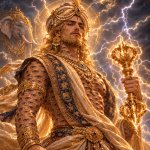
If people think Indra never ran for help in vedas then they are clearly delusional. Indra lost his vitality and vigour after killing vritrasur as per Brahmanas and aranyakas. Prajāpati and sometimes Agni restores it through rituals


Kingkong retweeted

Two Andhra Ikṣvāku kings in a row married Śaka (Scythian) princesses, and the last Ikṣvāku king we know of was the son of one of them.


In case anyone is wondering where is Indra , it's the middle couple whose head's are covered . It will be opened on the main ritual day


Even in that sense Indra is a Brahmagyani , the realized One . His teacher is Uma Haimavati .
Highly elevated Being in the hierarchy of entities . Just underneath the Saguna Brahman . Should be considered amongst the Jivanmuktas and Paramhamsas


Kingkong retweeted

Not the most accurate characterisation, it's more akin to the hero-cults of Achilles and Heracles being identified as emanations of Mars or Zeus and becoming as popular as the original cults of the Olympians.

Kingkong retweeted

Some people might soon start confusing Hayagrīva the Asura with Hayagrīva the Deva. The Goddess Night in the RV is also called Kṛṣṇa- does that make her a demon too? The RV calls several major Gods Asura. Does that make them demons as well?
tamaḥ kṛṣṇaṃ vyaktam asthita


Kingkong retweeted

It's obviously not Vāsudeva-Kṛṣṇa who probably existed two millenia after the Ṛgveda epoch. One shouldn't play the same spiritually petty games as those who indirectly or directly demean Indra.
Indra isn't solely a Puru-Bharata God. Rigveda 4.30.17 mentions how Indra carried Turvaśa and Yadu across or brought them safely through. It implies Indra's favor is not a Bharata/Puru hegemony.
"The lord of might [śacīpatiḥ], the wise Indra [indro vidvān], brought those two - Turvaśa and Yadu [tyā turvaśāyadū], across [apārayat], though they had not undergone the consecration bath [asnātārā]."
Same theme here: Ṛgveda 6.20.12 - "You, Indra, the Trembler [dhuniḥ], set flowing the waters held back by Dhuni [dhunimatīr … apaḥ], like streams rushing forth [sīrā na sravantīḥ]. When you crossed beyond the sea [samudram ati parṣi], O Hero [śūra], you brought Turvaśa and Yadu safely across [pārayā turvaśaṃ yaduṃ svasti]"
Ṛgveda endures because it is a pan-Bhārata text in its ultimate fruition, not just a Puru-Bharata tribal text. Let us not go down to the depths of the resentful, perpetually ironic, passive aggressive ilk that constantly use obnoxious X buzzwords like LARP and kang.
