

🇮🇳 in 🇺🇸 @mayoclinic RT != endorsement, views are persona|
Rochester, MN
Joined January 2013
- Tweets2K
- Following2.3K
- Followers583
- Likes19K





Dear mathematicians, biology welcomes you. Consider leaving the spherical cow at the door.

We’re releasing a broad range of new mathematical results produced by an internal frontier model.
We’ve been consulting with the independent Advisory Group on Mathematics and Artificial Intelligence at the Institute for Advanced Study, and we have drawn on their advice and public recommendations to inform how we release these results.
github.com/openai/math


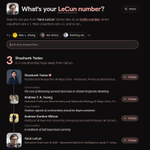
Six degrees of Yann LeCun
We mapped the coauthorship graph of every AI researcher on arXiv 🚀
Enter any two names to find the shortest path of papers connecting them
What’s your @ylecun number?
alphaXiv.org/number/@yann-le…

Shashank Yadav retweeted

Finally a more intuitive way to learn pLDDT/pAE? 😎
sokrypton.github.io/protein_…
(Character idea from @HannesStaerk & Alex Waldherr)
Shashank Yadav retweeted

Introducing the Muscle Biology Subgroup's Emerging Science Week @BiophysicalSoc! ✨
4 days of talks, 'Emerging Science and Scientists' in skeletal, cardiac & smooth muscle biology — Sept 14–17, 12:00–1:30pm EST daily.
Free registration — scan the QR code below to sign up!


Shashank Yadav retweeted

Been working on this a while, and super happy to share the first few pre-release chapter of this book on post-training. It’s called:
Post-Training AI: A Practical Guide to Fine-Tuning and Reinforcement Learning.
The idea behind the book is to take you on a simple line through post-training, to build intuition about how agents are learning in SFT, GRPO, distillation, and environments. It definitely skips a few concepts, and prioritises clear explanation of depth, but I think that’ll help most people start post-training.
The first two chapters are live in draft. They’re pretty fun already, they show you a minimal post-training implementation in a few hundred lines of code.
Chapter 1 is an intro that defines post-training. What each stage changes, what none of them can fix, and why the techniques now work outside frontier labs.
Chapter 2 is a speed run. You implement SFT and GRPO from scratch in pure PyTorch. Each loop fits in under 100 lines and runs on a free notebook GPU.
The rest of the book follows one model from base checkpoint to post-trained system, using TRL, transformers, PEFT, and the Hugging Face Hub.
Early release means raw and unedited. You read while I write. If you find problems, tell me. That is the point of releasing early.
learning.oreilly.com/library…

Presenting the poster tomorrow in Session C
@mlforhc @MayoRadOnc

New paper at @mlforhc (MLHC) 2026: when AI is used to predict treatment outcomes, a common practice is to treat it as binary classification – did a patient have the outcome by N years, or not?

Shashank Yadav retweeted

This work was led by @xinformatics with David Routman in Mayo Clinic’s Radiation Oncology AI & Data Analytics team. Interested in applying AI to practical medical problems? We’re hiring AI/ML research fellows and interns. Check here for updates: andrewfoongyk.github.io/#hir…
Shashank Yadav retweeted
Just presented at the ICML Mechanistic Interpretability workshop: openreview.net/pdf?id=evQ2B5…
Foundation models are promising for healthcare applications, but a common concern is how we can understand why they’re making their predictions.

Shashank Yadav retweeted

A 15-year-old dream has come true today. I started a PhD with the dream of creating a system that chants any Sanskrit shloka perfectly.
And here I am opening sourcing 𝐕𝐚𝐠𝐝𝐡𝐞𝐧𝐮 - 𝐀 𝐯ṛ𝐭𝐭𝐚 (𝐦𝐞𝐭𝐞𝐫) 𝐚𝐰𝐚𝐫𝐞 ś𝐥𝐨𝐤𝐚-𝐭𝐨-𝐜𝐡𝐚𝐧𝐭 𝐭𝐞𝐱𝐭-𝐭𝐨-𝐬𝐩𝐞𝐞𝐜𝐡 (TTS) 𝐬𝐲𝐬𝐭𝐞𝐦 𝐟𝐨𝐫 𝐒𝐚𝐧𝐬𝐤𝐫𝐢𝐭. This is the world's first vrutta-aware, open-source TTS for Sanskrit Chanting.

Shashank Yadav retweeted

If you’re coming to #ICML2026 🇰🇷, this Seoul Guide might be All You Need!
I’ve lived in Seoul for 20+ years and curated this all-in-one guide: Top 5 must-visits, 100+ recs with Google Maps, practical local tips, and more.
Check it out: ohmyksh.github.io/icml2026/i…
DMs are open and happy to give more details!
Shashank Yadav retweeted

Today we're announcing ESMFold2, an open scientific engine to power prediction, design, and discovery across protein biology.
The new model delivers state of the art performance on protein interactions, especially antibodies, a critical modality for therapeutics.
We have designed and validated miniprotein binders and single chain antibodies across five therapeutic targets that are important in cancer and immunology. We are seeing very high success rates, and affinities at levels consistent with therapeutic activity.
We’re also releasing an atlas of 6.8 billion proteins, and 1.1 billion predicted structures.
ESMFold2 is built on a state of the art language model that has been trained on billions of protein sequences.
A world model of protein biology emerges through language modeling.
We’ve used the techniques of mechanistic interpretability developed to understand large language models to understand the concepts ESM uses to represent proteins.
The model’s representation space has a compositional organization of features across scales, levels of complexity, and abstraction, that reflects and mirrors the understanding of protein biology developed through a century of empirical science.
This understanding emerges without prior knowledge, just from language modeling of protein sequences.
Language models are becoming a powerful substrate to understand and program biology.
The design of protein interactions is one of the most fundamental problems in biophysics, and has critical implications for the discovery of new medicines. A simple gradient based search with the model was able to discover high-affinity protein binders.
I'm excited by the potential this has to accelerate basic science and the understanding of proteins. And especially for the new avenues it opens up for therapeutic design and medicine.
Shashank Yadav retweeted

[SAVE THE DATE] MLCB 2026 will be held Nov 16–17 at the New York Genome Center in NYC!
Submission deadline is July 1 AOE
• 8-page full papers: oral or poster, with optional proceedings
• 2-page work-in-progress papers: posters
Spread the word! RT!
mlcb.org
Shashank Yadav retweeted

Personal update: I've joined Anthropic. I think the next few years at the frontier of LLMs will be especially formative. I am very excited to join the team here and get back to R&D. I remain deeply passionate about education and plan to resume my work on it in time.
Shashank Yadav retweeted
Scaling laws are powering AI. It’s time to scale biology.
Today we’re launching the Virtual Biology Initiative to generate the data to unlock scaling laws in biology and build accurate predictive models of the cell.
Digital representations of proteins are already expanding our understanding of life at the molecular level, and accelerating the design of molecules and medicines. Accurate digital representations of the cell could reveal the mechanisms that are responsible for disease, and show how to reverse them.
The protein data bank, and worldwide repositories of protein sequence biodiversity were created through decades of work by the scientific community. The advances in artificial intelligence for proteins would not have been possible without them.
The cell is orders of magnitude more complex, and we will need to create the data in just a few years rather than decades.
This will require a coordinated global effort. We're partnering with Broad, Wellcome Sanger, Arc, Allen, Human Cell Atlas, Human Protein Atlas, NVIDIA, and Renaissance Philanthropy.
Biohub is contributing to this effort as both a funder and a builder. We are developing microscopy to observe millions of cells in living organisms, and cryo-ET to resolve the cell in atomic detail. We're building instruments that expand the range of modalities and parameters that can be simultaneously measured. We’re developing molecular, cellular, and tissue engineering to create models of disease and design interventions.
The data we generate will be available to the worldwide scientific community.
We’re also committing $100M over the next five years to support work beyond Biohub.
We invite other scientific teams and funders to join.
Link: biohub.org/news/virtual-biol…

Amazing work!!!

New tutorial paper on the “Foundations of Schrödinger Bridges for Generative Modeling” is out on arXiv! 🧩
📖 arXiv: arxiv.org/abs/2603.18992
🔮 Project Website: sophtang.github.io/foundatio…
With 220 pages and 24 figures, this guide builds the theoretical foundations of Schrödinger bridges from the ground up, unifying the broad field of generative modeling with a single guiding principle: construct an optimal stochastic bridge between distributions while minimizing deviation from a reference process.
The rapid progress in generative modeling has made the field increasingly difficult to navigate from a foundational perspective, which motivated me to develop a resource that builds the core concepts needed to understand and contribute to new advances.
This guide contains intuitive explanations and step-by-step proofs covering:
🧩 The dynamic Schrödinger bridge formulation, lifting optimal transport to continuous-time stochastic processes between distributions, with direct connections to diffusion models, score-based methods, and flow matching.
🧩 A comprehensive toolkit for constructing Schrödinger bridges from first principles, describing stochastic optimal control, forward–backward SDEs, Doob’s h-transform, and Markov and reciprocal projections.
🧩 Extensions to complex and real-world problem settings, including the multi-marginal, unbalanced, discrete SB problems, highlighting the flexibility of the Schrödinger bridge framework in describing complex dynamical systems.
🧩 Practical, scalable algorithms for training and inference of dynamic Schrödinger bridges across modern generative modeling tasks.
More details in the thread 👇🏻

Shashank Yadav retweeted

The entire NSF research budget is ~$9B/year. This is literally funding every awarded PI at every field and every institution.
But we've decided that all of basic science is a rounding error in comparison to venture bets.
Please consider funding basic science more.
Shashank Yadav retweeted

🚀MIT Flow Matching and Diffusion Lecture 2026 Released (diffusion.csail.mit.edu/)!
We just released our new MIT 2026 course on flow matching and diffusion models! We teach the full stack of modern AI image, video, protein generators - theory and practice. We include:
📺 Videos: Step-by-step derivations.
📝 Notes: Mathematically self-contained lecture notes
💻 Coding: Hands-on exercises for every component
We fully improved last years’ iteration and added new topics: latent spaces, diffusion transformers, building language models with discrete diffusion models.
Everything is available here: diffusion.csail.mit.edu/
A huge thanks to Tommi Jaakkola for his support in making this class possible and Ashay Athalye (MIT SOUL) for the incredible production! Was fun to do this with @RShprints!
#MachineLearning #GenerativeAI #MIT #DiffusionModels #AI
