
CS PhD @princeton_nlp @princetonPLI; prev @SeoulNatlUni
Joined January 2023
- Tweets132
- Following752
- Followers477
- Likes1.3K


Pinned Tweet
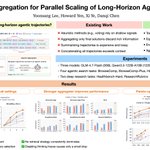
How should we effectively aggregate long-horizon agent trajectories? 🧐
Unlike CoT reasoning, agentic tasks pose unique challenges: they are long, multi-turn, and tool-augmented.
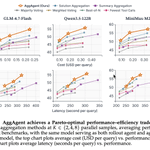
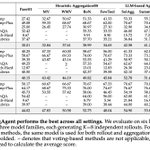
Introducing 👉🏻 AggAgent 👈🏻 — which treats parallel trajectories as an environment to interact with.

Yoonsang Lee retweeted

Presenting the poster at COLM tomorrow! Please drop by if you want to chat :)
⏰ Tuesday 4:30 - 6:30pm
🍭 Imperial Ballroom (# 20)

Presenting AggAgent at 🌁 @COLM_conf 🌉
⏰ Tuesday 4:30 - 6:30pm
🍭 Franciscan B (# 88)
Also, happy to chat about agent training, harness, test-time scaling, etc. 🤗


Drop by our SLIM poster too! @HowardYen1
⏰ Tuesday 4:30 - 6:30pm
🍭 Imperial Ballroom (# 20)

Yoonsang Lee retweeted

‼️Have you ever used a chess engine and wished it could explain its moves and evaluations?‼️
Introducing QUEEN, a 4B-parameter chess-language model that plays at the level approaching a typical Grandmaster and explains its moves in natural language.

Yoonsang Lee retweeted

The most profound paper of my PhD so far. We truly did something special to make LMs play/explain chess, needing both architectural & algorithmic innovation (natural-language analogue of the Alphazero algorithm) + applicable to many other domains. Please read on and share!
1/10

Yoonsang Lee retweeted

AI can increasingly make progress on open problems like Navier-Stokes. Yet defining a new problem still relies on human research taste.
Introducing ScholarCatalyst, a benchmark built from AI researchers’ firsthand accounts of what inspired their work.

Yoonsang Lee retweeted

New 📜 on evaluating long-context harnesses like RLMs and coding agents
Introducing LongHarness, a challenging benchmark evaluating both accuracy and efficiency. We find
1) clear accuracy gaps
2) >10× efficiency differences, even with same LM and similar accuracy
🧵

Yoonsang Lee retweeted

Could long-context architectures “find all contradictions” in a science literature? Not yet! 🧵
We study a new class of "high-complexity” tasks whose difficulty scales quadratically with corpus size (as opposed to linearly), reversing common LCLM decisions! (block-sparse attention, hybrid models…)

Yoonsang Lee retweeted

Multi-turn agents often make one early mistake and then NEVER recover. This breaks On-Policy Distillation on agentic tasks.😿
We introduce 🪀 PivotOPD, an on-policy distillation framework that trains agents to both: 1️⃣ Prevent pivotal mistakes, and 2️⃣ Recover from the states those mistakes create.
📄Paper: arxiv.org/abs/2609.40285
🌐Webpage: research.nvidia.com/labs/lpr…
💡 TL;DR: While OPD can't teach the student how to recover from mistakes (<1% prob on the right action), PivotOPD can❗️We teach the agent to recover from pivotal mistakes >3× more often than with OPD. This results in +6% gains over 13 baselines on Qwen3-1.7B/8B, and +3% gains on Nemotron-3.5.


Yoonsang Lee retweeted
After a long visa delay, I finally started my AP @UAlberta
It was an unusual year for my lab. I recruited students last year, but we still haven’t met in person. Grateful that, even so, they have done exciting work, with papers accepted to COLM and selected as ACL SAC Highlight


Yoonsang Lee retweeted

Hannam Oriental Roast Chicken (한남동 한방통닭): maps.app.goo.gl/tLfBWdW954Te…
Hybrid of Korean Fried Chicken + Traditional Chicken
It's been validated by countless foodies in Korea. Confession: I doubted the hype before visiting, but that was a huge mistake. Expect a very long line

Yoonsang Lee retweeted

.@danqi_chen, an expert in large language models, has been featured by the Communications of the ACM for her foundational work building small LLMs, which are vital to making modern models available on edge devices such as mobile phones.
bit.ly/4vhH5T0

ALT Danqi Chen
Yoonsang Lee retweeted

New Paper: Do Thinking Tokens Help with Safety?
Reasoning models generate “thinking” tokens before answering, which improves performance on many tasks like math and coding.
A natural hope is that models can also use thinking to deliberate about whether to refuse or comply a request.
But how true is this?
We find a surprisingly sobering answer: current reasoning models often do not use thinking tokens for real safety deliberation.
Work with: Abhishek Panigrahi, @prfsanjeevarora at @PrincetonPLI
(More in 🧵below)

Yoonsang Lee retweeted
If you’re coming to #ICML2026 🇰🇷, this Seoul Guide might be All You Need!
I’ve lived in Seoul for 20+ years and curated this all-in-one guide: Top 5 must-visits, 100+ recs with Google Maps, practical local tips, and more.
Check it out: ohmyksh.github.io/icml2026/i…
DMs are open and happy to give more details!
Yoonsang Lee retweeted

Today, agents execute isolated tasks. Tomorrow, agents will steer complex decisions across long horizons.
Introducing CEO-Bench, a first step to measure "Steering Intelligence." In CEO-Bench, agents are asked to run a simulated startup for 500 days.
ceobench.com

Yoonsang Lee retweeted

@princeton_nlp graduated 11 (!) PhDs at the hooding ceremony yesterday. Their research has fundamentally shaped the global AI landscape in so many ways, and they have been a core part of building the NLP group and its collegial spirit. It's been a real privilege working with and getting to know them all over the past few years!
@ZexuanZhong @AmeetDeshpande_ @SadhikaMalladi @_carlosejimenez @JensTuyls @VishvakM @__howardchen @xiamengzhou @gaotianyu1350 @danfriedman0 @_awettig
w/ @danqi_chen @prfsanjeevarora

Yoonsang Lee retweeted

Hooded six PhD students yesterday, my very first cohort at Princeton: Zexuan Zhong (@ZexuanZhong, 2024), Dan Friedman (@danfriedman0, 2025), Howard Chen (@__howardchen, 2025), Mengzhou Xia (@xiamengzhou, 2025), Tianyu Gao (@gaotianyu1350, 2025), and Alex Wettig (@_awettig, 2026)!
They started their PhD at the beginning of the pandemic and lived through one of the most revolutionary stretches our field has ever seen. Their work has shaped how we think about language models today. So proud of them, and can't wait to see what they do next!
Yoonsang Lee retweeted

MoEs are everywhere in frontier models, and they are deployed as a monolith system.
But many applications only need a narrow slice of capabilities, e.g., math, code, biomedical, etc.
So what if "modularity" is actually the missing opportunity for MoEs?
Today, we're releasing EMO: an end-to-end pretrained MoE where modularity emerges naturally, enabling selective use of experts!


We've released 8 parallel base rollouts for each (model x dataset) pair. Check out the links below: 👇👇
DeepSearchQA, HLE, HealthBench, ResearchRubrics
huggingface.co/collections/y…
BrowseComp, BrowseComp-Plus
drive.google.com/file/d/1c4M…
