

here because there is no way out
Joined March 2021
- Tweets2.4K
- Following1.8K
- Followers180
- Likes11.1K






dax retweeted

Growing up in the United States, NYSE was synonymous with the story of American capitalism. I vividly remember learning about the Buttonwood agreement in 9th grade history class. 24 stockbrokers met under a tree on Wall Street and formed the beginning of what would become the world's financial center. From pits to computers to now onchain markets, America has always led the way in innovating markets to improve price discovery and capital formation. Today the next chapter begins with ICE, trade[XYZ], and Hyperliquid.
ICE started as an electricity-trading platform in 2000, growing to acquire NYSE itself in only 13 years. It is a key infrastructure provider of America’s energy, bond, and mortgage markets. ICE is a rare story of exponential growth of a financial giant over decades, continually embracing innovation and technology.
trade[XYZ] was the first HIP-3 deployer and responsible for spearheading the flourishing global RWA perpetual market today. Only a year ago, trade[XYZ] launched its first RWA perpetual markets. They took a bet on HIP-3, which had just launched after months of tireless development. Having followed their journey from day 1, I cannot overstate how much Shoku and the team have poured into growing these markets to a genuine source of price discovery for the most important assets in the world.
Over the past three years, Hyperliquid has pioneered onchain infrastructure to house all of finance. Hyperliquid is nothing without its world-class builders. I am honored that trade[XYZ] and ICE have chosen to build on Hyperliquid to bring perpetual contracts to America.
When I first spoke to Jeff Sprecher around a year ago, he asked what success looks like to me. I thought for some time and joked that it would be seeing ICE building on Hyperliquid's technology. I could never have predicted the progress that we've made as a community in a single year to make this come true. Excited to see what we can build together next.

Intercontinental Exchange (ICE) and trade[XYZ] have announced their plan to use Hyperliquid as the infrastructure layer to deploy perpetual futures markets for US traders across crypto, equities, commodities, foreign exchange, and other real-world assets, subject to regulatory approvals. ICE operates NYSE and some of the largest exchanges and clearing houses globally.
In this structure:
+ Hyperliquid serves as the underlying technology infrastructure via HIP-3*
+ trade[XYZ] designs and implements the markets
+ ICE operates the regulated market and clearing structure
Existing trade[XYZ] HIP-3 markets will remain unchanged.
Hyperliquid is a neutral infrastructure layer with the goal of supporting large parts of the financial system. As with HIP-3, HIP-3* deployers are independent operators who use Hyperliquid as the onchain infrastructure layer for their own markets, while retaining control and responsibility over their deployment.
dax retweeted

Now that crime is legal I can brag about this publically
In 2021 I hit @CryptoGodJohn paid group for 6 figs by hunting the stops of their positions
I joined every single paid group on ct, mainly by using mirrors, and started tracking every single trade made on each. I quickly realized they were taking advantage of their users so I happily took advantage of them
I would use orderbook data and compare how each signal had an impact in the books
I had an automated Excel, it was fucking art with telegram notifs for every trade I should take
When I found guys who were heavily copytraded, I started wash trading and spoofing like a mfer to bring prices down and since they all used hard stop losses I would make bank on the slippage hit.
It wasn’t particularly hard since they would pick tickers with no liquidity to pump their own entries :)
shoutout @eliz883 who was by far the worst user of that predatory technique
I also made sure to hit you Eliz, in fact you were hit so often you started closing your positions 2 minutes after posting because I made your grift unprofitable past the pump and dump of your posts lol
It was the best on FTX because FTX OTC would buy my entire stack of some illiquid trash for like 4% from spot when it was literally empty and I had nuked it 20%+
Anyhow major thanks to @CryptoGodJohn
I ate real good thanks to your grifting, made more than 100k on your ass alone
I nuked you personally more than anybody else because I particularly hated how predatory you were to your users
Would be a shame if someone perpetuated what I began in 21 in your group again
I am an old man now, I retired from the shananigans
Thanks and fuck you
sold 1637 BTC (~ $100M ?) (~$63k)
sold ~ $230M of MSTR (~ $96)
bought $81M STRC at (~ $0.88)

Strategy increased its USD Reserve by $250M and repurchased $81M of $STRC. This increased USD Duration by 57 days to 2.3 years and tightened STRC’s BTC Credit by 5 bps. As of 8/2/26, we hold ₿842,138 in our BTC Reserve and $4.0B in our USD Reserve. $MSTR strategy.com/press/strategy-…

76
the bullish case for neoclouds is that demand for compute keeps increasing while compute is scarce to feed that demand
the bearish case is found by decomposing this demand among the different entities increasingly requiring compute and asking whether they help finance neoclouds

The fact that this post became the most successful one of my entire journey in terms of likes should make one think.
To me, it confirms that $NBIS is currently the most crowded trade on X within my feed.
Everyone seems to agree that neoclouds are the winners from Kimi. And that is usually the moment when it becomes interesting to look at the other side of the trade.
Demand is not the problem for the neoclouds. It was already huge before Kimi, and you can argue that open models push it even higher, because every new deployment is a new compute customer. The real question marks are financing and execution, and those get bigger, not smaller. Neoclouds borrow against long term offtake contracts. Here it helps to be concrete about who is actually on the other side of those contracts. Nebius does not primarily sell to small startups, its anchor customers are Microsoft and Meta, backed by multi year deals worth tens of billions. That is a strength, because it makes the financing bankable, but it is also the hidden dependency. The transmission does not run straight from the frontier labs, it runs through the hyperscalers. If the US frontier ecosystem cannot hold its high valuations, the labs cost of capital rises, and the hyperscalers that host and fund them start to rethink their own capex. And their offtake is exactly the collateral the neocloud financing rests on. So a repricing that begins at private labs nobody can short ends up landing on the balance sheet of a listed neocloud, one layer removed.
On top of that comes the quality of the new demand. Many small, short term customers hosting a Chinese open weight model are no substitute for a few large, bankable contracts. More GPU hours, yes, but not the kind of collateral you can build a senior secured facility on. So let us be clear about it. Life is easier for US neoclouds when two or three American frontier labs lead the market, not Chinese open source models.
In other words, the level of uncertainty has increased, and markets generally do not like uncertainty.
73
dax retweeted

I agree with your core point: from the perspective of the active decode path for a single sequence, Kimi's hybrid linear attention significantly reduces KV fetch overhead. Roughly 75% of the layers maintain only a fixed-size recurrent state, shifting the critical bottleneck toward high-bandwidth state updates and dense matrix multiplications. From that perspective, it has better long-term scalability than a traditional full-attention architecture.
That said, We don't think this is incompatible with DRAM and NAND continuing to play an important role.
First, Kimi is not entirely fixed-state. The remaining ~25% of MLA layers still maintain KV that grows linearly with context length. Looking purely at long-context KV capacity, Kimi effectively eliminates about 75% of the linear growth (which Kimi itself has highlighted as the maximum KV reduction), whereas DeepSeek's approach still scales linearly with context but compresses the total KV footprint to roughly 10% of the original at 1M context.
Second, let's talk about Kimi's "75% fixed-state." The state is only truly fixed-size if you have **a single sequence moving forward continuously while keeping only the latest state**. In a real serving system, however, you need prefix caching, recovery from intermediate positions, and agent branching. That means you cannot simply keep the latest recurrent state—you need to preserve multiple intermediate checkpoints. While each checkpoint is fixed in size, the number of checkpoints grows with context length, checkpoint granularity, and branching. As a result, Kimi reduces the HBM working set for an active request, but it does not necessarily reduce the overall DRAM cache pool by the same proportion.
This becomes even more relevant in an agent swarm setting. A single task may spawn multiple agents, tool calls, and reasoning branches. Shared prefixes can be reused, but once branches diverge, each branch maintains its own recurrent state, the remaining 25% KV cache, and intermediate checkpoints for future recovery and further branching. In other words, reducing the memory footprint of each individual agent may actually enable the system to run more agents concurrently, preserve more branches, and support longer execution traces. The total cache footprint therefore may not decrease—and could even increase.
We also need to consider the enormous capacity and cost gap between HBM, commodity DRAM, and NAND. HBM should hold the hot working set that is actively being computed and is most sensitive to bandwidth and latency. It is simply not economical to keep every agent session, prefix checkpoint, and historical cache resident in HBM. A much more practical architecture is memory tiering: hot state stays in HBM, warm checkpoints and KV reside in CPU DRAM, while cold prefixes, inactive sessions, and long-term agent memory are offloaded to SSD/NAND.
Finally, I think GPU utilization is another critical angle. Agentic workloads and long-context tasks spend a significant amount of time outside active decoding—waiting for tool calls, synchronizing with other agents, planning the next step, and so on. If every KV cache remains permanently resident in HBM, a large fraction of GPU memory ends up occupied by inactive sessions, leaving less room for new active requests and ultimately reducing GPU utilization.
The value of offloading is therefore not just reducing HBM cost—it is about freeing scarce HBM capacity so that GPUs remain dedicated to active computation. When a session becomes inactive, its KV cache, checkpoints, or recurrent state can be migrated to DRAM or SSD, and then brought back into HBM when execution resumes. This kind of memory tiering is conceptually similar to CPU cache hierarchies or operating system paging: the objective is maximizing cluster throughput rather than keeping all data in the fastest memory all the time.
Now consider Agent Swarms, where a single workload may involve dozens or even hundreds of concurrent agents, each with its own context, checkpoints, and memory. Even if Kimi substantially reduces the working set of each individual agent, the more likely outcome is that the system simply runs many more agents concurrently—not that all state permanently resides in HBM. In that sense, I view Kimi as changing the division of labor between HBM, DRAM, and SSD, rather than eliminating the need for DRAM or NAND. As long as there remains a large capacity and cost gap between HBM and DRAM/SSD, memory tiering and KV offloading will continue to be fundamental building blocks of large-scale inference systems.
You’re unable to view this Post because this account owner limits who can view their Posts. Learn more
dax retweeted

for those like me who need a @3blue1brown video to understand what this means say thanks to fable

hello there the jacobian conjecture is false thanx to my close friend akhil for asking about it and my other close friend fable for working during the world cup final
((1+xy)^3 z + y^2 (1+xy) (4+3xy), y + 3 x (1+xy)^2 z + 3 x y^2 (4+3xy), 2 x - 3 x^2 y - x^3 z): \C^3\to \C^3, has jacobian determinant -2, and sends (0, 0, -1/4), (1, -3/2, 13/2), and (-1, 3/2, 13/2) to (-1/4, 0, 0)

dax retweeted

I have a report full of security issues of a software I'm working on.
Codex won't fix them because of Cyber guardrails
Fable won't fix them because of Cyber guardrails
Kimi K3 fixed them all. No restrictions, just gets the job done.
This will end badly for OpenAI & Anthropic.
dax retweeted

There is also nothing worse than telling people you do crypto. Just say the word to basically anyone, and their sudden change in demeanor tells you everything you need to know. They move to a defensive posture as if you can scam them without a keyboard. My accountant even calls them digital assets, but we all know we are not serious people doing serious things.
It's not unjustified. Crypto is basically every grifter, scammer, low IQ opportunist on the planet merged into a single PVP greater-fool arena. It's all zero sum, just a distributed money game to take someone else's money.
I think what happened last cycle is the survivors realized that the stock market has turned into just as much a casino, but instead of tokens, we have AI and cash flows. Gambling > investing. Speculation, narrative, momentum, marketing; it is all basically the same as crypto, except with more liquidity and an actual utility/revenues. The NYSE isn't going to scam you like CZ, and unlike token holders, shareholders actually have rights (amirite $VVV lol).
AI is also real enough to change everything. It feels like the global economic system is changing very quickly now. I use AI for everything. It is now my search engine, personal assistant, and truth machine. I Claude more than I Google. And for every AI winner, there will be many losers.
The value of labor is also rapidly changing. I also think AI is deflationary and SAAS is a zero. Just open source everything today, or lose tomorrow. Physical AI is probably the next wave and in the near future robotics will even reprice manual labor again.
And what did crypto do during this wave of incredible innovation? Nothing lol. Crypto has gone through two stages (two cycles each stage), and is now starting it's third stage.
2010 -> 2017 This blockchain technology is interesting. Let's apply it to everything. Only problem is blockchain isn't really good at anything.
2018 -> 2025 There is a lot of money still flowing into crypto, let's scam everyone.
2026 -> 2032 Ai will fundamentally change how value moves digitally. SOV, stables, micropayments, trading network adoption begins.
We are now entering the adoption stage, powered by AI. Crypto from a usability standpoint is (and was always) complete garbage.
- You get hacked, you lose all your money.
- You send money to the wrong address, spoofed or fished, you lose all your money.
- You forgot your password, you lose all your money.
Crypto was always unusable for your average person. It was always difficult to set up and configure wallets, let alone manage security and process transactions.
Crypto was never going to work for humans (that's why there was never any adoption). BUT AI is exceptionally good at using crypto. It is good at setting up wallets, security, transactions, bridging, payments. AI isn't going to be using your Visa credit card to transact. Actually the underlying technology of blockchain as an efficient, distributed financial asset is now relevant again. AI is infinitely better at using crypto than people are.
My new thesis is very bullish on networks, and very bearish on crypto. Bearish on exchanges, bearish rails/L1s, bearish on crypto VCs/funds, bearish on defi, bearish on infrastructure/services, bearish on basically every coin, bearish on market makers, bearish on everything that isn't fair launch. We can probably throw 99% of crypto into the trash can and nothing will change.
So here is my thinking.
Bitcoin might still take another leg down, but it looks much stronger than I expected here, so I've started to average back in. If Saylor can fully integrate a traditional financial market ponzi into it and still can't kill it, nothing can. I think Strategy is a net negative for Bitcoin, but I also think they have entangled their holdings in enough complexity that they will probably survive and squeeze supply at least for the next cycle. I think the odds Bitcoin is $150k(+) in <18 months is higher than the odds it is <$60k. Also it feels like everyone is waiting for $40k right now, so whatever.
Ethereum isn't dead in the same sense that fax machines aren't dead. People still use fax machines (I think). Ethereum committed suicide when it abandoned decentralization long ago. Then the foundation squeezed all the juice out of it. The only guarantee in life at this point is that Ethereum will never break all time high (yes, even in 10 years when the dollar has halved in value, no one is buying your $ETH bags sorry).
Solana leaned into the utility of scamming people. This is good if you are a scammer, but not good if you don't like to be scammed. There is probably more grift in Solana than in the rest of crypto combined (which is an accomplishment). Every Solana token is also a scam. It was a good run, but even Solana has run out of people to scam. The best way to use Solana is don't.
Basically all old L1s/L2s are slowly going to zero. Robinhood/Stripe have their own chains. Wall street isn't buying your coins, they are selling you Canton.
$ADA, $LINK, $AVAX, $DOT, $ATOM are all going to zero. $TIA, $SUI, $SEI, $ZRO, $OP all zero. $XPL, $KTA and $MON are probably zero too (though still efficient enough for a small chance at adoption if Base hasn't already killed them). The winning rail probably hasn't been invented yet, but rest assured it will be centralized and primarily for AI2AI microtransactions.
Fuck $XRP, $BNB, $TRON, $ASTER. Complete perpetual market maker scams. If you hold these, fuck you too. Actually if you hold Ripple you are so low IQ already, it's not even your fault.
Turns out 90 of the top 100 cryptos were all scams too. Half of them brought to you by CZ. At this point, it's easier to just classify every coin as a scam until proven otherwise.
Zcash and Monero will both be worth more dollars per coin in the future. Both are also not lame to hold and are the only coins in all of crypto that have equal if not higher aura than Bitcoin. Do whatever you want with that information. I also have a dystopia thesis (humanity and AI will not mix well), where $ZEC/ $XMR do exceptionally well over the next few decades (assuming quantum resistance is solved).
Bittensor and Hyperliquid are probably still the most interesting networks in crypto. Both suffer from limited decentralization. Hyperliquid validators are centralized. Bittensor has zero governance. Both work and have utility.
I only hold Bittensor, not Hyperliquid. Bittensor will do another cycle. The narrative (incentivizing open source AI) is probably the strongest narrative in anything right now (even traditional markets). Bittensor at this point is also more of a network than a crypto. Same with Hyperliquid. Both tokens are now secondary to the utility they provide, which is a good thing.
I don't think POW will ever die. Stuff like Litecoin and Kaspa both benefit from historical distribution cycles and organic community backing. Scarcity is also impossible to artificially replicate.
Memes are forever lottery tickets. You know who buys lottery tickets? Poor people. Infinite supply, 99.99999% will go to zero. Stick with $DOGE, $SHIB, $PEPE, $TRUMP, $SPX, or anything with a strong, organic community. Always take profit. Even better, don't buy them.
If you buy $ANSEM you will lose all your money. If you buy $PUMP you will lose all your money. If you buy $M you will lose all your money. If you listen to anyone who told you to buy these to buy anything else, you will lose all your money. Actually fuck $PUMP. This might have been the worst thing to ever be created. I hope the lawsuits send them to hell. Block anyone who promotes or is associated with this crime.
There are a lot of interesting but unaligned tokens these days. $AAVE, $NEAR, $AERO, $UNI, $ARB, $LIT. These tokens have utility/fees but suffer from garbage tokenomics and flawed economic design (simple greed).
Polymarket/Kalshi proved one of the few actually utilities of blockchain. Prediction networks (open market deployment and fair resolution) are inevitable.
New themes.
1. Stable microtransactions
2. Prediction/resolution networks
3. Non-retarded Hyperliquid competitors (no not $LIT or $ASTER lol).
4. New/fair incentive networks (like Bittensor).
5. Fair stables (like OUSD).
The problem with crypto since the beginning was dilution (infinite tokens). And now it is significantly less interesting than everything else; AI, robotics/drones, quantum, space.
Bitcoin will win SOV, there will be a few stablecoin rail winners, maybe a few microtransaction/x402 winners. There will be a few incentive networks. Prediction/perp networks too. Privacy will always be interesting (long $ZEC/ $XMR). POW and POUW will always exist, and retain value. But this is like 20, maybe 30 tokens max. Everything else is a zero. Search for scarcity or recursive revenue loops.
Crypto is still investable, but if you are not concentrated into quality you are completely fucked. New cycle starting soon. Good luck.
dax retweeted

Despite the most historic oil shock ever, retail sales has accelerated from 2.4% at year end to 6.7% YoY, one of the strongest paces we have seen in 35 years.
Why? Because policy is loose and the household wealth is up ~12TRN YTD.
Ignore the doomers kiddos.


dax retweeted

The Robinhood Chain is the cleanest case study of what happened to ETH's economics over time.
Since inception, @RobinhoodApp Chain has grossed ~$816K in revenue.
@Arbitrum, the middleware provider, takes 10%: ~$80K.
Arbitrum then pays Ethereum for settlement: $1,538.
The margin profile roughly:
Robinhood: 89%
Arbitrum: 10%
Ethereum: 0.15%
If your thesis is "ETH is money," Robinhood building here is ultra bullish. More activity, more ETH collateral, more lindyness.
If your thesis is "ETH is a revenue generating asset," this is the ultra-bear case.
And here's the uncomfortable truth: Robinhood was never going to build on Solana, Sui or any monolithic L1. They want the stack customization. They want to be landlords, not renters. Ethereum won this deal on merit.
It's just not pricing it right.
A healthy split to me looks more like:
Robinhood: 75%
Arbitrum: 10%
Ethereum: 15%
Ethereum sells the most valuable settlement layer in crypto at marginal cost. Things need to change. @ethlabs_org

news coming out that 29 of July ADR's will be listed on Korea and therefore some still think they will be able to convert their korean shares to ADRs...
if the premium is not resolved the source of the issue still persists and no one will be able to arbitrage it


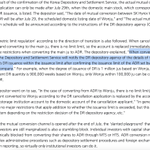
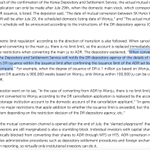
KOREAN LOCAL MEDIA: ARBITRAGE BETWEEN SK HYNIX’S KOREAN-LISTED COMMON SHARES AND NASDAQ-LISTED SKHY IS CURRENTLY MALFUNCTIONING
According to the Korea Securities Depository, actual applications for two-way conversion will only become possible after July 29, when the newly issued Korean common shares corresponding to the ADR offering are listed domestically.
The KSD stated, “Applications for conversion between SK hynix’s underlying common shares and ADRs are expected to become available only after July 29, the scheduled domestic listing date of the underlying shares.”
It added that the actual conversion timetable will be announced in accordance with instructions from the DR depositary, Citibank.
$SKHY
2
223

$NBIS down 10% today on this news
some attribute it to Deepseek IPO headline, others to NY signing the first statewide data center moratorium - governor.ny.gov/sites/defaul…
in my opinion it is an overreaction given Nebius data center distribution - assets.nebius.com/assets/aa1…


NEW YORK TO ENACT THE FIRST STATEWIDE DATA CENTER MORATORIUM IN THE U.S., PER NYT.
Gov. Kathy Hochul will pause approvals for new hyperscale data centers using 50MW+ of power for one year while the state studies energy, water and environmental impacts.
The order takes effect immediately, but does not affect projects that already have required permits. Hospitals, universities and back-office financial services are not expected to be impacted.

1
1
450
also if new US supply gets throttled while demand increases, permitted capacity gets more valuable.
nebius business model is not much vulnerable to the moratorium wave... nebius owns >75% of contracted power, generates behind the meter and builds on pre-zoned industrial land.
1
1
72