



Pinned Tweet
Themes over tickers. Long-term over quick trades.
Thesis/thematic investor here, with a bias toward long-term compounders. Names I am super bullish on: $ANET, $HOOD, $RDDT, $AXON, $CRDO.
26, full-time corporate, full-time obsessed with building generational wealth one thesis at a time.
Follow along my investing journey.
$SOFI just had a flawless quarter and the one tiny thing is that it’s still a lending story.
Revenue up 44% is nice, but the real story is net income up 73%. Sofi is finally turning growth into real profit, so it’s no surprise the stock rose 13% today.
The engine looks healthy too. Deposits jumped $5.8B, margins expanded and credit improved despite record loan volume. Then they raised guidance and guided 2027 EPS to $0.90, ahead of the Street.
Here is how my 3 watch items played out:
1. Fee revenue: up about 40%, but nearly all of that growth came from loan origination fees. Interchange and brokerage are growing fast, just not big enough yet.
2. Returns: ROTCE finally hit ~10%. The business is getting more profitable.
3.Cross buy: flat at 51%, but only because a record 1.2M new members diluted it. 37% of members now use 2+ products, up from 33% a year ago.
The last step is proving Sofi can grow fees without leaning too much on lending.
Real concern or am I being too picky?


$ASTS is mooning today and barely moved on the Brazil spectrum news yesterday.
Today it's up 8%.
Delayed reaction or just a risk on day?

I open my brokerage app during work like it's going to change anything.
It never does but I still do it.
Anyone else?
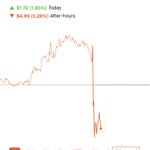
I finally found out why $RDDT fell 7% today.
Looks like the market was betting Anthropic would become Reddit’s next big data licensing customer. But Anthropic’s S-1 flagged the $RDDT lawsuit as a major risk, with no settlement in sight.
$GOOGL and OpenAI already pay for Reddit’s data. Is the Anthropic deal just delayed, or is the market overestimating Reddit’s AI opportunity?
Would you buy this dip or stay on the sidelines?

Cooking dinner and I get a notification that $CRDO is pumping. What’s going on?


Watching Man United and watching my portfolio this season feels exactly the same. Lots of hope. Not a lot of results.

$SOFI reports Q3 on Tuesday and here are 3 things that I am watching:
1. Fee based revenue
This is the key to Sofi becoming less dependent on lending. Fee based revenue grew 25% YoY to $472.3M in Q2, after 23% in Q1. I want YoY growth back above 30%.
2. Returns on capital
Management’s long term ROTCE target is 20% to 30%, but returns are still in the single digits. I want to see Q3 net income grow faster than tangible book value.
3. Cross buy
This is the core to the everything app story. In Q2, Sofi added 2.2M products, twice as many as members for the first time and 51% of new products came from existing members. I want to see cross buy keep climbing.
Should the market value $SOFI as a bank with a lending business or as a tech platform?

Markets right now are headline and macro driven.
AI companies keep delivering strong earnings and they still get sold off.
Fundamentals aren't what's moving price.

$HOOD reports Q3 on Tuesday and here are 3 things that I am watching:
1. Net deposits
This is the number I care about most. Q2 hit a record $21.7B (28% annualized), but August slowed to $4.0B (14% annualized). I want Q3 to stay above 20%.
2. Event contracts and crypto
Event contracts revenue grew 10x+ to $156M in Q2, while crypto has been the weak spot. With the midterms hub live and crypto perps just announced, I want to see event contracts keep ramping and crypto finally stabilize.
3. HOOD Summit follow through
15+ new products, including AI agents, earnings contracts, extended options hours and 24/7 stock trading coming in 2027. I want to see early adoption and whether they are driving new trading volume.
Do you guys think Robinhood can keep growing even when retail trading cools off, or is $HOOD still just a bet on retail sentiment?

Earnings I am watching this week:
$MSFT, $GOOGL, $AMZN: Cloud growth and AI capex
$NOW: One of my biggest software positions
$RDDT: Can US DAU grow?
$HOOD, $SOFI: 2 of my biggest fintech holdings
$VRT: AI power and cooling backlog
$SNDK: Is AI demand spreading to storage?
What’s on your list?

#earnings for the week of October 26, 2026
earningswhispers.com/calweek
$MSFT $GOOGL $INTC $AMZN $SNDK $SOFI $HOOD $SKHY $NOW $CAJPY $STX $APH $CAT $QXTI $CLS $BSX $KLAC $UPS $V $KO $VRT $VZ $GLW $GEV $FCX $ENPH $CDNS $RMBS $RBLX $NUE $CAKE $CVNA $FDX $FFIV $FTNT $CARR $CCJ $CNC $AMKR $PNR $RDDT $LLY $TMUS $STM $WELL $VMC $VFC $TWLO $UBS $IP

ALT The most anticipated earnings releases for the week of October 26, 2026, are Microsoft #MSFT, Alphabet #GOOGL, Intel #INTC, Amazon #AMZN, Sandisk #SNDK, SoFi #SOFI, Robinhood #HOOD, SK Hynix #SKHY, ServiceNow #NOW, and Seagate Technology #STX.
Which finance movie actually taught you something?
1. The Big Short
2. Wolf of Wall Street
3. Margin Call
4. Moneyball
Or are they all just entertainment?
My personal favorite is The Wolf of Wall Street.
What’s yours?

Is anyone else weird like me, or is it just me?
It’s Friday night and before I go to bed I randomly get the urge to research stocks and analyze my portfolio holdings.
Please tell me I am not alone lol
I recently reached 500 followers!
It’s been a longer and harder journey than I expected. There were moments when I thought about quitting, but the support and engagement from the FinX community kept me going.
For those who don’t know me yet, here’s a little about myself:
-26 years old, born and raised in Malaysia, I moved to the US for college and studied finance.
-I currently work in compensation at a Fortune 500 company.
-Outside of investing, I enjoy traveling, exploring food and coffee spots, gaming, EDM and Manchester United.
I actually spent years sitting on the sidelines before finally deciding to post on X. A few accounts that inspired me to take the leap were:
@CarsonTalkMoney
@Brian_Stoffel_
@LeifInvests
@drayinvests
Seeing others share their investing ideas inspired me to do the same. I wanted to exchange ideas, learn from the community and hopefully help a few people along the way.
A little late to the trend, but I also want to shout out my top 5 in the X circle:
@KGInvests_
@BrightLabsMedia
@hitborg
@Little_K_Story
@StokPix
Thank you to everyone who has taken the time to engage with my posts and make this community what it is. It genuinely means a lot.
500 is just the beginning. Here’s to the next 500 lets all gain some alpha together!

$NOK crushed earnings but the stock is selling off anyway. Here’s how my 3 watch items played out:
1. AI & Cloud orders
Orders hit €1.5B (+118%) and revenue reached €631M (+123%), now 12% of sales. Orders continue to outpace revenue and Nokia says demand exceeds what it can ship. The bigger picture is that AI is now a major growth engine for Nokia, with Optical and IP Networks expected to grow 25% to 30% in 2027.
2. Margins
I expected mobile gross margin to fall to 44% to 46%, but it held at 47.5%, partly due to Q4 deliveries being pulled forward. Network Infrastructure operating profit also grew 51% to €216M, with margins reaching 10%. That's AI demand showing up in earnings.
3. AI RAN
$TMUS completed its first live AI RAN voice call and 19 operators are now engaged. The technology is progressing, but without orders, it’s still a future opportunity rather than a growth driver today.
The main negatives were -€99M in free cash flow and FCF conversion guidance being cut to 35% to 55%.
I think this selloff is an overreaction. Do you guys still believe in $NOK?


I am bullish on the AI trade.
But that's why I love X, you hear perspectives that challenge your own.
And I agree with Rose here. History shows the companies powering a technological revolution don't always capture the most value. More often, the biggest winners are the customers and businesses that build on top of it.

What if everyone is right about AI but wrong about the investment?
This will probably get under the skin of quite a few people, particularly those heavily invested in AI infrastructure businesses. But I would encourage everyone to put their biases aside for a moment, forget about the stocks they own, and examine these businesses from a bird’s eye view. Are they truly extraordinary businesses with wonderful economics, sustainable competitive advantages, pricing power, and high returns on capital? Or are we confusing extraordinary demand for something with the existence of an extraordinary business?
I think this is something too many investors overlook. History is filled with industries that transformed the world and experienced tremendous growth, yet many of the businesses operating within them struggled to generate attractive returns for shareholders. Airlines revolutionized transportation, telecommunications connected the world, and railroads transformed economies, but that didn’t automatically make the companies wonderful investments. Just because the world desperately needs something doesn’t mean providing it is an extraordinary business.
When I examine AI infrastructure businesses, I see extraordinary demand and revenue growth, but also staggering capital requirements, huge financing needs, and expensive equipment that becomes outdated surprisingly quickly. Unlike businesses that can grow enormously without requiring much additional capital, these companies need to spend billions simply to expand their capacity. And eventually, actually rather quickly, much of that equipment will need to be replaced. So how much of this impressive growth will actually translate into cash that belongs to shareholders?
Consider depreciation, which I think is one of the most underappreciated aspects of these businesses. Imagine a company purchases $10 billion of computing equipment and assumes it will remain economically useful for 5 years, resulting in $2 billion of annual depreciation. But if the equipment’s actual economic life turns out to be 4 years, that annual economic cost increases to $2.5 billion. That’s a $500 million difference simply because one assumption about the useful life of the equipment changed.
And here’s something even more fascinating. The same technological advancements making AI increasingly powerful may simultaneously make existing computing equipment less competitive. If tomorrow’s equipment delivers twice the computing power for the same price, what happens to the economics of yesterday’s infrastructure? Technological progress can create extraordinary value for society while simultaneously destroying some of the economic value of the assets purchased to support it.
Then there’s pricing power, which deserves considerably more scrutiny. When demand exceeds supply, providers can enjoy attractive prices, but that doesn’t establish a durable competitive advantage. What happens when competitors expand capacity, supply catches up to demand, and customers gain more alternatives? Will these businesses retain attractive pricing, or will competition eventually transfer much of the economic benefit to customers in the form of lower prices?
I’m also fascinated by the enormous emphasis on EBITDA and revenue growth. Imagine a company invests $10 billion in infrastructure and generates $3 billion in annual EBITDA, which sounds extraordinary until you subtract $2 billion in economic depreciation and $600 million in financing expenses. Suddenly, you’re left with just $400 million in pretax earnings. The business hasn’t changed, but your understanding of its economics certainly has.
1/👇