

🚀 Speeding Up Enterprises & Startups - Built a few SaaS
Irvine, California
Joined August 2013
- Tweets22.6K
- Following1.7K
- Followers2K
- Likes17.2K





🚨 The internet is under attack
@Microsoft says AI agents have gone after hundreds of organizations, and some got admin access to cloud systems in under three hours.
@CrowdStrike tracked four groups running AI-agent attacks that actually worked. One hit at least 15 healthcare organizations in Argentina.
Old PHP bugs that had been sitting around for years became working attacks with AI's help. @Cloudflare CEO @eastdakota says they're seeing millions of attempts.
And the platforms we build on are cracking at the same time.
@Railway says customer secrets may have been accessed.
@LiteLLM shipped a release with a backdoor in it.
@zeaburapp got breached again and is shutting down.
@gitlab patched a top-severity flaw going back 12 years of releases.
@nodejs patched a serious bug, and @vercel rolled out firewall protection.
Attacks used to take time and skill.
AI is shrinking both. Defense still happens one patch at a time.
Patching faster won't close that gap.
You have to build like the attacker is already inside.


Whats happening right now is probably way worse than the Hugging Face incident.
AI-powered attacks are hitting real organizations while major platforms disclose breaches and critical flaws.
- Microsoft reports AI agents targeting hundreds of organizations, reaching privileged cloud access in under three hours in multiple cases. It attributes the ConnectWise compromise to the same group.
- CrowdStrike documented four operators running successful AI-agent campaigns. One compromised at least 15 Argentine healthcare organizations.
- PHP2Shell: AI helped turn longstanding PHP flaws into working exploits. Cloudflare’s CEO reports millions of exploitation attempts. Their AI involvement is unknown.
- Railway disclosed possible access to customer secrets. LiteLLM shipped a backdoored release. Zeabur confirmed another breach and is shutting down.
- GitLab patched a maximum-severity flaw affecting 12 years of releases. Node.js patched a serious code-execution vulnerability, with Vercel deploying firewall protections.
Feels like a turningpoint.


An AI company just gave away the world's #1 decision model for free.
@baseten's research arm, @baselabs, released mammoth-1 under an open license, so anyone can download it, use it and build on it. The day before, it was locked: "All rights reserved."
It ranks #1 out of 208 models on the Jev Decision Index.
Its smaller sibling, elephant-1, is the best model on that board under 15B parameters.
Both were built on @Alibaba_Qwen's Qwen3.5, and they published almost the full recipe for how they trained them.
So why give away the best model?
Because being #1 doesn't last. @perplexity_ai's model took the top spot on October 6. Two weeks later, someone else had it.
And Baseten doesn't make money selling models.
It makes money running them: companies pay Baseten for the computing power to use AI.
Every team that adopts mammoth-1 is a potential Baseten customer, and both models are even free for a week on its platform.
@AIatMeta does the same thing with Llama. Give the model away, and earn on everything built around it.
The model is free. Running it isn't.

Today we release mammoth-1 and elephant-1!
We post-trained mammoth-1, the #1 ranked best decision model in the world, and elephant-1, which is the best model under 15B (and beats Jev).
We're open-sourcing all model weights and provide a technical report detailing all our training and data methods.

why did OpenAI build an agent that reads screenshots of websites designed for humans?
Operator shipped January 23, 2025. its own virtual browser, clicking buttons, typing, scrolling through pages the way a person would.
six months later it was gone as a standalone product, folded into ChatGPT agent in July.
i don't read that as a failure. the browser was more of a bridge.
a few things it got right, and one i'm less sure about:
clicking pixels works on every site, an API never will. coverage beat elegance.
it pauses for passwords and payment details and asks before anything high-consequence. annoying, but it's the only reason anyone trusted it near a credit card.
the live view where you can take over mid-task mattered more than any autonomy demo. AI as the default actor, human steps in for the last 5%, that's the shape that actually holds up.
the part i'm unsure about is cost. running a frontier model on every scroll and click is expensive, and most of those steps are routing and filtering, not reasoning. But I know all of the image/video compression people have pointed out to me there are ways to drastically lower this.
OpenRouter just put Armor in beta, a Jev checking tool calls before they execute, reportedly beating Claude Code's auto classifier at a fraction of the cost. that's tool-adaptation doing exactly what it should.
in my own setup and with the AI-native teams i follow, it's the same pattern every time lol. cheap models do the grunt work, and the smart one only gets called when something actually needs thinking.
Operator proved agents can use the web.
whoever wins next proves they can do it without paying frontier prices for every click

A startup with no product just raised $1 billion.
It's called Flapping Airplanes, a small San Francisco team that builds software to make AI chips run faster.
Index Ventures and Lux Capital led the round at a $6 billion valuation, 4x what the company was worth in January.
So why pay that much for a company that hasn't sold anything yet?
Because AI has a chip problem.
Demand for AI is growing faster than the world can make @nvidia chips.
If you can't get more chips, the next best thing is getting more out of the ones you already have.
That's what Flapping Airplanes works on.
They rewrite the low-level software that tells chips what to do, so less time gets wasted between steps.
One co-founder says getting even 10% more out of every chip would be "tremendously economically valuable."
For scale, this one check is bigger than all 13 rounds Index led this year combined.
Investors aren't paying for revenue here. They're paying for a young team betting it can ease AI's biggest bottleneck.
At $6 billion, that's an expensive bet on a fix nobody can buy yet.

We’ve spent the past year developing new primitives for GPUs. We believe this enables new algorithms to change how machines learn, open new markets, and dramatically reshape AI’s cost structure.
We have raised a $1 billion Series A, co-led by Index and Lux.
a company that runs other people's tests is now worth $1B.
a year ago it was worth $60M.
blacksmith ran 5M CI jobs a week in january. now it's past 90M. ARR grew 17x right alongside it.
that's not luck. that's agents.
anthropic says its CI volume grew 25x in six months as claude took over most of its code output.
agents write the code. nothing merges until it's built and tested.
writing got cheap. trust didn't.
blacksmith bet early that CI shouldn't run on rented hyperscaler VMs. they use gaming-grade CPUs, and one customer can spike to tens of thousands of cores and back.
the entire CI tools market is sized at ~$2.09B for 2026. sequoia just priced one runner company at nearly half of that.
I see the same shift in my own work. I used to wire up RFdiffusion + ProteinMPNN + AlphaFold by hand. now Biomni designs binders for me with minimal input.
generating candidates is basically free.
validating them is where the time, compute, and money go.
the bottleneck didn't disappear. it moved downstream, and it's way harder to catch if you aren't looking for it.
the scarce skill now is asking the right questions and judging the answers, not producing more output [2].
so for any agent stack, ask where the output goes to be trusted.
whoever owns that layer owns the bill.

@sequoia is leading our Series C at a $1B valuation.
We started Blacksmith in 2024 to make CI faster and less painful. In January we ran 5 million CI jobs a week. Today it's over 90 million and growing, and we’re still early.

ALT Line chart of weekly CI jobs run on Blacksmith, growing from 5.4M in January to 90.5M in October 2026.
The answer key matched the test-taker 👀
In 2024, Reducto published RD-TableBench, 1,000 human-annotated tables, and put itself on the leaderboard.
In April 2026, rival Pulse audited it. 89 answer-key files were byte-for-byte identical to Reducto's own output.
In 15 of them, the key and Reducto made the exact same mistake. Independent parsers didn't.
Pulse still won on the uncorrected key. 0.9684 vs 0.9308.
And this isn't a one-off.
Meta tested 27 private Llama-4 variants on Chatbot Arena before release.
OpenAI had access to the FrontierMath dataset behind o3's big score.
Cognition posted strong SWE standard results, then raised $175M at a $2B valuation.
Whoever builds the test sees it first. The score drifts toward the answer key. The money follows the score.
I see this how it breaks down in drug discovery all the time. When I run REINVENT inside an RL loop, the scoring function shapes everything the generator produces. Build your scorer from your own model's outputs and you're not optimizing for good molecules. You're optimizing for yourself.
Same thing here, just with a fundraise attached.
Fair credit: Reducto now labels the benchmark "Created and published by Reducto" and offers up to $5K in credits for side-by-side comparisons. Its own guide tells buyers to build ground truth without the systems under test.
Good advice. Take it.
Leaderboards are marketing. Your data, your eval, your call.

Adit Abraham of @reductoai on why everything in AI is "state-of-the-art all the time," and how to find what actually works for you:
"One of the unfortunate things about the AI industry... is benchmarks have become marketing over time."
"There's a public benchmark out there that we tested where if you take the same documents and you add a little bit of noise, like you tilt it one degree, you add a little Gaussian blur, the provider that published the benchmark gets way, way worse than everyone else, but everyone else is kind of consistent."
"Our recommendation is actually LLM as a judge is quite strong today if you're thoughtful about how you think about a rubric and how to approach it."
"We want to see the industry move closer to people testing on their own data, with tools maybe to make that evaluation easier."
"Instead of trusting a generic benchmark, you really should be at a point where you know what works best for you."
@aditabrm
Did a smaller model just beat GPT-6 Astra and Claude Opus 5.5 in SECURITY!?
Corridor's bet on a 9B fine-tune over GPT-6 Astra and Claude Opus 5.5 signals that security vendors are about to stop paying frontier-model API bills for narrow tasks, and the frontier labs' security-focused revenue is the first thing exposed.
the forecasts that if a fine-tuned Qwen 3.5 9B can beat two frontier flagships on a specific security task with the lowest latency of 14 models tested, every security vendor currently paying per-token for GPT-6 or Opus 5.5 has a meeting coming about why they still are.


$630M says the best protein design model belongs behind a paywall.
Baker's lab and NVIDIA just shipped one under BSD 3-Clause. Free for commercial use.
Since 2024, that paywall has been the bet Chai Discovery's investors made. It just got a lot harder to defend.
Protein design means asking software for a molecule that grips a disease target. Antibodies against the TNF receptor alone pull in billions a year, per Nature.
RFD4-Proteina covers seven design tasks, antibodies and enzymes included. That's a toolkit.
Chai already open-sourced Chai-1 for structure prediction under Apache 2.0. So the moat was always the design layer. Now that layer has a free competitor with a Nobel name on it.
Open models get wired into pipelines. Pipelines become defaults. Defaults win.
The hard part was never picking the "best model." It was the plumbing. Licensing friction is plumbing too.
Being first isn't just about features. It's about becoming the thing people reach for first. Lately, I find myself using Claude over OpenAI.
Paid models still have a shot, but only if they sell what open weights can't: wet-lab validation, proprietary data, faster paths to a real candidate.
Would you build on open or pay for the edge?

@NVIDIAHealth and the Institute for Protein Design, led by Nobel laureate David Baker, just released RFD4-Proteina today at GTC Berlin, an open model that designs a protein’s sequence and structure together against a target. Apheris is a launch distribution partner. We run RFD4-Proteina on your own GPUs, inside your environment, and you can fine-tune it on your own structures and assays to design VHHs, antibodies, binders and enzymes and customize it to your chemistry.
Every "cheap" AI model has an expensive secret.
@mirendil says one researcher trained a strong AI coding model for under $10M.
What the headline skips: four months earlier, Mirendil raised $200M.
Both numbers are true. Only the cheap one gets shared.
We've seen this before:
➡️@MistralAI, 2023. Raised €105M four weeks after starting. Called its first model "three months of intense work." Later said Mistral Large cost just €20M to train, while sitting on €500M in funding.
➡️@deepseek_ai, 2024. Said its V3 model cost $5.6M to train, not counting the research that came before it. @nvidia lost $589B in a day.
@SemiAnalysis_ later put DeepSeek's real hardware spend at well over $500M.
➡️Mirendil, now.
The trick is simple.
The small number usually covers only the final training run.
The team, the experiments and the hardware are left out of the picture.
To be fair, Mirendil counted more than most.
Its $10M includes the experiments, the AI agents' running costs and the data work, and agents wrote over 99% of the code.
But that "one researcher" works inside a 20-person team with a $100M+ @googlecloud deal behind it.
And nobody has independently tested the model yet.
@EpochAIResearch puts staff at 29–49% of what a frontier model costs.
Keep the team small and the cheap number looks even cheaper.
Nobody's lying with the cheap number.
They're just choosing what to count.

We formally announced Mirendil less than 4 months ago. Today, I'm excited to share an important milestone for:
Pretraining at scale without a pretraining team.
Mirendil's mission is to solve Recursive Self-Improvement (RSI) and use it to democratize frontier AI development, ultimately accelerating science and technology. At Mirendil, when we think about RSI, we think holistically about the company as an intelligent entity that self-improves toward its goal. From that perspective, the most powerful notion of acceleration is reducing the time and resources (number of human experts, compute, and other costs) needed to achieve ambitious goals.
Given that pretraining is perhaps the most important yet most challenging part of frontier AI development, we decided to run an ambitious controlled experiment: Starting fully from scratch, can we significantly reduce the time, number of human experts, and compute resources needed to go all the way to successfully pretraining a strong coding model at scale?
Mirendil-Base is the result of this experiment. Our first pretrained model was built by one researcher in 3.5 months, with less than $10M in compute. This includes all the research and small-scale experiments it took to get there, as well as the final training run.
The recipe holds up as the models get bigger. For reference, Mirendil-Base is in the 100B-500B parameter range, Mirendil-Base-Large in the 500B-2T range, and Mirendil-Base-XL in the 2T-10T range.
We're beginning to see a world where a single researcher, empowered by AI, can take on work that once required an entire research organization. As these systems improve, the bottleneck shifts from the size of a team to the ambition and judgment of the people directing them. This has profound implications for who gets to build AI and, ultimately, who gets to push the frontiers of science and technology forward.
We’ll share independent evaluations, post-training benchmarks and API-access sooner than you think so stay tuned!

A physicist with zero @AnthropicAI stock now helps decide who runs Anthropic.
Anthropic's board is controlled by 1,000 shares that pay nothing.
A Harvard physicist just became one of four people who vote them.
Christopher Stubbs, astrophysicist and former Harvard Dean of Science, is the first physicist on Anthropic's Long-Term Benefit Trust
That seat matters more than it sounds.
There are 1,000 Class T shares out of 1.74 billion authorized. Less than one in a million.
They get no dividends and nothing in a liquidation. What they do get is the power to elect and remove directors.
Since April 2026, Trust-appointed directors have held a majority of the board.
New funding rounds can't dilute those seats, because directors are elected class by class.
Undoing any of this takes the Trust signing off, plus 75% of board seats and a stockholder supermajority on top.
Trustees serve one-year terms and pick their own successors.
Stubbs joins Ben Bernanke, Richard Fontaine and Neil Buddy Shah. One of five seats is still open.
Plenty of AI labs talk about mission-first governance, and most of it lives in a blog post. Anthropic put theirs in the certificate of incorporation, as a golden-share structure that's genuinely hard to unwind.
The bet is that oversight works best from people with nothing to sell. Stubbs owns zero Anthropic stock and now helps choose who runs it.
Where I get stuck is accountability. A trust that picks its own successors is insulated from investors. It's also insulated from everyone else.
I'm not convinced self-renewal is a better weak point than shareholder pressure. It's a different one.

Dr. Christopher Stubbs is joining our Long-Term Benefit Trust. Chris is an experimental physicist and a former Dean of Science at Harvard University. He has also advised the US government on national security and arms control.
Read more: anthropic.com/news/christoph…

AI found a hole in the language behind 70% of the web.
A human leaked it two days early.
Two PHP core bugs. CVSS 9.2. Present since version 5.4
No authentication needed. On mod_php, the exploit fires before your app's code even loads.
Wiz found one with Gemini and GPT. Calif found one too, independently, using GPT-5.6 Sol.
Over a decade undetected. Then two teams pointed AI at the code and both turned something up.
The embargo bought two months. PHP reworked the engine, and Cloudflare, AWS and Microsoft shipped mitigations.
Then it hit Hacker News on October 20.
Cloudflare's WAF rules went live 9 hours before disclosure. Attackers were already reworking payloads to get around them.
The last comparable PHP bug, CVE-2024-4577, got picked up fast by threat actors and ransomware crews
My take: the leak isn't really the story. What matters is that it got found twice.
If two defender teams landed on it independently, assume anyone running the same models can too. The "Defender's Window" used to be real breathing room. Now it's a head start, and it gets shorter every time.
So stop treating patching like a monthly chore.
Upgrade to 8.5.12, 8.4.27, 8.3.36 or 8.2.35. Can't yet? Disable session.upload_progress today
While you're in php.ini, turn off expose_php and lock down disable_functions. That way the next web app bug is a lot harder to turn into a full host takeover.
If your team's honest answer to "how fast can we ship a critical patch" is "next sprint," fix that this week.


OpenAI models helped researchers—operating as part of our Patch the Planet initiative—discover critical security flaws in PHP, an open-source programming language used to run an estimated 70% of websites.
Over the past two months, we led a coalition of maintainers, researchers, and security providers to prepare fixes and protections ahead of disclosure. This duration was necessary because the fix was quite intricate and required a major change to the PHP engine. Every site using PHP can now safely upgrade their version to stay secure, in addition to applying mitigations from various security vendors.
Due to the severity of these flaws and PHP’s widespread use, we consider this bug to be one of the most impactful vulnerabilities in recent memory. It also marks a new phase, where AI can find security bugs with internet-scale impact.
This is an example of the Defender’s Window in action: to our knowledge, frontier AI was able to find this vulnerability ahead of attackers, giving defenders time to prepare.
openai.com/index/coordinated…

Readers added context they thought people might want to know
OpenAI may claim a role in the coordinated response and patching process. But the initial discovery and exploit development, however, occurred several months earlier by an independent researcher.
x.com/lcfr_hax/statu…
NVIDIA says it can now drop a working AI factory onto a site in 14 days.
The catch is four words in the press release: "at a prepared site."
Here's what DSX POD actually is.
Partners like Dell, HPE, Lenovo, Schneider Electric and Vertiv build complete Vera Rubin AI factories inside modular containers.
Compute, networking, cabling, rack power and liquid cooling get installed and tested at the factory, then shipped ready to plug in.
NVIDIA says that cuts deployment from six months to as little as 14 days.
Deliveries start in early 2027.
@JensenHuang's framing:
"An AI factory creates value when it starts producing tokens — not when construction is complete."
Every month spent wiring racks is a month of GPUs earning nothing.
Sun Microsystems ran this play in 2006.
Project Blackbox put an entire data center inside a 20-foot shipping container.
Sun claimed it deployed 10 times faster, priced it from $500,000, and pitched it at companies that had run out of room or couldn't get more power.
The box worked. Power was still the wall.
Same wall today.
In March, @nvidia itself called energy the biggest bottleneck for AI buildouts, with over $300 billion in equipment backlogs and more than 200 gigawatts of projects waiting in U.S. grid interconnection queues.
DSX POD shrinks everything that happens after the power shows up.
So the race moves. When the building takes two weeks, the winner is whoever already holds a powered, cooled, connected site.
NVIDIA just made the data center the fast part.
The slow part is a utility queue, and no container ships faster than that.

Microsoft has already won the NHS AI contract that hasn't been put out to bid yet.
NHS England is rolling Microsoft Copilot out to 505,000 staff for about £120 million, and won't say how many licences it bought.
Dr John Kilpatrick asked under Freedom of Information in August.
NHS England withheld the licence count and the business case under Section 43, citing commercial interests. For the contract terms, it pointed him to Microsoft licences "of which Copilot sits within."
That phrase is the whole story.
Copilot came bundled into a 2023 deal through reseller Bytes, worth up to £930 million, that gives the NHS's 1.5 million workers core Microsoft 365 software.
Computer Weekly found 132 of 213 trusts run email and identity through Microsoft 365. It counted 1,889 routable Microsoft DNS records, against 229 for Amazon and 24 for Google.
The Bytes deal can only be extended to 2028. In April, NHS England paid IDC £46,000 to benchmark Microsoft pricing ahead of a "large-scale software licensing procurement."
Copilot walks into that renewal already installed, at a reported discount of about £18 per user per month.
Rivals get their national route through an NHS Shared Business Services AI framework. After talks with suppliers it was raised from £150 million to £750 million before VAT. First awards aren't expected until March 2027.
Microsoft's showcase is Yorkshire Ambulance Service. There, area operations manager Tom Smith used Copilot to pull together the data behind a push to cut trips to A&E. Conveyance fell from 60% to 56%, against a 50% target.
That's the clip. The contract puts Copilot inside the NHS's Microsoft renewal before the open framework has named a single supplier.

Today in the UK, I saw how the Yorkshire Ambulance Service is using Copilot to cut down on administrative work and make better use of its data, and ultimately provide a better experience for medical personnel and patients.
It's an early example of what's possible as NHS England expands Copilot to as many as 500,000 clinicians and support staff across the country.
SK hynix still sells half the world's HBM.
A year ago it was 64%.
Counterpoint had them at 50% in Q2 2026. Samsung went from 21% to 33% in one quarter.
SK hynix isn't answering with new tools. They're leaning on the packaging line they already own.
iHBM, unveiled in May, puts silicon cooling right next to the base die's worst hotspot. They're claiming thermal resistance drops by more than 30%.
It runs on Advanced MR-MUF, which is already at volume. No new equipment needed.
Hybrid bonding still does better on heat, roughly 35% at 20-high. But it costs two to three times as much to make.
SK hynix's first mass-production hybrid line was worth about 20B won. The MR-MUF bonders they bought from Hanmi and Hanwha last year came to about 130B won.
HBM5 is expected to be 20-high, which is exactly where hybrid bonding was supposed to take over.
If you've ever sat through a capex review, you know which number usually wins that meeting.
So iHBM doesn't replace copper. Think of it as insurance, keeping the line that built their Nvidia lead earning money while the hybrid tools ramp.
Samsung committed to hybrid bonding for HBM4. SK hynix is heading into HBM5 still calling the same epoxy suppliers that got them here.
Every time JEDEC raised the height ceiling, MR-MUF made it through another generation.
I wouldn't bet against it yet. HBM5 is where we find out whether the incumbent process holds or the new one finally takes over.

SK hynix has begun discussions with its supply chain to prepare for adoption and production of "iHBM," a next generation technology designed to reduce heat in HBM, according to Korean media reports.
iHBM places thermal control elements (ICE) in the signal interconnect region of the base die, creating a new path for heat to escape. SK hynix claims this can cut thermal resistance by more than 30%.
iHBM uses a wafer level packaging (WLP) process built on Advanced MR-MUF, the signature process SK hynix already uses to stack HBM dies and fill the gaps between them in a single step. As a result, iHBM is expected to rely on a materials, parts, and equipment supply chain similar to that of existing HBM.
SK hynix has reportedly set a target of applying iHBM starting with HBM5.
etnews.com/20261021000240

Hey @X, connect me with people who are into:
🤖 Generative AI & LLMs
🧩 Multi-agent systems & orchestration
💻 Building with Claude Code & Cursor
⚡ AI-powered tools & productivity
🔧 Open-source projects & developer tools
🚀 Shipping products & building in public
🌐 Future of software & AI innovation
💡 Solopreneurship & digital businesses
What are you working on? Let's connect! 🤝
Scorpions kill 3,250 people a year.
The antivenom takes months and a herd of horses to make.
Claude designed proteins against the same toxins in 64 hours ⬇️
Over 1.2 million people get stung by scorpions every year, mostly children far from good hospitals.
And the treatment has barely changed:
You milk venom from thousands of scorpions, inject it into horses, wait, and end up with a drug that covers only a few toxins.
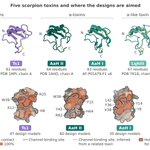
To tackle this, Claude went after five neurotoxins at once, from Mexico, Brazil, North Africa and the Middle East.
It ran 12 design tools, generated 318,484 proteins, screened 553,052 design-toxin pairs and burned about 10,000 GPU hours.
From that pile, two contract labs tested 211 designs.
Only 17 stuck to their target.
But the best of them, Cn2-B1, grips the Mexican scorpion's toxin at single-digit nanomolar strength, close to antibodies that have protected mice.
These proteins work like a plug.
Each toxin attacks the sodium channels in your nerves, and a binder sits on the exact spot the toxin uses to grab on.
So the hit rate was 18%, which Anthropic calls typical for protein design.
That's the real point.
A model hitting the field's normal success rate is now an ordinary result.
Because humans did this the slow way first. In January 2025, Susana Vázquez Torres led a 33-author Nature paper that designed proteins against snake toxins and protected mice from lethal doses.
She called drug development there "slow and laborious."
She reviewed Claude's run and called it a "promising first step."
But nothing has been tested in a mouse yet.
Getting the binders took three days.
Getting them to children in rural Mexico is still the hard part.

New on our Science Blog: designing protein binders against scorpion neurotoxins.
Scorpions sting about 1.2m people every year, and antivenoms are often costly or in short supply. Claude has made an early step toward finding new treatments.
anthropic.com/research/claud…

440,000 GPUs. 1,012 megawatts. just for the chips.
that's musk's next cluster, vera rubins online by end of Q2 2027.
but before i jump into my analysis, thanks @kimmonismus for the highlight on this topic
the math: tom's hardware puts each rubin at 2.3 kW in max-p. multiply it out & you hit ~1 GW before you've powered a single CPU, let alone the switches and cooling pumps. if you've built a computer, you know!
for scale, colossus 2, which semianalysis calls the first single-site ~1 GW data center, hit that number for the whole campus.
SpaceX's entire nameplate compute on sept 30? 1.7 GW.
so when musk says 20 GW, he's not talking chips. he's talking power & cooling, built "far in excess of what is needed to turn the GPUs on."
his words: "the constraint on deployment of superintelligence is more in power and cooling and infrastructure than it is in chips."
on the ground that looks like a 41-turbine, 1.2 GW gas plant in southaven, mississippi, plus 69 temporary turbines sticking around till july 2027 and 720 megapacks spotted by satellite. a biblically accurate data center, basically
i spend way too much time reading model papers & infra breakdowns, and this is the part ppl keep skipping lol
the chips got one sentence on the call. the power plan? "highly proprietary."
no cap, that tells you where the moat is? I think so but I'm sure there's stuff I'm missing
compute wants to grow like e^x. the grid really, really doesn't. until we start using nuclear power plants again
everyone's still arguing about models while the actual race is turbines
Elon Musk is targeting a single training cluster with 440,000 NVIDIA Vera Rubin computers online by the end of Q2 2027, up to 20GW in 2027! (Anthropic will love that)
On SpaceX’s Q3 earnings call, he said the planned cluster could help make Grok "potentially the best model."
His broader expansion target: roughly 13 GW of AI compute online by the end of 2027, including around 10 GW added that year!
SpaceX is also aiming to add 20 GW of power and cooling infrastructure in 2027. Musk described that infrastructure as a constraint on the buildout.


OpenAI has bought 23 companies since August 2023.
Most of those products are dead. Which is kind of the point.
Only four deals have a listed price, and Jony Ive's io makes up $6.5B of the $7.8B total
The rest run on the same script.
Statsig: $1.1B in stock.
Its founder became CTO of Applications. The product got handed off to Amplitude in May 2026, and the team stayed.
Roi: one of four employees made the jump. The app stopped serving customers in October 2025.
Hiro: shut down April 20, 2026. Server data deleted May 13.
Torch: a medical records tool, roughly $100M, now folded into ChatGPT Health.
And now Orchestra Bio. No terms disclosed. It's headed into Rosalind.
So I read these announcements one way now.
Ignore the product and follow the team.
OpenAI is buying people who've already mapped one ugly workflow end to end. The software is mostly packaging.
The Rosalind timing gives it away.
OpenAI's own help page says GPT-Rosalind is most useful for early discovery. Pricing went live October 5.
Fifteen days later they bought a team whose agents track a drug through manufacturing and into the clinic.
That reads like a roadmap to me, not a feature add.
Founders, if OpenAI comes calling, price the deal on what your team knows about the workflow. The product probably won't outlive the close.
We’ve acquired Orchestra Bio, a platform that helps biopharma teams coordinate the complex process of drug development.
Together, we’ll build on Rosalind, our AI models and tools for life sciences research, to streamline those operations and help new treatments reach patients sooner.
Welcome @ashokaraj_ and team!
openai.com/index/openai-to-a…

Every new gatekeeper ships a black box.
Within weeks, someone's selling the checklist.
2003: @Google's Florida update wipes out sites that had ranked #1 for years.
2011: @jcpenney gets caught with paid links and drops from No. 1 to somewhere in the 70s.
Same year, Demand Media IPOs above $2B. Then Panda hits and the stock falls 79%.
2012: Penguin. People were seriously telling site owners to abandon their domains and start over.
Now it's @Meta @Muse .
2.5M downloads in two weeks.
Early research suggests Muse pulls candidates from Meta's catalog, runs them through its own ranking, then browses merchant sites to evaluate them.
So it's two fights, not one.
First you have to get into the candidate pool.
Then you have to get picked out of it.
The "AI SEO" crowd is pouring everything into the second fight. Schema and cleaner descriptions, mostly, so agents can read the page.
Fine. Do that. Accurate prices and stock still matter.
But if you never make the pool, your perfect product page is a speech to an empty room.
And if the ranking leans toward brands people already recognize, the incumbents' lead just compounds.
In every one of these cycles I've watched, the advice chases whatever's easiest to measure. Rarely the thing that decides who gets seen.
Readable isn't discoverable.
And discoverable still isn't recommended.
The moat in agent shopping is customers asking for you by name.
Worth being honest about whether your team is treating this as a page problem or a brand problem. Most of the effort I'm seeing is going into the page.

Meta Muse is now recommending our client's product as the best option on the market, then pushing people to sign up (see image below)
it's even sh*t talking their biggest competitor
this is the future of AEO
here's how to get there first (with 11 optimizations):
1. update your pages "accessibility tree"
this is literally how Muse reads your website.
do these four things:
1. add names to all icon buttons. For example, label your three line hamburger menu: aria-label="Open menu"
2. add a