

A Broader Perspective | Law Firm
Madonna House, Westlands.
Joined July 2025
- Tweets958
- Following208
- Followers6.7K
- Likes609







Pinned Tweet
🚨🚨 BREAKING: COURT OF APPEAL DECLARES - A TITLE DEED CANNOT DEFEAT A PROVEN TRUST
In Erick Kipkurgat Kiprono v Patrick Kimutai Kiprono, the Court of Appeal has sent shockwaves through land ownership disputes after ordering a registered landowner to surrender half of land he held solely in his name. The dispute traces back to around 2000 when two parties allegedly agreed to jointly purchase 10 acres from Lonrho Agribusiness for KSh 350,000. Because one party worked in Nairobi, the other handled the transaction. The sale agreement expressly stated the purchaser was acting as agent for both and even allocated 5 acres each in the schedule. However, when the title was eventually issued, the entire land was registered in only one name. When the excluded party later demanded his share, the registered owner flatly denied any joint purchase, contribution, or trust.
The Court of Appeal was not convinced. After re-evaluating the evidence, the judges found the intention to jointly own the land was not speculative; it was written into the very sale agreement used to obtain Land Control Board consent. Testimony from the attesting advocate, the vendor’s lawyer, and the vendor’s representative all confirmed the joint purchase. The Court emphasized that a trust will be implied where parties’ intention is clearly established, and that equity will not allow a registered proprietor to approbate and reprobate by relying on the same agreement to obtain title while denying the beneficial interest recorded in it. Crucially, the Court held that the Land Control Act could not be used as an instrument of fraud where consent had already been obtained on the basis of a disclosed joint interest.
For the ordinary mwananchi, this decision is a serious reality check. Many people believe the name on the title deed is the end of the story, it is not. If evidence shows land was bought jointly or one party acted as agent for another, courts can and will slice through the register and enforce a trust. What many are not ready for is this: informal family arrangements, handshake land deals, and “weka kwa jina yako kwanza” transactions are legally dangerous. Going forward, anyone entering joint land purchases must document contributions clearly and align registration with the true intention; because in today’s Kenya, the courts are increasingly willing to look beyond the title and follow the money and the intention.
Kindly retweet widely.
@georgediano @Thuranira_1 @DavisThuranira @joshuamalidzo @NelsonHavi Iran #NunuaGariUsijenge #MainaAndKingangi World Wildlife Day #UsalamaBarabarani Road Safety Reforms Trump Kuwait Wamuthende Dubai

ROBA & ASSOCIATES LLP retweeted
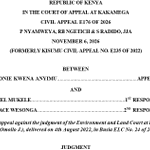
🚨🔥 YOUR FAMILY LAND WAS GRABBED DECADES AGO. CAN THE COURT STILL HELP YOU GET IT BACK? ⚖️
Imagine discovering that land which belonged to your late father or grandfather was transferred and subdivided into several parcels without your family's knowledge. You go to court years later, armed with allegations of fraud, only to be told that your case is too late. That is the battle in Anyimu v Mukele & another [2026] KECA 2488 (KLR). The appellant challenged land transactions dating back to 1975, 1978 and 1981, alleging that the deceased's land had been unlawfully transferred and subdivided. But the Court of Appeal dismissed his appeal, agreeing that the claim was time-barred and that fraud had not been strictly proved. The family meeting held in 1990, the deceased's own thumbprints on transfer documents and evidence from family members all weighed heavily against the claim.
This decision is a serious warning to anyone dealing with family land: waiting until a succession dispute erupts before investigating the land records can cost an estate its claim. The Court also clarified that the current requirement under section 3(3) of the Law of Contract Act for land sale agreements to be in writing does not invalidate transactions made before 1st June 2003, because section 3(7) excludes those earlier contracts. And where fraud is alleged, it must be specifically pleaded and strictly proved; missing documents at the Lands Registry, a questionable identity-card number or registration in a minor's name will not automatically establish fraud. If you suspect that ancestral land was transferred without authority, do not wait for another generation to discover the problem. Have the title history, succession records and transfer documents examined early. In land disputes, delay can be just as costly as fraud itself.
Kindly retweet widely🙏
ROBA & ASSOCIATES LLP retweeted
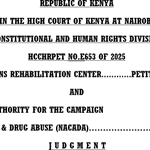
🚨🔥 NACADA HAS ORDERED YOU TO CLOSE. MUST YOU JUST PACK UP AND ACCEPT YOUR LOSSES? THE HIGH COURT SAYS THIS! ⚖️
Imagine spending years building a business, employing people and serving the community, only to receive a letter ordering you to shut down within days. That is what happened to Better Me Options Rehabilitation Centre in Kajiado after NACADA issued a closure notice citing alleged regulatory violations, including staffing, treatment programmes and patient safety concerns. The centre went to the High Court, arguing that it had never been given a fair opportunity to respond to the allegations before the closure was imposed. In Better Me Options Rehabilitation Center v NACADA, the Court found that the material presented did not sufficiently demonstrate that the centre had been given a meaningful opportunity to be heard before the decision was made.
This decision carries a message for every Kenyan dealing with a powerful public authority: you do not lose your rights simply because the other party is a government agency. NACADA has the legal mandate to regulate rehabilitation centres, but that mandate must be exercised within the Constitution and the law. The High Court quashed the closure notice for violation of the right to fair administrative action under Article 47. This does not mean rehabilitation centres are free to ignore regulatory standards; NACADA can still inspect and take lawful enforcement action. But whether it is NACADA or another regulator, you are entitled to fair treatment. If an authority has shut down your business, cancelled your licence or made a decision affecting your livelihood without giving you a fair hearing, do not suffer in silence. The law provides avenues to challenge administrative decisions made outside the law.
Kindly retweet widely🙏
ROBA & ASSOCIATES LLP retweeted
🚨🔥 YOU PAID FOR THE PLOT, THE SELLER RESOLD IT FOR MORE MONEY, AND SOMEONE ELSE BUILT ON IT! MUST YOU JUST LOSE YOUR MONEY? THE HIGH COURT SAYS THIS.
Imagine paying KSh 800,000 towards a KSh 900,000 plot, only for the seller to turn around and sell that same land to another buyer for KSh 1.5 million - without first giving you proper notice to complete the transaction. Worse still, the new buyer enters the land and puts up permanent structures. This was the predicament facing Ronald Omunametsa Mugadi in Ronald Omunametsa Mugadi v John Jeremiah Rofus & another, Mombasa ELC Appeal No. E024 of 2025. The trial court dismissed his case, partly reasoning that it could not rewrite the contract and that the seller had already been acquitted in a criminal case arising from the transaction. On appeal, the High Court rejected that reasoning and made an important distinction: an acquittal in a criminal case does not extinguish a buyer's right to pursue a separate civil claim for breach of contract. The Court further held that where an agreement fixes no completion date and time is not of the essence, a seller cannot simply resell the property without first giving the buyer notice to complete within a reasonable period. The seller had breached the agreement.
But the most important lesson for anyone buying land is that winning a breach-of-contract claim does not automatically mean getting the land back. The Court declined to order demolition, possession or an injunction because the buyer had never taken possession and had not pleaded specific performance. Instead, it awarded him KSh 800,000 as a refund and KSh 600,000 for loss of bargain - a total of KSh 1.4 million, plus interest. This is a powerful reminder that land transactions require more than a handshake, a receipt or an agreement tucked away in a drawer. Before paying, conduct due diligence, document every payment, insist on clear completion timelines and seek legal advice when a seller starts changing the terms of the deal. If you have paid for land that was later sold to someone else, or a seller has refused to honour a sale agreement, do not assume your money is gone or that the matter is beyond legal remedy. The law may still provide a way to recover your money and the value of the bargain you lost. ⚖️
Kindly retweet widely🙏
ROBA & ASSOCIATES LLP retweeted
🚨🔴 EVER CLASHED WITH THE POLICE, ONLY TO FIND YOURSELF FACING PRISON? WHAT RECOURSE DO YOU HAVE? READ THIS!
Imagine being arrested, charged with assaulting a police officer and then fined KSh 200,000 - with seven years in prison hanging over your head if you cannot pay. That is what happened to James Gachogo Muira. But on appeal, the High Court at Nyandarua examined the evidence and found serious inconsistencies in the officer’s account of how he was injured. The officer gave conflicting explanations, while the medical report documented a forearm injury but did not record the alleged head injury. The Court found the conviction unsafe, quashed it and set aside the sentence. The appellant was ordered released unless otherwise lawfully held. In James Gachogo Muira v Republic, Criminal Appeal No. E009 of 2026, the Court delivered a powerful reminder: an accusation, even one involving a police officer, must still be proved beyond reasonable doubt.
But there is another important lesson in this judgment. The trial court had imposed seven years’ imprisonment as the default sentence for failure to pay a KSh 200,000 fine. The High Court held that, since Section 103(a) of the National Police Service Act does not prescribe a separate default sentence, Section 28(2) of the Penal Code applied - and capped the default imprisonment at 12 months for a fine exceeding KSh 50,000. That is a significant safeguard against unlawful punishment. Whether you are facing an assault charge, an allegation of obstructing police officers, or a sentence you believe is unlawful, do not assume that a conviction is beyond challenge or that every sentence imposed by a court is automatically legal. The right to a fair trial includes the right to have evidence properly tested and the law correctly applied. Know your rights. Challenge what the law allows you to challenge.
Kindly retweet widely🙏
ROBA & ASSOCIATES LLP retweeted
🚨🔥 KRA COLLECTS YOUR TAXES - BUT WHO PROTECTS YOU WHEN THE TAXMAN CROSSES THE LINE? YOUR RIGHTS DO NOT END AT THE KRA GATE!
With Kenyans increasingly feeling the weight of taxation, a crucial question must be asked: does paying taxes mean surrendering your rights to the Kenya Revenue Authority? Absolutely not. In Francis Awino v Commissioner General, Kenya Revenue Authority, Constitutional Petition No. E007 of 2026, the High Court examined KRA's handling of a tax exemption application by a registered person with disability seeking to import a vehicle. The dispute brought into focus an important principle: tax exemptions provided by law are not favors from KRA, and administrative power must be exercised within the law. KRA is entitled to verify applications, demand supporting documents and prevent abuse of exemptions - but its decisions and processes remain subject to constitutional standards of legality, fairness and accountability. The taxpayer is not powerless simply because the other party is KRA.
Here is where every mwananchi needs to pay attention: the law provides avenues to challenge decisions or omissions by the Commissioner under Sections 229 and 230 of the East African Community Customs Management Act. The Court also recognised that an exemption application must be processed through the applicable statutory procedures; submitting documents does not automatically guarantee approval. Although the petition was dismissed as premature, the judgment is a reminder that KRA's authority is regulated by law, just as the taxpayer's obligations are. Whether you are facing a disputed tax assessment, a delayed exemption, a customs dispute, or an administrative decision you believe is unlawful, do not simply surrender or ignore the process. Know the available review and appeal mechanisms, observe the timelines, and seek legal advice early. You have a duty to pay lawful taxes. KRA has a duty to administer the law lawfully. Neither side is above the law. ⚖️
Kindly retweet widely🙏🙏
ROBA & ASSOCIATES LLP retweeted
🔴 A GIFT OF LAND CAN EXPIRE - AND 12 YEARS OF SILENCE CAN COST THE OWNER EVERYTHING
The Supreme Court has delivered a major warning to landowners and a powerful clarification for long-term occupiers. In Kakuzi PLC v Makuyu Club (Suing through Trustees) [2026] KESC 69 (KLR), the Court held that occupation which begins with permission or a donation is not automatically adverse possession - but where that permission is no longer legally binding on a subsequent owner, continued open, exclusive and uninterrupted occupation can become adverse, and the statutory clock can begin to run.
The jurisprudential holding is clear: a change of ownership can fundamentally change the legal character of occupation, and a title holder cannot simply sit back while another person openly possesses the land for decades.
Fort common mwananchi, the lesson cuts both ways. A title deed is powerful, but it is not a magic shield against the passage of time. If you buy land already occupied by another person, investigate who is on it and why, and if their occupation is inconsistent with your ownership, take effective legal or physical steps to assert your rights. On the other hand, living or using land for many years does not automatically make it yours; the requirements of adverse possession must still be strictly proved. But Makuyu Club’s victory over approximately 70 acres sends one unmistakable message across Kenya: in land law, sometimes the owner who does nothing for too long can watch the law move in favour of the person who never left.
Kindly retweet widely🙏
ROBA & ASSOCIATES LLP retweeted
🚨🔥 A LENDER CANNOT TURN A KSH 400,000 LOAN INTO A KSH 1.82 MILLION DEBT WITHOUT PROOF! HIGH COURT SETS IMPORTANT RULES ON PRIVATE LOANS, INTEREST AND THE IN DUPLUM RULE! ⚖️
In a significant decision delivered on 29 October 2026, the High Court at Nairobi in Anthony Mwangi v Eva Wanjiru Mwangi, Civil Appeal No. E685 of 2024, has clarified important principles governing private lending. First, a loan agreement does not become invalid merely because only the borrower signed it; the lender can accept the offer by advancing the money. Second, a lender must strictly prove every amount claimed, including who advanced the money and the basis of the alleged debt. Third, payments made by a borrower must be credited against the outstanding debt, regardless of how the lender describes them. Most importantly, the court applied the in duplum rule as a ceiling on the interest recoverable in this private loan dispute, holding that total interest could not exceed the outstanding principal. It did not, however, declare that section 44A of the Banking Act automatically applies to every private lender.
The impact is clear. The respondent had obtained a judgment for KSh 1.82 million over an alleged KSh 700,000 loan. On appeal, the court found that only KSh 400,000 had been proved, credited KSh 220,000 in payments and reduced the award to KSh 251,395 as at the filing of the suit. Applying the interest ceiling, it capped the total recoverable principal and interest at KSh 408,454. This is a powerful reminder that a demand letter is not proof of a debt, interest must have a lawful and provable basis, and courts must examine the actual figures rather than rubber-stamp a lender's calculations. Whether you are lending money, borrowing from someone, or being pursued over an alleged debt, proper documentation and sound legal advice matter.
Kindly retweet widely🙏🙏
🚨🚨YOUR LAND CANNOT BE COMPULSORILY TAKEN FOR PUBLIC USE JUST ANYHOW! THE COURT SENTS A STRONG MESSAGE TO LAND AUTHORITIES⚖️
Can the government or a public authority take your private land for a public project and leave you in the dark about what is happening to your property? In a significant judgment delivered on 27 October 2026, the Environment and Land Court at Garissa, in Ali Hassan Abdirahman & another v National Land Commission & others, quashed a notice targeting 5,317 plots for allocation or regularisation because it failed to disclose crucial information required by law, including details identifying the affected parcels and the terms and values of the proposed transactions. The court reaffirmed a principle that matters to every Kenyan: land authorities cannot bypass mandatory legal safeguards when dealing with land. People must be given adequate information and a genuine opportunity to participate before the process moves forward.
The court ordered a fresh, lawful notification process and stopped further implementation under the quashed notice until the required process is completed. Although this case concerned land regularisation in Mandera, its message reaches every corner of Kenya: public purpose is not a blank cheque to ignore the law or the rights of people whose land is affected. If your land is threatened by compulsory acquisition, allocation or a public project, do not wait until the damage is done. The legality of the process, the notices issued and the protection of your property rights matter. At Roba & Associates Advocates LLP, we understand that land is more than a title deed - it is your home, your investment and your future. If your land rights are at risk, seek legal advice on your options before it is too late.
Kindly retweet widely🙏

ROBA & ASSOCIATES LLP retweeted
🚨🚨 WERE YOU FIRED DURING THE 2020 COVID-19 PANDEMIC ON GROUNDS OF REDUNDANCY? YOU MAY STILL HAVE A CLAIM FOR COMPENSATION. READ THIS! ⚖️🔥
When COVID-19 hit, many businesses struggled, and workers lost their jobs. If your employer declared you redundant during that period, you may have accepted it as part of the crisis and moved on. But did your employer follow the law before sending you home? In Kenya Engineering Workers Union v M/S Garage and Industry Ltd [2026] KEELRC 14694, two employees who had served their employer for about 15 years were declared redundant in May 2020 because of reduced work. The court accepted that the pandemic had caused genuine business difficulties. However, the employer failed to prove that it had issued the required redundancy notices to the union and the labour officer before terminating the employees. That failure proved costly.
On 22 October 2026, the Employment and Labour Relations Court declared the terminations procedurally unfair and awarded the two employees severance pay of KSh 248,700 and KSh 189,179.40 respectively, plus six months’ salary each as compensation. They were also awarded certificates of service, and the employer was ordered to pay the costs of the suit. The message is simple: even during a pandemic, employers were not free to ignore the law. If you lost your job during COVID-19 on grounds of redundancy, it may be worth having your termination documents reviewed to establish whether you have a viable claim. Did your employer follow the law when you lost your job during the pandemic?
Kindly retweet widely🙏
ROBA & ASSOCIATES LLP retweeted
🚨🚨 WHAT IF YOU RETURN TO YOUR LAND AFTER 22 YEARS - ONLY TO FIND OUT THE LAW MAY NO LONGER BE ON YOUR SIDE? 😳
Can you lose your land because someone else has occupied it for years while you did nothing to reclaim it? That is the question arising from Bonphas Khaimba Kwendelo & Omar Mohamed Omar v Leopold Prudensio Mureithi & Others, decided by the Environment and Land Court at Milimani, Nairobi, on 22 October 2026. The two applicants went to court claiming they had occupied parcel Nairobi/Block 99/257 in Highridge since 2003, living on and developing the property openly, continuously and without the registered owners’ permission. They sought to acquire ownership through adverse possession. None of the respondents opposed the claim, but the court still had to determine whether the applicants had presented sufficient evidence to establish their entitlement.
The court found that the applicants had proved their claim and declared the first and second respondents’ titles extinguished. It ordered the Chief Land Registrar to register the two applicants as proprietors and restrained the respondents from selling, transferring or otherwise interfering with the property. Under sections 7, 13, 17 and 38 of the Limitation of Actions Act, a person may acquire land through adverse possession after at least 12 years of qualifying occupation, provided all the legal requirements are satisfied. This does not mean that simply entering or occupying another person’s land makes it yours. The occupation must meet the strict legal test. So, should landowners lose property they legally own because they failed to reclaim it for years, or is adverse possession a fair way of protecting people who have occupied land openly for decades? 🔥
Kindly retweet widely🙏