

A Broader Perspective | Law Firm
Madonna House, Westlands.
Joined July 2025
- Tweets958
- Following208
- Followers6.7K
- Likes609







ROBA & ASSOCIATES LLP retweeted
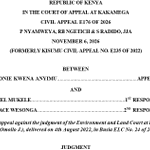
🚨🔥 YOUR FAMILY LAND WAS GRABBED DECADES AGO. CAN THE COURT STILL HELP YOU GET IT BACK? ⚖️
Imagine discovering that land which belonged to your late father or grandfather was transferred and subdivided into several parcels without your family's knowledge. You go to court years later, armed with allegations of fraud, only to be told that your case is too late. That is the battle in Anyimu v Mukele & another [2026] KECA 2488 (KLR). The appellant challenged land transactions dating back to 1975, 1978 and 1981, alleging that the deceased's land had been unlawfully transferred and subdivided. But the Court of Appeal dismissed his appeal, agreeing that the claim was time-barred and that fraud had not been strictly proved. The family meeting held in 1990, the deceased's own thumbprints on transfer documents and evidence from family members all weighed heavily against the claim.
This decision is a serious warning to anyone dealing with family land: waiting until a succession dispute erupts before investigating the land records can cost an estate its claim. The Court also clarified that the current requirement under section 3(3) of the Law of Contract Act for land sale agreements to be in writing does not invalidate transactions made before 1st June 2003, because section 3(7) excludes those earlier contracts. And where fraud is alleged, it must be specifically pleaded and strictly proved; missing documents at the Lands Registry, a questionable identity-card number or registration in a minor's name will not automatically establish fraud. If you suspect that ancestral land was transferred without authority, do not wait for another generation to discover the problem. Have the title history, succession records and transfer documents examined early. In land disputes, delay can be just as costly as fraud itself.
Kindly retweet widely🙏

ROBA & ASSOCIATES LLP retweeted
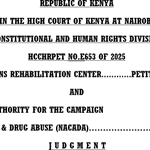
🚨🔥 NACADA HAS ORDERED YOU TO CLOSE. MUST YOU JUST PACK UP AND ACCEPT YOUR LOSSES? THE HIGH COURT SAYS THIS! ⚖️
Imagine spending years building a business, employing people and serving the community, only to receive a letter ordering you to shut down within days. That is what happened to Better Me Options Rehabilitation Centre in Kajiado after NACADA issued a closure notice citing alleged regulatory violations, including staffing, treatment programmes and patient safety concerns. The centre went to the High Court, arguing that it had never been given a fair opportunity to respond to the allegations before the closure was imposed. In Better Me Options Rehabilitation Center v NACADA, the Court found that the material presented did not sufficiently demonstrate that the centre had been given a meaningful opportunity to be heard before the decision was made.
This decision carries a message for every Kenyan dealing with a powerful public authority: you do not lose your rights simply because the other party is a government agency. NACADA has the legal mandate to regulate rehabilitation centres, but that mandate must be exercised within the Constitution and the law. The High Court quashed the closure notice for violation of the right to fair administrative action under Article 47. This does not mean rehabilitation centres are free to ignore regulatory standards; NACADA can still inspect and take lawful enforcement action. But whether it is NACADA or another regulator, you are entitled to fair treatment. If an authority has shut down your business, cancelled your licence or made a decision affecting your livelihood without giving you a fair hearing, do not suffer in silence. The law provides avenues to challenge administrative decisions made outside the law.
Kindly retweet widely🙏

ROBA & ASSOCIATES LLP retweeted
🚨🔥 YOU PAID FOR THE PLOT, THE SELLER RESOLD IT FOR MORE MONEY, AND SOMEONE ELSE BUILT ON IT! MUST YOU JUST LOSE YOUR MONEY? THE HIGH COURT SAYS THIS.
Imagine paying KSh 800,000 towards a KSh 900,000 plot, only for the seller to turn around and sell that same land to another buyer for KSh 1.5 million - without first giving you proper notice to complete the transaction. Worse still, the new buyer enters the land and puts up permanent structures. This was the predicament facing Ronald Omunametsa Mugadi in Ronald Omunametsa Mugadi v John Jeremiah Rofus & another, Mombasa ELC Appeal No. E024 of 2025. The trial court dismissed his case, partly reasoning that it could not rewrite the contract and that the seller had already been acquitted in a criminal case arising from the transaction. On appeal, the High Court rejected that reasoning and made an important distinction: an acquittal in a criminal case does not extinguish a buyer's right to pursue a separate civil claim for breach of contract. The Court further held that where an agreement fixes no completion date and time is not of the essence, a seller cannot simply resell the property without first giving the buyer notice to complete within a reasonable period. The seller had breached the agreement.
But the most important lesson for anyone buying land is that winning a breach-of-contract claim does not automatically mean getting the land back. The Court declined to order demolition, possession or an injunction because the buyer had never taken possession and had not pleaded specific performance. Instead, it awarded him KSh 800,000 as a refund and KSh 600,000 for loss of bargain - a total of KSh 1.4 million, plus interest. This is a powerful reminder that land transactions require more than a handshake, a receipt or an agreement tucked away in a drawer. Before paying, conduct due diligence, document every payment, insist on clear completion timelines and seek legal advice when a seller starts changing the terms of the deal. If you have paid for land that was later sold to someone else, or a seller has refused to honour a sale agreement, do not assume your money is gone or that the matter is beyond legal remedy. The law may still provide a way to recover your money and the value of the bargain you lost. ⚖️
Kindly retweet widely🙏

ROBA & ASSOCIATES LLP retweeted
🚨🔴 EVER CLASHED WITH THE POLICE, ONLY TO FIND YOURSELF FACING PRISON? WHAT RECOURSE DO YOU HAVE? READ THIS!
Imagine being arrested, charged with assaulting a police officer and then fined KSh 200,000 - with seven years in prison hanging over your head if you cannot pay. That is what happened to James Gachogo Muira. But on appeal, the High Court at Nyandarua examined the evidence and found serious inconsistencies in the officer’s account of how he was injured. The officer gave conflicting explanations, while the medical report documented a forearm injury but did not record the alleged head injury. The Court found the conviction unsafe, quashed it and set aside the sentence. The appellant was ordered released unless otherwise lawfully held. In James Gachogo Muira v Republic, Criminal Appeal No. E009 of 2026, the Court delivered a powerful reminder: an accusation, even one involving a police officer, must still be proved beyond reasonable doubt.
But there is another important lesson in this judgment. The trial court had imposed seven years’ imprisonment as the default sentence for failure to pay a KSh 200,000 fine. The High Court held that, since Section 103(a) of the National Police Service Act does not prescribe a separate default sentence, Section 28(2) of the Penal Code applied - and capped the default imprisonment at 12 months for a fine exceeding KSh 50,000. That is a significant safeguard against unlawful punishment. Whether you are facing an assault charge, an allegation of obstructing police officers, or a sentence you believe is unlawful, do not assume that a conviction is beyond challenge or that every sentence imposed by a court is automatically legal. The right to a fair trial includes the right to have evidence properly tested and the law correctly applied. Know your rights. Challenge what the law allows you to challenge.
Kindly retweet widely🙏

ROBA & ASSOCIATES LLP retweeted
🚨🔥 KRA COLLECTS YOUR TAXES - BUT WHO PROTECTS YOU WHEN THE TAXMAN CROSSES THE LINE? YOUR RIGHTS DO NOT END AT THE KRA GATE!
With Kenyans increasingly feeling the weight of taxation, a crucial question must be asked: does paying taxes mean surrendering your rights to the Kenya Revenue Authority? Absolutely not. In Francis Awino v Commissioner General, Kenya Revenue Authority, Constitutional Petition No. E007 of 2026, the High Court examined KRA's handling of a tax exemption application by a registered person with disability seeking to import a vehicle. The dispute brought into focus an important principle: tax exemptions provided by law are not favors from KRA, and administrative power must be exercised within the law. KRA is entitled to verify applications, demand supporting documents and prevent abuse of exemptions - but its decisions and processes remain subject to constitutional standards of legality, fairness and accountability. The taxpayer is not powerless simply because the other party is KRA.
Here is where every mwananchi needs to pay attention: the law provides avenues to challenge decisions or omissions by the Commissioner under Sections 229 and 230 of the East African Community Customs Management Act. The Court also recognised that an exemption application must be processed through the applicable statutory procedures; submitting documents does not automatically guarantee approval. Although the petition was dismissed as premature, the judgment is a reminder that KRA's authority is regulated by law, just as the taxpayer's obligations are. Whether you are facing a disputed tax assessment, a delayed exemption, a customs dispute, or an administrative decision you believe is unlawful, do not simply surrender or ignore the process. Know the available review and appeal mechanisms, observe the timelines, and seek legal advice early. You have a duty to pay lawful taxes. KRA has a duty to administer the law lawfully. Neither side is above the law. ⚖️
Kindly retweet widely🙏🙏

ROBA & ASSOCIATES LLP retweeted
🔴 A GIFT OF LAND CAN EXPIRE - AND 12 YEARS OF SILENCE CAN COST THE OWNER EVERYTHING
The Supreme Court has delivered a major warning to landowners and a powerful clarification for long-term occupiers. In Kakuzi PLC v Makuyu Club (Suing through Trustees) [2026] KESC 69 (KLR), the Court held that occupation which begins with permission or a donation is not automatically adverse possession - but where that permission is no longer legally binding on a subsequent owner, continued open, exclusive and uninterrupted occupation can become adverse, and the statutory clock can begin to run.
The jurisprudential holding is clear: a change of ownership can fundamentally change the legal character of occupation, and a title holder cannot simply sit back while another person openly possesses the land for decades.
Fort common mwananchi, the lesson cuts both ways. A title deed is powerful, but it is not a magic shield against the passage of time. If you buy land already occupied by another person, investigate who is on it and why, and if their occupation is inconsistent with your ownership, take effective legal or physical steps to assert your rights. On the other hand, living or using land for many years does not automatically make it yours; the requirements of adverse possession must still be strictly proved. But Makuyu Club’s victory over approximately 70 acres sends one unmistakable message across Kenya: in land law, sometimes the owner who does nothing for too long can watch the law move in favour of the person who never left.
Kindly retweet widely🙏

ROBA & ASSOCIATES LLP retweeted
🚨🔥 A LENDER CANNOT TURN A KSH 400,000 LOAN INTO A KSH 1.82 MILLION DEBT WITHOUT PROOF! HIGH COURT SETS IMPORTANT RULES ON PRIVATE LOANS, INTEREST AND THE IN DUPLUM RULE! ⚖️
In a significant decision delivered on 29 October 2026, the High Court at Nairobi in Anthony Mwangi v Eva Wanjiru Mwangi, Civil Appeal No. E685 of 2024, has clarified important principles governing private lending. First, a loan agreement does not become invalid merely because only the borrower signed it; the lender can accept the offer by advancing the money. Second, a lender must strictly prove every amount claimed, including who advanced the money and the basis of the alleged debt. Third, payments made by a borrower must be credited against the outstanding debt, regardless of how the lender describes them. Most importantly, the court applied the in duplum rule as a ceiling on the interest recoverable in this private loan dispute, holding that total interest could not exceed the outstanding principal. It did not, however, declare that section 44A of the Banking Act automatically applies to every private lender.
The impact is clear. The respondent had obtained a judgment for KSh 1.82 million over an alleged KSh 700,000 loan. On appeal, the court found that only KSh 400,000 had been proved, credited KSh 220,000 in payments and reduced the award to KSh 251,395 as at the filing of the suit. Applying the interest ceiling, it capped the total recoverable principal and interest at KSh 408,454. This is a powerful reminder that a demand letter is not proof of a debt, interest must have a lawful and provable basis, and courts must examine the actual figures rather than rubber-stamp a lender's calculations. Whether you are lending money, borrowing from someone, or being pursued over an alleged debt, proper documentation and sound legal advice matter.
Kindly retweet widely🙏🙏

ROBA & ASSOCIATES LLP retweeted
🚨🚨 WERE YOU FIRED DURING THE 2020 COVID-19 PANDEMIC ON GROUNDS OF REDUNDANCY? YOU MAY STILL HAVE A CLAIM FOR COMPENSATION. READ THIS! ⚖️🔥
When COVID-19 hit, many businesses struggled, and workers lost their jobs. If your employer declared you redundant during that period, you may have accepted it as part of the crisis and moved on. But did your employer follow the law before sending you home? In Kenya Engineering Workers Union v M/S Garage and Industry Ltd [2026] KEELRC 14694, two employees who had served their employer for about 15 years were declared redundant in May 2020 because of reduced work. The court accepted that the pandemic had caused genuine business difficulties. However, the employer failed to prove that it had issued the required redundancy notices to the union and the labour officer before terminating the employees. That failure proved costly.
On 22 October 2026, the Employment and Labour Relations Court declared the terminations procedurally unfair and awarded the two employees severance pay of KSh 248,700 and KSh 189,179.40 respectively, plus six months’ salary each as compensation. They were also awarded certificates of service, and the employer was ordered to pay the costs of the suit. The message is simple: even during a pandemic, employers were not free to ignore the law. If you lost your job during COVID-19 on grounds of redundancy, it may be worth having your termination documents reviewed to establish whether you have a viable claim. Did your employer follow the law when you lost your job during the pandemic?
Kindly retweet widely🙏

ROBA & ASSOCIATES LLP retweeted
🚨🚨 WHAT IF YOU RETURN TO YOUR LAND AFTER 22 YEARS - ONLY TO FIND OUT THE LAW MAY NO LONGER BE ON YOUR SIDE? 😳
Can you lose your land because someone else has occupied it for years while you did nothing to reclaim it? That is the question arising from Bonphas Khaimba Kwendelo & Omar Mohamed Omar v Leopold Prudensio Mureithi & Others, decided by the Environment and Land Court at Milimani, Nairobi, on 22 October 2026. The two applicants went to court claiming they had occupied parcel Nairobi/Block 99/257 in Highridge since 2003, living on and developing the property openly, continuously and without the registered owners’ permission. They sought to acquire ownership through adverse possession. None of the respondents opposed the claim, but the court still had to determine whether the applicants had presented sufficient evidence to establish their entitlement.
The court found that the applicants had proved their claim and declared the first and second respondents’ titles extinguished. It ordered the Chief Land Registrar to register the two applicants as proprietors and restrained the respondents from selling, transferring or otherwise interfering with the property. Under sections 7, 13, 17 and 38 of the Limitation of Actions Act, a person may acquire land through adverse possession after at least 12 years of qualifying occupation, provided all the legal requirements are satisfied. This does not mean that simply entering or occupying another person’s land makes it yours. The occupation must meet the strict legal test. So, should landowners lose property they legally own because they failed to reclaim it for years, or is adverse possession a fair way of protecting people who have occupied land openly for decades? 🔥
Kindly retweet widely🙏

ROBA & ASSOCIATES LLP retweeted
🚨🚨 YOUR CASE CAN BE DISMISSED FOR DELAY-BUT WHAT IF THE COURT GETS THE FACTS WRONG? THIS IS WHAT HAPPENS NEXT! ⚖️
Imagine going to court to recover your money, winning the case, then watching the person who owes you money drag their feet when they try to reopen it. Surely, at some point, the court must say enough is enough? That was the battle in Kelvin Kithendu Kioko v Beatrice Muthoki Kiamba, HCCA E013 of 2025. Kelvin wanted the court to set aside a judgment entered against him after he failed to file a defence. His application stalled for months, and the trial court eventually dismissed it for want of prosecution. But when the matter reached the High Court, Justice Cherere spotted a problem: the trial court had relied partly on a direction allegedly given on 15 March 2023, yet there were no proceedings on record for that date. A court cannot simply rely on a direction that the record does not confirm.
🔥 The High Court set aside the dismissal and ordered that Kelvin’s application be heard urgently. This was not a declaration that he owed nothing, nor did it erase the original judgment. He still has to convince the trial court to reopen the case. The point is that delay matters, but so does fairness; a court must consider the circumstances and whether a less drastic option, such as costs and an expedited hearing, would do justice. So, where do you draw the line? Should a litigant lose their chance to defend a case because they delayed, or should courts give them another chance when the record itself raises questions?
Kindly Retweet widely🙏

ROBA & ASSOCIATES LLP retweeted
🚨🚨 WHAT DO YOU DO WHEN YOU APPEAL A LIFE SENTENCE, ONLY FOR THE COURT TO GIVE YOU THE DEATH PENALTY? THE COURT OF APPEAL HAS AN ANSWER! 🔥
Imagine appealing a life sentence, hoping for a better outcome, only for the High Court to replace it with a death sentence. That is what happened to Edward Kimathi Gabriel, Boniface Karani Njeru and Nicholas Muriithi Njeru. But here is the twist: the prosecution had not cross-appealed for a harsher sentence, and the appellants had not been warned that their appeals could leave them worse off. In its judgment in Edward Kimathi Gabriel & 2 Others v Republic, the Court of Appeal held that the High Court had erred in enhancing the sentences in those circumstances. The Court relied on established jurisprudence, including Aggrey Mugesani v Republic and M’Itiri v Republic, reaffirming that an accused person must be warned of the risk of a harsher sentence before the appeal proceeds where enhancement is contemplated. An appeal must not become a procedural trap.
So, what happens next? The death sentence is set aside but the conviction still stands! The Court of Appeal dismissed the challenge to the appellants’ robbery-with-violence convictions but overturned the unlawful sentence enhancement and restored the original life imprisonment sentences. This is the crucial distinction: the appellants did not walk free, and the Court did not find them innocent. It corrected the process through which their punishment had been increased. The ruling sends a powerful message: even where a conviction is upheld, appellate courts must respect procedural safeguards before imposing a harsher sentence. If you appeal a sentence, should the court be allowed to make your punishment more severe without first warning you? 🔥
Kindly retweet🙏

ROBA & ASSOCIATES LLP retweeted
Wakenya, we celebrate you today.
Happy Mashujaa Day, Kenya!
🤖 Made with AI

ROBA & ASSOCIATES LLP retweeted
🚨🚨 YOU DEFAULTED ON A BANK LOAN, THEN THE BANK SOLD YOUR LAND WITHOUT PROPER NOTICE - WHO OWES WHOM NOW? THIS COURT OF APPEAL RULING IS A BOMBSHELL! 🔥
Imagine borrowing money from a bank, falling into arrears, then discovering that your land has already been auctioned without the legally required notice. That is what confronted Jimmy Nuru Angwenyi in Development Bank of Kenya Limited v Jimmy Nuru Angwenyi, Civil Appeal No. E501 of 2020, decided on 16 October 2026. The bank sold his Thika property for KShs 650,000, despite its own valuer placing the forced-sale value at KShs 1.2 million and the open-market value at KShs 2 million. The critical problem? Evidence before the Court showed that the bank had not served the required statutory notice under section 69A of the then-applicable Indian Transfer of Property Act. The Court reaffirmed that a borrower’s default does not give a bank permission to ignore the law. A lender exercising its statutory power of sale must comply with the required notice procedure and take reasonable steps to obtain the best price reasonably obtainable.
Now here is where it gets interesting. The High Court had awarded Angwenyi KShs 2 million in damages, representing the property’s open-market value at the time of sale. The bank appealed, arguing that the damages should instead reduce the outstanding loan debt, while Angwenyi cross-appealed seeking KShs 20 million. The Court of Appeal dismissed both the appeal and the cross-appeal, leaving the KShs 2 million award undisturbed because the higher valuation relied on by Angwenyi was not supported by comparable evidence. The lesson? Owing a bank money does not strip you of your legal rights, and a bank’s power to auction your property is not a licence to disregard the law. Banks must follow the required procedures; borrowers must also prove their claims with credible evidence. So, if a bank sells your property unlawfully, should it still be allowed to pursue the outstanding loan without accounting for the damages it has been ordered to pay? 🔥
Kindly retweet🙏

ROBA & ASSOCIATES LLP retweeted
🚨🚨 HAVE YOU SEEN THE TRENDING NEWS ABOUT MURAGE OF MODERN PACIFIC FURNITURE AND CONTENT CREATOR SPARKY? HERE IS WHAT THE LAW SAYS ABOUT DEFAMATION! 🔥
There has been a lot of talk online following reports that Murage is considering suing Sparky over a video allegedly targeting his wife and business. But beyond the online drama, there is a serious legal question worth discussing: what does someone actually need to prove to win a defamation case in Kenya? First, the words complained of must be defamatory - that is, capable of lowering a person's reputation in the eyes of reasonable members of society. They must also refer to the claimant and have been communicated to at least one other person. A viral video may satisfy the publication requirement, but views, shares and online outrage do not automatically prove defamation. The actual words, their context and whether they conveyed damaging false allegations all matter. Truth may be a defence, while fair comment or honest opinion may also protect certain statements. A business can sue over injury to its trading reputation, while a person seeking redress for remarks about their spouse's personal reputation will ordinarily need to bring their own claim.
Freedom of expression protects criticism, opinions and discussion of matters of public interest; it does not give anyone a blank cheque to publish false, reputation-damaging allegations. Equally, feeling insulted does not guarantee victory in court - the claimant must prove the legal ingredients of defamation, and the person sued may have valid defences. In Kenya, civil defamation claims are generally subject to a 12-month limitation period, so delay can be costly. For now, this is a reported threat of legal action, not a court finding that Sparky defamed anyone. The lesson for content creators, businesses and ordinary Kenyans is simple: before you post, expose or accuse, ask yourself whether you can substantiate what you are saying. Now let’s discuss: should content creators face legal consequences for damaging allegations, or could defamation lawsuits be used to silence legitimate criticism? 🔥
Kindly Retweet widely🙏

ROBA & ASSOCIATES LLP retweeted
🚨🚨 BREAKING FROM THE COURT OF APPEAL: YOU CANNOT CLAIM A MILLION-SHILLING SALARY JUST BECAUSE A CONTRACT SAYS SO - PROVE IT IS GENUINE!
In Jackson M. Italakua & Angela Birir v Kenya Farmers Association Limited (consolidated Civil Appeals E060 and E061 of 2022), the Court of Appeal has delivered a warning to employees and employers about disputed employment contracts. Two senior employees claimed they were contractually entitled to a basic salary of KShs 170,000 per month, plus house allowance and gratuity, but said they were paid only KShs 119,070. Their employer argued that the KShs 170,000 contracts had been procured through misrepresentation and did not reflect an authorised salary review. The Court examined the signed contracts, board decisions and payslips, finding that the evidence supported a basic salary of KShs 119,070 and that the employees had failed to establish a valid contract entitling them to KShs 170,000. It dismissed both appeals and awarded costs to the employer.
The lesson is bigger than the figures involved: a signature dispute, a disputed contract or an allegation of underpayment must be resolved through credible evidence, not assertion alone. Employees should preserve authentic contracts, renewal letters, payslips and records of salary reviews. Employers, too, should maintain clear documentation of board approvals and contractual changes. The Court also reaffirmed that appellate courts must examine the evidence carefully while giving appropriate weight to the trial court’s factual findings. If your employer pays you less than the salary stated in a contract, what evidence would you need to prove your claim? And should an employer be allowed to rely on a lower-paying contract when the employee disputes signing it?
Kindly retweet widely🙏

ROBA & ASSOCIATES LLP retweeted
🚨🚨 BREAKING FROM THE COURT OF APPEAL: ADVERSE POSSESSION CAN SURVIVE DEATH! YOU MAY STILL CLAIM LAND THROUGH A DECEASED PARENT.
In Kanziwa Limited v Kandie & another [2026] KECA 2080 (KLR), the Court of Appeal dismissed a company’s appeal over approximately 124 acres in Njoro, Nakuru County, which the late Aaron Kimosop Kandie allegedly purchased in 1982 and occupied with his family for decades. Although the company denied the sale, documents including Land Control Board consents and correspondence supporting the proposed transaction persuaded the Court that the purchase had genuinely been contemplated. The Court reaffirmed that a purchaser’s long, open and uninterrupted possession can mature into adverse possession even where the transfer remains incomplete. Crucially, the right does not automatically die with the person who occupied the land: the deceased’s legal representatives may pursue the claim on behalf of his estate.
The decision carries important lessons for landowners, purchasers and families inheriting disputed property. Under section 7 of the Limitation of Actions Act, the limitation period for recovering land is generally 12 years, while section 38 provides the route through which a person may seek registration after acquiring land by adverse possession. The Court also agreed that section 3(3) of the Law of Contract Act did not defeat the claim merely because a written sale agreement was absent in the circumstances of this case. But occupying land for 12 years does not automatically make you the owner; the claimant must prove the legal elements of adverse possession. The appeal was dismissed with costs. If your parent occupied land for decades but died before obtaining title, could your family still claim it? This judgment says the claim may survive - if the evidence and law support it. ✅
Kindly retweet widely🙏new.kenyalaw.org/akn/ke/judg…

ROBA & ASSOCIATES LLP retweeted
🚨🚨DID YOU KNOW YOU CAN LOSE A LOVED ONE IN A ROAD ACCIDENT, GO TO COURT SEEKING JUSTICE, AND STILL WALK AWAY WITH NOTHING? READ THIS HIGH COURT DECISION!
In Mary Chelangat John & Paul Kiboro Moiben v Reinard Kioko Ibrahim & Equity Bank Kenya Limited, Malindi High Court Civil Appeal No. E003 of 2025, a family sought compensation after Allan Kiplimo Moiben died in a road accident at Mtwapa on 8 February 2022. The trial court had awarded damages, including KShs 500,000 for loss of dependency, after finding the deceased 80% liable and the other driver 20% liable. But on appeal, Justice A.K. Ndung’u reached a dramatically different conclusion. The only eyewitness testified that the deceased left his lane and collided with the vehicle approaching from the opposite direction. The High Court held that the family had not proved any specific negligent act by the other driver. The mere fact that an accident occurred, the judge stressed, does not establish negligence; neither does a police abstract, on its own. The court therefore found the deceased 100% liable and set aside the trial court’s judgment.
But there was another crucial lesson: the court also found that the claim for loss of dependency lacked sufficient proof identifying the dependants and demonstrating the financial support they actually received from the deceased. Even though the family alleged that he earned KShs 200,000 monthly, income alone did not establish dependency. The appeal was allowed, the trial judgment was set aside, and the family’s suit was dismissed, with costs awarded to the successful appellant at trial and on appeal. Think about that: a family can lose a compensation award not because the death did not happen, but because negligence against the defendant was not proved. For anyone pursuing a fatal accident claim, eyewitness evidence, proof of the other driver’s specific negligence, and evidence of actual dependency can be decisive. Do you think this judgment correctly applies the burden of proof, or should courts take a different approach when a family has lost its breadwinner?
Please Retweet widely🙏

ROBA & ASSOCIATES LLP retweeted
🚨🚨 FAIRNESS AT WORK IS NOT OPTIONAL: EVEN WHEN AN EMPLOYEE FACES SERIOUS ALLEGATIONS, THE LAW STILL DEMANDS A FAIR HEARING!
In Arunda Oludhe Ai v Bridge International Academies Foundation [2026] KEELRC 2780 (KLR), a Grade 1 teacher who had worked for the school since 2013 was suspended and summarily dismissed after a parent alleged in a school WhatsApp group that a child had been punished. The school maintained that investigations supported the allegation, but the Employment and Labour Relations Court found no letter inviting the teacher to a disciplinary hearing and no adequate evidence that he had been given a meaningful opportunity to hear and challenge the evidence against him. Justice Hellen Wasilwa held that the disciplinary process was fundamentally flawed. Under sections 41 and 45 of the Employment Act, an employer must follow a fair hearing process and establish a valid reason and fair procedure before terminating employment. A serious accusation, however troubling, does not excuse an employer from these obligations.
The decision is a reminder to employers that investigating an allegation and fairly disciplining an employee are two different things. Schools have a duty to protect children, but they must also respect the rights of their employees and follow the law. The Court awarded the teacher KShs 192,302 in notice pay and compensation, together with a certificate of service, costs and interest. This was not a declaration that corporal punishment is acceptable; it was a finding that the dismissal process failed the legal test of fairness. Can an employer lawfully dismiss someone based on an investigation without giving them a meaningful chance to challenge the evidence?
Kindly retweet widely🙏

ALT https://kenyalaw.org/akn/ke/judgment/keelrc/2026/2780/eng@2026-10-08
ROBA & ASSOCIATES LLP retweeted
🚨🚨 YOU HAVE THE TITLE DEED. YOU HAVE PHOTOS OF THE PEOPLE ON YOUR LAND, BUT YOU STILL LOSE THE EVICTION CASE - HERE’S WHY THE COURT SAID “PROVE WHERE YOUR BOUNDARIES ARE”👇👇
In Omar Abdalla Mohamed & 10 Others v Ali Galole Dim & 4 Others, ELC Malindi E015 of 2024, the Plaintiffs produced a title deed and official search showing ownership of Lamu Island/Block IV/28, measuring about 3.6 hectares, and presented photographs of structures allegedly erected by the Defendants. They also called witnesses, including a village elder, who identified the Defendants as persons residing on the land. Yet the Environment and Land Court dismissed the suit. Why? Because the Defendants had expressly denied occupying the property, and the Plaintiffs’ burden under sections 107 and 109 of the Evidence Act was still to prove the critical fact they were asserting: that these particular Defendants were actually occupying this particular parcel. The Court stressed that ownership and trespass are not the same thing. A title may prove ownership, but it does not automatically prove that a disputed structure sits within the boundaries of that title.
🔥This is the part landowners and people facing encroachment need to know: the Court held that photographs alone were insufficient where the exact location of the structures was disputed. The Plaintiffs needed to go further by producing expert evidence, including a map/survey evidence capable of demonstrating the boundaries of Lamu Island/Block IV/28 and showing that the Defendants’ structures fell inside those boundaries. The Court therefore found that the Plaintiffs had not proved encroachment and dismissed the claim. The lesson is serious: before rushing to court for eviction, make sure you can technically place the trespasser on your land. If someone has built next to your boundary, claims your parcel is public land, or disputes where the structures actually sit, a title deed and photographs may not be enough. Have you confirmed the exact boundaries of your land before filing that eviction or trespass case?
Kindly Retweet widely🙏🙏

ROBA & ASSOCIATES LLP retweeted
🚨🚨 THE CONTRACT CALLED HIM A “CONSULTANT” - HE WENT TO COURT CLAIMING EMPLOYEE RIGHTS WORTH KShs 5.3 MILLION. THE JUDGE ASKED ONE QUESTION: “WERE YOU EVER AN EMPLOYEE?”
In Okaka v Tulsi Construction Ltd (2026), Ammos Okaka was engaged by Tulsi Construction Ltd as a Project Manager at KShs 180,000 per month. When payments stopped, he went to the ELRC demanding KShs 5.31 million, being 11 months’ salary, notice pay, service pay, leave, house allowance and compensation for unfair termination. His argument was that despite the consultancy label, the reality of the relationship made him an employee: he was supervised, attended meetings, submitted reports and was expected to manage the project. He even pointed to an email from the company referring to him as an “employee.” But the Court examined the actual contract and found something decisive: throughout the agreement he was described as a consultant, he was paid a consultancy fee, he was required to submit monthly invoices, and the agreement was for project-management consultancy until completion of the project or earlier termination. Most importantly, he produced no invoice and no evidence establishing an employer–employee relationship.
🔥 THE MESSAGE FROM THE COURT IS BIGGER THAN THE KShs 5.3 MILLION CLAIM: you cannot simply put the word “employee” on your pleadings and acquire employment rights. Justice Hellen Wasilwa held that the Claimant was never an employee and that the ELRC therefore had no jurisdiction over the alleged contractual dispute, dismissing the entire cause. For consultants, contractors and professionals, this is a warning to understand exactly what your contract creates before you sign it. For companies, it is equally important: calling someone a consultant is not necessarily enough if the actual relationship demonstrates employment. The real battle can be fought through the terms of the contract, payment structure, control, invoicing, duties and the evidence surrounding the relationship. One question can therefore be worth millions: ARE YOU REALLY AN EMPLOYEE - OR DID YOU SIGN A CONSULTANCY AGREEMENT?
Kindly Retweet widely🙏
