

17y/o @AlphaSchool Building the next generation of Ed-tech that will reach 1 billion kids.
Joined August 2023
- Tweets735
- Following192
- Followers6K
- Likes702




A new study found that ~26% of teens reported feeling happier after using social media.
The teens self-reported their happiness levels, and the results could be attributed to complete randomness.


$10 budget each.
Hakiu 5.5 vs GPT-6 Luna.
Prompt: "Show off your motion graphics skills and build an educational video from this [script]"
Jev grades essays as well as Opus 5.5, for a tenth of the cost.
I used both models to grade 36 AP (Advanced Placement) essays from College Board.
On average, Jev's score was 0.5 points from the AP graders' score. For Opus, it was 0.6 points.
In this test, Jev compared each essay to essays that had AP scores. For each pair, Jev answered yes or no to the question "Does this essay deserve the higher score?"
Jev grades an essay in approximately 0.3 seconds. Opus takes approximately 15.
Jev costs approximately $0.002 per essay. Opus costs approximately $0.02 per essay.
ElevenLabs v4 is invaluable for the education industry.
Gone are the days when you couldn't effectively teach science and English with just voice models.

Introducing Eleven v4 and Eleven v4 Turbo, our fastest and most emotive voice models yet.
Ranked #1 by Artificial Analysis.
"AI tutoring encompasses lesson planning, text-based conversational tutoring, and practice problem generation." ... "Human tutors taught one-to-one in live video calls."
Could the AI results be summed up to students simply answering more practice questions?

Today we establish that AI is as good as expert human tutors for immediate GRE learning gains (p=.015, n=2,383 students, study conducted July-Sep 2026).
One hour with an expert GRE tutor: $75.
One equivalent hour with an AI tutor: 7 cents .
918x cheaper, equivalent learning (p=.044, n = 140).
In 5 of 7 academic topics, the top AI tutor beat the expert human tutors on average.
How we measured it: pre-test -> 1 hour with (AI or human or no) tutor -> post-test.
There are no LLM judges. Learning gains are post-pre. Everything is real students.
Why we did this:
> 1 trillion USD is being spent per year on machines making machines better. StudentBench shows us how to shift these resources so machines also make humans better.
Why I did this:
I grew up in rural Kentucky. My dad, grandad, and great grandad were all mailmen. Getting into a good college changed my life. Now we have done a rigorous study to help AI labs evaluate LLMs and help show how bright AI can be for students of all incomes.
I believe in good science that leads to the democratization of opportunity.
The research paper behind StudentBench: arxiv.org/abs/2609.28470
Data, code, details: in this thread
If you're wondering what I'm selling, sorry to disappoint: we released all study data for free on Hugging Face, and made studentbench.org free to use. Enjoy.
lots more in the video / thread!!

Jev has accelerated the timeline for personalized education by years.
The biggest bottleneck in building personalized education with AI is validating the quality of the material it generates.
For the courses I’m building, generating lessons is only ~5% of the content cost.
The other ~95% is validation and improvement.
One of the biggest costs is checking whether a lesson gives a student too much information to process at once, overloading their working memory.
Running that analysis across all of our content with frontier models gets incredibly expensive.
At our current scale, even if Astra used half as many tokens as Jev, it would cost us ~$250,000.
With Jev: ~$2,000.
I built the tool we’re using for the working-memory check and made it available here:
github.com/AustinAWay/Workin…

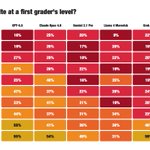
I tried 17,000 times to get AI to write at a first-grade reading level.
It failed every time.
So I fine-tuned a Qwen model that scores near-perfectly on reading-level benchmarks.
huggingface.co/AustinWay/qwe…

Austin Way retweeted

This should be required reading for everyone to understand the relationship between language and learning.
More so if you operate 1 or 2 degrees from education field.


“Have AI tutor you” is useless advice.
I tested 255 AI models, reviewing over 20,000 chats across 10 subjects.
AI’s ability to write at the requested grade level varies significantly by subject.
Despite the variation, the models never reliably hit the target reading level.
x.com/Austin_Way/status/2098…


Austin Way retweeted

I was reading this article, and Austin makes a great point.
There is a massive distinction between a chatbot teacher and a human teacher.
When a teacher talks, everything they say is said once.
There is no record of it afterward, and you subconsciously know that. So you put in more effort to understand and remember what they say.
We don’t treat chatbots the same way.
When you talk to Claude, you know every response will still be there whenever you need it.
That changes how much attention you give it.
We all know the feeling of getting a long answer to something that should have taken two sentences and just skimming through it.
And if you forget something, there is very little cost. You can always scroll back up.
That is the fundamental problem with AI tutors: the format itself incentivizes you to rely on the chat history instead of actually remembering what you learned.
Austin Way retweeted

AI chatbots will never be able effectively.
The learning with AI comes from optimizing it and maximizing its abilities.
If you can figure out how to do that, your learning will be much better.
Use an AI chatbot to learn, and you will forget everything within a week.
Austin Way retweeted

I do agree that, at the moment, AI can't teach you anything
However, it IS getting better, smarter, and more competent, and there's no reason its trajectory won't continue until it crushes all deterministic apps and human tutors.
AI tutors have no place in the classroom.
They repeatedly fail to deliver on their promises (as I show below).
But there's still hope for AI-powered education...
Austin Way retweeted

15y/o. Built self stabilizing 6 legged robot.
Controlled entirely by an Iphone.
Made in under a 100 hours for less than $300.
💯
One of the most valuable things you can do is test with students. You learn things you'd never think of.
I've seen so many edtech products w/ content two grades above the student's reading level.
It's so hard to realize that's even a problem until you watch students use your product. (One of many examples.)
Genuinely one of my favorite edtech teams right now!

