
Mostly historical linguistics. Main focus right now is Nuristani (Katë). Otherwise Afroasiatic and everything from Tokyo to Timbuktu.
Cologne, Germany
Joined July 2010
- Tweets691
- Following227
- Followers450
- Likes2.3K


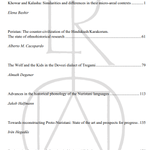



My review article of Zoller's "Indo-Aryan and the Linguistic History and Prehistory of North India" is now out in "Kratylos":
kratylos.reichert-online.org…
2
2
431
Now out in Bhāṣā (open access): My article on Gāndhārī orthography/phonology and how it relates to the modern Indo-Aryan languages of the far northwest:
doi.org/10.30687/bhasha/2785…
2
260
Now available for download from the publication server of the University of Cologne:
The revised and expanded version of my dissertation
“A Grammatical Description of the Katë Language (Nuristani)”
kups.ub.uni-koeln.de/73732/
Proper book publication coming a while later.
My contribution to the "Roots of Peristan" conference volume: "Nuristani Theonyms in Light of Historical Phonology" (with some updates and corrections in the margins)
researchgate.net/publication…

A short etymological note on Bactrian λαδο 'law' and its likely descendants in Nuristani, which I wrote around two years ago, is now finally out in the Bulletin of SOAS (Open Access): doi.org/10.1017/S0041977X230…
My impression after 1 month of learning Sumerian: Sumerologists are doing something as routine practice that scholars of Chinese or Japanese have never attempted (probably for good reason): unambiguous transliteration of logographs while also indicating the pronunciation intended
The term "antisemitic" was adopted by 19th c. proponents of race ideology from the terminology of early historical linguistics. In their ideologies language affiliation was seen as the same thing as affiliation with a "nation/people/race/stock". They constructed a contrast

This would be like arguing that all English speakers are <Germanic> because the English *language* is Germanic.
<Antisemitic> has always referred specifically to prejudice against Jewish people. In fact it was coined by a German race-agitator as the name of his new organization:

1
3
350
An interesting case of retroflex arisal: Comorian Bantu languages seem to develop older *nj into dental /n̪d̪/, which together with n̪d̪ from loans displaced the original *nd to the retroflex place of articulation (> /ṇḍ/). Similar things probably going on with *t > /ṭ/.
1
8
960
This mass authorship tactic produces some funny results: At least one person is listed here as an author who I know would not agree with the conclusions of the paper.

New hybrid hypothesis for the origin and spread of the Indo-European #languages. New study in @ScienceMagazine by an intl. research team of linguists and geneticists led by @MPI_EVA_Leipzig. See: tinyurl.com/mr2bxeaw & doi.org/10.1126/science.abg0…

4
888
Full article now out in "Transactions of the Philological Society" (open access)!
"A Partial Decipherment of the Unknown Kushan Script"
(Svenja Bonmann, Jakob Halfmann, Natalie Korobzow & Bobomullo Bobomulloev)
doi.org/10.1111/1467-968X.12…


Ready to meet a new Middle Iranian language?
Check out our presentation
"A partial decipherment of the Unknown Kushan Script"
academia.edu/97965292/
Full paper coming soon!


Ready to meet a new Middle Iranian language?
Check out our presentation
"A partial decipherment of the Unknown Kushan Script"
academia.edu/97965292/
Full paper coming soon!
Around three months ago, Tajik archeologist Bobomullo Bobomulloev reported the discovery of new inscriptions in the Unknown Kushan Script of Central Asia.
Today we will present our partial decipherment of this script for the first time.


This post is from an account that no longer exists. Learn more


4 years late, but finally out in IJDL:
The proceedings of the 2019 Cologne Nuristani Workshop
doi.org/10.29091/97837520023…
The journal is not in open access, but you can read my contribution (on historical phonology) here:
researchgate.net/publication…


3
278

