






Pinned Tweet
Cannot express how amazing this feels,
thanks to @eigenlabs @jieyilong and all other contributors.
thanks to all those DM's and messages of love.
And also thanks to my @OctavFi team mates for giving me the push to keep going further.

The paper is led by @jieyilong, CTO of @Theta_Network, with coauthors from @ethereumfndn, @StarkWareLtd, @Starknet, @trailofbits, @brevis_zk, @SeiNetwork, @pauli_group, @OctavFi, @sciencevr, @nasqret at Adam Mickiewicz University, and researchers at Warsaw University of Technology and Stanford's Free Systems Lab.
On the comparison, the 2 efforts use different interfaces and accounting conventions, so the paper treats this as a numerical comparison rather than a formal claim.
Craig Gidney and Tanuj Khattar of @GoogleQuantumAI reviewed the manuscript before publication.
Read the full paper on @arxiv: arxiv.org/pdf/2609.09582


first graded circuit under 3n for secp256k1 point addition back in October ... now first under 2.5n too
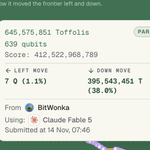
Just posted 639 qubits on ecdsa.fail, below the 5n/2 = 640 in Jo & Lee's asymptotic bound
Couldn't have done it without the recent low-Q work from @odin_free, @JackieLeeETH, @almondquantum, @akashneelesh and especially ser @nasqret

guess not anymore, I have formally proved that a validator will take at most 604497386198401696480443941423039233672056843956262611240144118453974882764353409596694785910843529629961798654508 or roughly 6 × 10^113 RISC-V steps to verify any Ethereum block.
this is an extremely conservative bound, more steps than there are atoms in the observable universe (~10^80). but ... it's finite, and it holds for every block with a gas limit up to 200M, no matter what's in it. until now the only answer we had was ∞.
the proof covers the whole stateless validator:
- input decoding
- every possible transaction
- every EVM call frame
- every precompile
- computing the state root
the bound is carried from the source program through every compiler pass down to RISC-V steps.
it took ~423k lines of Lean, written by a swarm of @claudeai agents: Opus 5.5 orchestrating, Sonnet 5.5 agents building proof packages in parallel. every step is checked by Lean's kernel, and the official evm.fast verifier Built on @yukonresearch in collaboration with
@zksecurityXYZ, @Veritylab, @ethereumfndn which then rebuilt and re-checked all of it with an independent kernel replay taking 13 hours of verification.
now the fun part, making the number smaller ...
full submission: github.com/Layr-Labs/evm.fas…


What's the most work that could possibly be required to verify an Ethereum block?
Today, we can't prove an answer. All we know is the validator always finishes. evm.fast is an open challenge to change that: contributors compete on a leaderboard to find mathematically guaranteed bounds for verifying Ethereum, no matter what's in a block.
Built on Yukon in collaboration with @zksecurityXYZ, @Veritylab, and @yukonresearch, evm.fast seeks provable limits that keep verification cheap, predictable, and possible on modest hardware.
Try it yourself:
evm.fast

BitWonka ❌ retweeted

Built on the Octav API while it was still happening, with help from @arkham's new enterprise data.
Every attacker wallet, every hop, every open loan, across EVM and Tron. Updated every 15 minutes.
Drained vs frozen, live:
go.octav.fi/binance-drain-da…


BINANCE DRAIN TRACKING DASHBOARD
Using @OctavFi and the new @arkham enterprise products I quickly put together a dash to track what the attacker is up to. Self updating and improving every 15 min.
Track:
drained vs frozen
open defi loans
all attached wallets
txn flows
full timeline
go.octav.fi/binance-drain


BitWonka ❌ retweeted
Your auditor asks for NAV on a date that's already in the past.
We rebuilt it block by block, and found a $1M+ position that wasn't on anyone's list.

not a bad saturday
- get liquidated at 1000x
- submit a record breaking 732 Qubit circuit on ecdsa.fail
- win at a friendly race of go-karts
- add support for @DeriveXYZ V3 on @OctavFi
BitWonka ❌ retweeted
you might think the bunker talk is fud. another pivot to pump some magic internet coins.
or you open your eyes and point your clanker (or your brain) at the curves. ecdsa fail.
that chart is the price of the hard part of the quantum attack on your signatures. 10.7B in may. under 1B today. @BitW0nka hit this week and took another tenth.
forget the unreleased lab models. this is bitwonka with claude and a gc of gardeners and lunatics. a public model, on a public leaderboard.
autoresearchers don't wait for a lab to explain reality to them. they break into new ones.
we always knew a quantum computer eats your curves. the only question was the price, and the price is in freefall.
start now and it's a migration. wait and it's headlights.
c u in the bunker

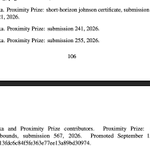
getting cited in research papers just hits different ... AI is enabling us to do things we could never have imagined
I have the utmost respect for researchers now, can not imagine how they've been achieving all this for multiple decades without such assistance


Happy to announce my latest work with @skominers and @SuccinctJT !
eprint.iacr.org/2026/2056
TLDR: we transfer the techniques from better.codes to yield 5-10% proof size reductions in several SNARKs today, and supply an efficient decoder for knowledge soundness
🧵/ n

BitWonka ❌ retweeted

Chad @BitW0nka 🫡
The paper is led by @jieyilong, CTO of @Theta_Network, with coauthors from @ethereumfndn, @StarkWareLtd, @Starknet, @trailofbits, @brevis_zk, @SeiNetwork, @pauli_group, @OctavFi, @sciencevr, @nasqret at Adam Mickiewicz University, and researchers at Warsaw University of Technology and Stanford's Free Systems Lab.
On the comparison, the 2 efforts use different interfaces and accounting conventions, so the paper treats this as a numerical comparison rather than a formal claim.
Craig Gidney and Tanuj Khattar of @GoogleQuantumAI reviewed the manuscript before publication.
Read the full paper on @arxiv: arxiv.org/pdf/2609.09582
BitWonka ❌ retweeted
Proud to have the best engineers at Octav! @BitW0nka is a one of the best. Good job
The paper is led by @jieyilong, CTO of @Theta_Network, with coauthors from @ethereumfndn, @StarkWareLtd, @Starknet, @trailofbits, @brevis_zk, @SeiNetwork, @pauli_group, @OctavFi, @sciencevr, @nasqret at Adam Mickiewicz University, and researchers at Warsaw University of Technology and Stanford's Free Systems Lab.
On the comparison, the 2 efforts use different interfaces and accounting conventions, so the paper treats this as a numerical comparison rather than a formal claim.
Craig Gidney and Tanuj Khattar of @GoogleQuantumAI reviewed the manuscript before publication.
Read the full paper on @arxiv: arxiv.org/pdf/2609.09582
nice to see myself on the homepage 😅 challenge accepted, returning from retirement ...


Introducing Yukon Weekly Giveaways.
We're putting $10K on the board every week.
Solve Yukon challenges, improve benchmarks and earn Yukon Points.
Each Friday:
- $5K to the week's Top Yukon Points winner
- $5K through a random draw, with odds weighted by Yukon Points
A new week starts every Friday.
Bring your hardest work: yukon.org
(No purchase necessary, full rules below ⤵️ )

3
13
1,758

BitWonka ❌ retweeted
At @OctavFi we started something new and it's already paying off.
Every Friday, the entire team drops the roadmap and builds an AI project. One rule: it has to make our lives easier or bring more value to our customers. A few weeks in, the results speak for themselves.
@ATTRIUS_ built an app that reads everything across Telegram, Slack, email and Pipedrive, then generates a full map of our customers and exactly how we can serve them better.
@Charlie85270R shipped a side-by-side comparison of every data provider on the market. He also built a loop that hunts down every unknown contract address in our database and tries to match it. (V1 in the next post.)
@BitW0nka created a harness to spin up a loop for any agent. We now have agents continuously scanning our entire database, so we're never blindsided by a missing protocol or contract.
@LucBlackburn built an agent that reviews every repo every 30 minutes and trains on them, catching bugs fast and flagging old code that should be upgraded to new patterns.
The takeaway: if you're not running local LLMs, you're already behind.
At @OctavFi we run multiple Mac Studios and Mac Minis, hold several Claude and Codex licenses, and just added 2 new DGX Sparks to the stack.
If you want help optimizing or upgrading your own workflow, ping me. Happy to share what's working.

