




Pinned Tweet
You are not bullish enough on $QS.
⚡ The technology is real
844 Wh/L energy density. 12-minute fast charge (10–80%). 1,000+ cycles, less than 5% degradation. Anode-free lithium-metal with a ceramic separator thinner than a human hair.
🔋 The graphite problem nobody prices in
Every lithium-ion battery needs graphite. Over 90% of global supply comes from China.
$QS is anode-free. Zero graphite. Zero China dependency.
In a world of tariffs, supply chain decoupling, and energy sovereignty — it's a structural moat almost no analyst is modeling.
🤝 The commercial ecosystem is being assembled
Automotive:
• Volkswagen / PowerCo — Collaboration Agreement + $130M conditional royalty prepayment, up to 80 GWh licensed capacity
• Hyundai — JDA signed
• Honda — JDA signed
• Mystery North American OEM — JDA signed December 2025 👀
My hypothesis on the mystery OEM: Ford or Tesla.
→ Ford: Solid Power JDA expired Dec 31, 2025. ~$18B in conventional battery contracts cancelled. Timing is surgical.
→ Tesla: Maxwell Technologies acquisition history. CEO publicly commenting on anode-free patents. Not eliminated.
Both fit. I'm watching both.
Beyond automotive:
• Fluence ($FLNC, Siemens/AES JV) — multi-year stationary storage agreement (grid, data centers, solar)
Manufacturing supply chain:
• Murata — JDA signed October 2025 for ceramic separator industrialization. What most miss: Murata isn't just a supplier — they develop their own solid-state batteries. This is two SSB players aligning on a shared technology stack.
Corning isn't just helping $QS scale ceramic separator production. They have developed their own proprietary "Ribbon Ceramics" manufacturing process — a high-speed, high-precision ceramic forming technology that positions them not only as a supplier, but as a future seller of solid-state battery components at scale.
Corning's Program Director of Energy Materials put it plainly:
"Regardless of the chemistry, the technology gives us a winning advantage."
They're not betting on $QS out of charity. They're betting because their own commercial roadmap depends on solid-state batteries becoming real — and they've chosen $QS as the partner to make that happen.
• Digatron — Eagle Line production equipment
This is not a startup with a deck. This is an ecosystem being assembled in plain sight.
🏭 Eagle Line is operational
First commercial-scale solid-state production line — inaugurated, running for months. The lab-to-factory transition is underway.
🏍️ Real-world proof point incoming
Ducati V21L — field testing live in 2026.
I'm personally watching two events:
→ World Ducati Week: July 2026
→ IAA Munich: September 2026
First public validation on a real vehicle. It's happening this year.
🚀 Beyond EVs — and I'm genuinely excited about this
The non-automotive pipeline is barely discussed. I believe 2026 will change that.
$QS has officially listed its target commercial applications:
→ Nuclear
→ Drones & defense
→ Electric vehicles
→ Wind energy storage
→ Smartphones
→ Smartwatches
Stationary storage & data centers: $QS already has the Fluence agreement in place. First-mover position in an infrastructure segment exploding with AI-driven demand. More news coming.
Drones & defense: No graphite = no China supply chain = full domestic production potential. The latest drone footage is not just a demo — it's a signal.
And this week $QS announced Dr. Mark Maybury to its Strategic Advisory Board.
Dr. Maybury is currently VP of Commercialization, Engineering & Technology at Lockheed Martin — leading the transition of cutting-edge research into scalable products for commercial and defense applications. He previously served as Chief Scientist of the U.S. Air Force (2010–2013), and as CTO at Stanley Black & Decker.
His own words:
"I see tremendous opportunity for QuantumScape to redefine energy storage across multiple sectors, including defense, where reliable, high-performance batteries are mission critical."
Consumer electronics: Density + safety at scale.
$QS is not priced for any of this.
The non-automotive TAM is real. The agreements are being signed. The people are joining. The announcements are coming.
You can't expect a 10x without stomaching 50–80% drawdowns.
Check your thesis. If it's still intact — and mine is — tune out the noise and trust management to execute.
The shorts won't win forever.
Thank you for reading.


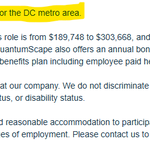
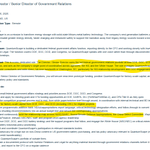
$QS just posted a role for a Director of Government Relations in Washington. Brand-new position, reporting straight to the CFO.
On the ER, Siva said QS was looking for non-dilutive funding for the 100 MWh line, including from the government.
What stood out most to me in the posting is the phrase “factory-scale capital.” To me, QS is already thinking beyond 100 MWh.
The posting is pretty clear about what they want: land prototype funding fast, go after factory-scale capital, and have a say in US battery policy.
They’re targeting the DOE, DARPA, DIU, DPA Title III, and even the Pentagon’s Office of Strategic Capital. They also want the tech recognized as critical to get a real line in the defense budget. And push for US government battery purchasing to require non-China content.
Of course, a job posting doesn’t mean funding secured, and these programs take time. The funding plan is expected with Q4 results.

The role is remote, but based in Washington, D.C. or the D.C. metro area. The listing itself is tagged Maryland, right next to the capital.


$RDT: The "LLMs will kill Reddit’s traffic" narrative is the main thing weighing on $RDDT right now, and I think it’s overdone.
Huffman on the last call: search is volatile, "but that’s not where our business lives." Revenue comes from logged-in users who actually use the app, and that base keeps growing (+7%, total DAU +18%). US DAU dipped slightly because of Google referrals, and ads still did +64% in the same quarter.
The other thing: Reddit is still pretty bad at monetizing. Huffman admitted the feed is "just behind the state of the art," and an international user brings in about 5x less than a US one. That’s a lot of room left.
Reminds me of the "AI kills SaaS" panic.
Long $RDDT.


Reddit is an amazing company with incredible fundamentals
It’s a company with an unfuckwithable MOAT : human conversations about human experiences
Its cultural impact is unmatched and this has allowed management to turn the company into a free cash flow generator
More right wing people should be allowed to speak up (peacefully) on the platform, and banning should be moderated (lol), other than this it’s a banger of an app
Current EV/sales = 7
My PT when sentiment shifts : EV/sales = 18
My PT when euphoria settles in : EV/sales = 35
PT if growth slows down meaningfully : EV/sales = 5
PT if growth slows down meaningfully and margins deteriorate : EV/sales =3
$RDDT #RDDT


$QQQ
Clean bounce off 702.7, a level tested multiple times since July. Wick below, close above, then +1.4%. Buyers defended it.
Now the question: technical bounce or real reversal?
→ Gap 715–720 with the 8 EMA (717) inside: first resistance. A daily close above 720 = first real signal
→ 726–728: 21 EMA + last lower high. Below it, the structure stays bearish
8 EMA below the 21 EMA since mid-October, short-term momentum still favors sellers.
Lose 702.7 and it’s 685.8, then 669–678 with the 200MA.
Big week ahead: big tech earnings + PCE on Thursday. The gap could get settled fast, either way.


$QQQ: yesterday's gap has been filled and yesterday's lows were retested. Buyers are firmly defending the 707–710 zone. If it breaks, it's straight to 703.
Short term, we're in a consolidation phase, which is normal within a long-term uptrend.
If AI names like $NBIS, $BE, $LITE and $MU close green tonight, even on a small bounce, we can consider that a floor has been found. That's still a positive sign.
Next catalyst: $NVDA's GTC tomorrow, which could spark the rebound.
$RBRK at $135. Entry was $55. Still holding — the thesis plays out exactly as expected.
$ZS exited a bit early, had a $260 target. We entered at $191, so no complaints on the P&L. Just left a few dollars on the table.
The whole cyber sector is repricing right now and the momentum is real. Every name running — $CRWD, $PANW, $ZS, $RBRK. The names that were dumped on "AI disruption" fear are now being bought on "AI demand."
Same companies. Same fundamentals. Narrative flipped.
The structural tailwind hasn't changed: AI is expanding attack surfaces faster than enterprise security teams can respond. That's not a quarterly rotation — that's a multi-year budget story. Until macro forces IT spend cuts, hard to see what stops this.
Still long $RBRK.

I opened a position in $RBRK at $55 on Friday. I'll continue to add to it if the price drops further.
$RBRK is down 50% from its highs while posting its best financial year ever.
7x NTM P/S. Forward PE turning positive in FY27 ($0.07–$0.27 non-GAAP EPS guided). 28% normalized revenue growth. 18% FCF margin. NRR >120%.
$CRWD trades at 19x P/S / ~67x forward PE for 20% growth. $PANW trades at 13x P/S / ~23x forward PE for 14% growth. $ZS trades at 10x P/S / ~62x forward PE for 20% growth.
Rubrik is the fastest grower in cybersecurity at the deepest discount to peers — and the gap exists entirely because the market decided AI disrupts data protection.
That thesis is backwards.
Every enterprise deploying AI agents has the same three unsolved problems: what data did they touch, what identity did they assume, can you roll it back when something goes wrong. Rubrik sits across your entire stack — on-prem, cloud, SaaS, identity providers — with a native threat engine and orchestrated recovery built in. They just shipped Rubrik Agent Cloud to govern AI agents at enterprise scale.
AI doesn't disrupt $RBRK. AI is the next demand driver. Raymond James called the selloff "excessive." Baird called it "panic-driven and narrative-led." They're right.
The ARR chart tells the story: $587M → $1,462M in 12 straight quarters, zero deceleration. Net new ARR accelerated three consecutive quarters to a record $115M on a $1.46B base. FY27 guidance: $1.84B ARR, ~$270M FCF.


$ZS: trade closed ✅
Sold my Feb 19 2027 $220 Call yesterday.
Entry: $22.65
Exit: $32.50
Result: +43%
The double bottom played out: breakout, retest, then the move up.
Why exit before $268:
• Macro uncertainty is too high right now
• Volume on this option is thin: if the market drops harder, I might not be able to sell it
• I need cash to redeploy
NFA, just my opinion.
$RDDT -7.36% today, back to $133.63.
I went through the full filing. Reddit shows up 7 times, as one of Anthropic’s main litigation risks.
No settlement. No accrual. Anthropic says it will “defend vigorously.”
The market priced out a deal before the IPO.
But the case survived dismissal on contract claims, where fair use doesn’t apply. Anthropic itself admits a settlement could force it to change its scraping practices.
Bartz got the same language before settling for $1.5B. Anthropic now has $130B+ in cash.
Earnings Thursday after the close.


$RDDT is shutting every free door to its data.
• RSS feeds: gone Nov 13
• Public API: closed by March 2027
• Old Reddit: restricted to recent users
AI assistants pulling Reddit answers today will need a commercial deal to keep doing it.
"Other revenue" (mostly data licensing) was already +24% YoY to $43M in Q2. Every AI lab now has to come to the table, Anthropic included.

$QS's Q3 10-Q, filed on October 23, adds important details on the PowerCo relationship, less upbeat than the earnings call.
In October, QS and PowerCo amended their collaboration agreement again:
Transition payments, $7M in total, are removed.
Both sides are entering negotiations on a new program, including the next-generation roadmap and applications beyond automotive such as data centers and robotics.
During these negotiations, PowerCo won't make milestone payments.
The 10-Q also states that certain technical milestones were not achieved within the planned time frames, and that the corresponding payments won't be made.
Another signal: QS reversed $8.1M in expense tied to management's performance stock units, for development and commercialization goals now deemed not probable.
What hasn't changed: the PowerCo license still isn't signed, and the $130M royalty prepayment depends on it. The PowerCo agreement remains the only agreement explicitly aimed at commercializing QS technology.
My read: on the call, Siva described the amendment as a regular update, focused on technology advancements. The 10-Q also shows delays on the QSE-5 program and an ongoing renegotiation. The November 11 Kyoto symposium becomes all the more important, since the new PowerCo program is meant to cover next-generation technology.

Worth noting: the amendment, filed as an exhibit to the 10-Q and signed by PowerCo's CTO and CPO, states that both sides intend to continue their collaboration and negotiate in good faith a new program (SOW-3), with new milestones, extended to data centers and robotics. In the meantime, QS keeps working on the current program's milestones.

$QS: On November 11, $QS holds its 3rd annual Solid-State Battery Symposium in Kyoto, Japan. Siva Sivaram will present the next generation of its technology, beyond QSE-5.
What’s announced, per the Q3 letter: more details on the “next-generation technology platform and collaboration model with automotive customers.”
Siva gave a hint on the Q3 call: QS’s ceramic separator enables an anode-free lithium-metal architecture that works with any cathode chemistry. In its Q2 letter, QS also mentioned cells larger than QSE-5. The goal is to bring all automotive customers onto this common platform, and Volkswagen PowerCo is already aligning its program with it.
Why Japan matters: according to Siva, Japan’s prime minister has said the country needs to become the leader in solid-state. And at last year’s Kyoto symposium, the official photo brought QS leadership together with three Japanese players:
Atsushi Ogawa, COO of Innovative Research Excellence at Honda, who said the industry must move past the research phase to begin manufacturing and scale up.
Kazuhiro Doi, Corporate Executive at Nissan, who said low-pressure operation is a key requirement for next-generation solid-state batteries, and a key benefit of QS technology.
Nagato Omori, Executive Vice President at Murata, QS’s partner for ceramic separator production.
My read on Honda: both announcements concern it directly. On QS’s “Partner Engagement Pathway” slide, Honda sits at the JRA/JDA stage, which QS defines as joint research and development agreements to co-develop next-generation cells. I think this joint work, which generated its first billings this quarter, has contributed to the platform being presented in Kyoto. The new collaboration model could then define Honda’s path toward licensing. A licensing deal as early as Kyoto would be a big surprise given how recent the agreement is, but a public show of support for the new platform seems more likely.
Siva noted on the call that product announcements have to come from customers themselves. The Kyoto symposium, where Honda already spoke last year, would be the ideal setting for that. Murata should logically be there too.
What about Nissan? Beyond Kazuhiro Doi’s presence last year, two people from its Advanced Technology Center sat in the front row at the Eagle Line inauguration in February. Nissan is clearly following QS closely, even if nothing points to an agreement yet.
This event should bring a lot of news. To my knowledge, it’s the first time QS has promoted a symposium this much in advance, both in its shareholder letter and on the earnings call. A sign that the company has something important to show.


$QS Q3 call: what Siva Sivaram added beyond the shareholder letter.
The 100 MWh line: data center and defense customers don’t have their own cell factories, so QS needs to offer them a manufacturing solution. Equipment cost to QS is targeted below $100M. Site selection is underway and confidential. The capital plan and 2027 guidance will come with Q4 results. QS is pursuing non-dilutive funding: customers, government, ecosystem partners and licensing. Government grants and loans are among the options.
The licensing model stays in place for automotive: QS will transfer its technology to PowerCo and Honda so they can produce themselves. The new line targets aerospace, defense and data centers first.
PowerCo: the relationship remains strong. Payments are moving to a milestone-based model, transition payments are eliminated, and the collaboration will expand to data centers and robotics.
Automotive: beyond Honda and PowerCo, two other top-10 automakers are active engagements, and a new agreement was signed with a global player in mobility manufacturing.
Product announcements will have to come from the customers themselves.
Data centers, feedback from OCP: the battery is shifting from a backup role to an active, constant smoothing role, as racks approach 1 MW. Safety is the absolute priority, which today limits architects to LFP at a performance cost. QS claims better thermal stability than even LFP. And customers want volume, hence the 100 MWh line: a 2028 start aligns with the industry’s timeline.
On the data center use case: full discharges are rare, a few times a month or a year. The battery mostly handles fast swings around mid-charge, with the fastest swings handled by capacitors. A friendlier profile for cycle life than automotive.
Timing: data centers and defense could reach market faster than automotive, whose target is unchanged. QS wants multiple customers signed before the line starts in 2028.
Kyoto, November 11: the ceramic separator enables an anode-free lithium-metal architecture that works with any cathode. Aligning automakers on this platform would, in Siva’s words, make QS the “de facto operating system” of solid-state batteries.
$QS: Following $QS's announcement with its Q3 results, Mühlbauer Group has now spoken on LinkedIn about their partnership for the 100 MWh production line.
The group thanks Siva Sivaram and Luca Fasoli for their trust, and says it will bring its automation and cell assembly expertise to solid-state battery manufacturing.
Mühlbauer also acknowledges the stakes: scaling a new battery technology to industrial production is a challenge it says it's ready to take on with QS.

$QS: Siva Sivaram shared more on LinkedIn about the 100 MWh production line announced by $QS.
His reasoning: demand for solid-state batteries from AI data centers, aerospace and defense is outpacing what any pilot line can deliver. Hence the partnership with Mühlbauer, chosen for its system integration and engineering depth, with start of production targeted for 2028.
In the accompanying video, Luca Fasoli from QS and Josef Mühlbauer, CEO of Mühlbauer Group, present the partnership.
What we know since the Q3 call: equipment cost to QS is targeted below $100M, site selection is underway, and QS is pursuing non-dilutive funding. The funding plan will come with Q4 results.

