




Pinned Tweet
this was lots of fun and lots of all nighters over the past few weeks. really happy with what we achieved!

NVIDIA Blackwell can achieve 303 output tokens/s for DeepSeek R1 in FP4 precision, per our benchmarking of an Avian API endpoint
Artificial Analysis benchmarked DeepSeek R1 on an @avian_io private API endpoint. Running DeepSeek R1 in FP4 precision on NVIDIA Blackwell, their endpoint achieved 303 output tokens/s - the fastest speed we have measured yet for DeepSeek R1.
The FP4 version of DeepSeek R1 maintained accuracy across our evaluation suite as compared to the native FP8 version.
Inference speed is especially critical for reasoning models that ‘think’ before they answer - we look forward to wider availability of NVIDIA Blackwell hardware in the coming months!

in December of 2021 I saw a GitHub repo doing LoRA fine tuning. I realized immediately that it would allow for different elements in the batch to receive different fine tuned models, effectively allowing a single GPU to serve multiple specialized models with very small overhead
I spent the next hour writing a prototype and showed our customers, who were very excited by this. as far as I can tell, this didn’t wind up in the open source world for close to a year after this, and FireworksAI sent me a marketing email advertising this functionality as on October 14 of 2026

i found the optimal first interview question, difficulty: impossible
tell me about one concrete action in your career, in a way where I can understand why it is impressive given what you knew at the time. use as few words as possible
1
2
216
Of course that’s your contention.
You’re a first-year inference engineer.
You just read SemiAnalysis’s blog and saw megakernels coming to TPUs and AMD, so naturally you believe that’s the way to get to speed of light.
Next month, when you get your hands on an inference engineering cookbook—Baseten’s, probably—you’ll be singing from the treetops about the 500 nanoseconds of critical-path latency you save on every GEMM pipeline drain.
That’ll last until sometime next year, when you watch a pirated geohotz lecture livestream and become convinced that PDL gives you a strict superset of megakernel capabilities.
“Well, as a matter of fact, I won’t, because PDL introduces—”
“PDL introduces unnecessary stalls because its synchronization mechanism is very coarse.”
Yeah, I read that too. HazyResearch’s blog, “Look Ma, No Bubbles!” Just below Figure 2.
Do you have any thoughts of your own on the subject, or should I just point my agent at the SGLang repo and have it do it for me?


for OpenAI, Anthropic, and many other companies, Cost Of Goods Sold -> Cost Of Tokens Served, and I would like to be able to say I coined that term iff it becomes widely used
5
376
wait are we actually about to be so very back on the henry adams curve?

BREAKING: For the first time in American history, the Department of Energy has approved a commercial nuclear microreactor's safety analysis for full-power operations.
LA-based Radiant secured the approval, with testing planned at Idaho National Laboratory.

ALT Source: Radiant Rendering
1
7
613
i remember in august '25 asking a researcher about whether "reverse distillation" was possible, because this area was deafeningly silent.
like of course a smaller model's representations are better than random init


conservation of matter gives a secure store of value, only if you can't do cheap fusion
conservation of energy gives a secure proof of compute, which so far has just made another store of value
but unlike gold, compute doesn't just sit in a vault: it can do trustless inference

Last month, we demonstrated high-rate alchemy: turning mercury into real, stable gold, beating CERN’s record by a factor of 10.
Last week, we enriched isotopes in the world’s most powerful plasma centrifuge, beating the Soviet record that stood for 40 years.
Now, we’re building a fusion reactor in San Francisco to achieve record power density.
1
191
if I had a nickle for every time someone has done this and won a nobel prize, I'd have two nickles. which isn't a lot, but it's weird that it's happened twice


What is AI really capable of in bio?
To separate hype from reality, we spent 3 months working firsthand with @AnthropicAI's internal research model to see if it could create an experimental scorpion antivenom.
Introducing Citrini Therapeutics.
citriniresearch.com/p/citrin…

1
10
2,931
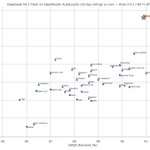
is everybody on OpenRouter just quantizing DeepSeek 4.1 Flash into oblivion to cut costs? I suppose the auto-exacto tier exposes some of this, but we need better.
commodity markets like wheat or corn have had a concept of provenance forever, and for the commodity of LLM tokens, this seems sorely needed.
every request here was ran on 8x B200s but could be ran on a 5090, a CPU, or a toaster and the hash of the logits would match, so you don't need to trust any provider.
this is using the public weights, but using bit exact inference with a custom rust-based DSL directly emitting PTX instructions for fully deterministic, integer only operations.

ALT chart of auto-exacto benchmarks from OpenRouter for DeepSeek 4.1Flash
met someone who essentially got a multimillion dollar house for free out of this tragedy bc a major bank’s vault flooded, but it held the sole promissory note for a mortgage. the bank repeatedly took them to court but the judge just said “ok produce the promissory note”

2
274
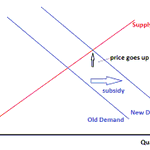
im begging people to realize that econ 101 charts apply to more than just corn or wheat prices. if you stopped subsidizing demand for a bushel of corn or wheat, the price for said bushels goes down, not up

ALT econ 101 chart on subsidized demand


unironically thought this was Manhattan at first


Good read on Apple Neural Engine architecture from author of ANE driver for linux
eiln.github.io/posts/ane.htm…

309
this is precisely the workload for which megakernels are infinitely better suited than the traditional serving stack with cuda graphs + optimized kernels

Dense → Mixture of Experts (MoE), 2023
Uniform Looped Transformer → Mixture of Recursions (MoR), 2025
Same move, different axis:
MoE makes width conditional: each token picks its experts.
MoR makes depth conditional: each token picks how many times it loops.
A learned router lets easy tokens exit after one pass while hard ones keep recursing. Same weights reused, compute spent where it's actually needed.
Paper (NeurIPS 2025): arxiv.org/abs/2507.10524

1
6
592
it’s been repeatedly shown since 2020 that increasing (at least direct) interpretability almost axiomatically decreases intelligence. this is just a rephrase of The Bitter Lesson, so it’s not surprising that supplanting CoTs with looped transformers improves everything


A lot of hype around OpenAI's Astra model here on my timeline today. Apparently, this goes back to a new article from The Information, which said Astra is a "recurrent depth or looped transformer".
It's always interesting to read about new or different approaches (including rumors about what the closed labs may be up to), but let's debunk this a bit.
About 2 months ago, I shared the architecture details of Nanbeige, for example, where "Nanbeige4.2-3B is pretrained from scratch on 28T tokens with a Looped Transformer that reuses the layer stack to increase capacity without adding parameters."
Yes, that's it. The looped transformer idea is just reusing layers in the transformer block.
In the case of Nanbeige, the main idea is to reuse the same 22-layer stack (=transformer block) twice instead of once. So, effectively it extends the 22-layer architecture to 44 layers, but without duplicating the weights.
In simple terms, this roughly doubles the size of the model (if we ignore the embedding and output layers for a second). But instead of requiring 2x the storage and RAM to host this model, it stays at the same size since we reuse the components. However, it's almost 2x as expensive in terms of compute, because we run the embedded text through almost 2x as many layers.
Why? In the Nanbeige 4.2 technical report, the researchers found that two passes gave the best trade-off and retained about 75% of the token efficiency of a standard architecture. (More passes gave barely any gains but made the training much slower and much more expensive.)
While, as far as I know, Nanbeige 4.2 is the first notable open-weight model that adopted this approach, the idea goes back to the NeurIPS paper "Mixture-of-recursions: Learning dynamic recursive depths for adaptive token-level computation". Actually, this paper proposes a mechanism that is a bit more sophisticated by adding a learned router that determines whether each token receives one, two, or more passes. So, easy tokens can exit early while harder tokens receive additional computation.
In sum, Astra may be a really good model, but this shouldn't be about this "looped transformer aspect," which is just a tiny architectural tweak.
Also, the statement "the new technique works in a way that obscures some or all of the AI's reasoning, otherwise known as 'chain-of-thought'" is not necessarily true with respect to the looped transformer method. It's possible that The Information journalist refers to some other technique or misunderstood the looped transformer method.
Reusing layers does not by itself suppress visible chain of thought. It adds computation in hidden states before the next token is emitted, just as ordinary transformer layers do.
But based on the information we have, the only plausible interpretation here is that if a model uses more of these recurrent passes, it may need to generate fewer intermediate reasoning tokens. So then more of its computation happens in latent activations that cannot be read as text. But we would get the same effect if we were scaling up the model size, like GPT 5.6 Luna -> GPT 5.6 Sol.

behold: grokking in your browser tab


my personal site trains a tiny transformer in your browser on modular addition, so you can watch it overfit and get an easter egg when it groks. you can also see the attention scores shift during training & when scrolling the page, which uses a hilbert curve to change inputs

ALT landing page for poole.ai
1
286
my personal site trains a tiny transformer in your browser on modular addition, so you can watch it overfit and get an easter egg when it groks. you can also see the attention scores shift during training & when scrolling the page, which uses a hilbert curve to change inputs
ALT landing page for poole.ai