

World Climate Declaration, signed by more than 2000 scientists and experts. Message: there is no climate emergency. Book: The Frozen Climate Views of the IPCC.
Amsterdam, The Netherlands
Joined March 2020
- Tweets4.3K
- Following708
- Followers8.3K
- Likes2.4K







CLINTEL FOUNDATION retweeted

I sat down with @marcelcrok @ClintelOrg for a wide-ranging discussion and debate over climate science and policy. I enjoyed our conversation.
Now available . . .

Scrap the Paris temperature targets, says @RogerPielkeJr. They don’t tell us which policies work.
Yet households and businesses pay the price of those policies. And their patience has limits.
Ever-higher energy bills. Industry moving abroad. European leaders should not be surprised when the yellow vests return. Pielke also sees expensive energy as a driver of the political upheaval across many countries.
His “iron law”: when climate policy collides with the economy, the economy wins.
A temperature target or a deadline for “net zero” won’t change that. His alternative: technological progress that cuts emissions AND increases prosperity.
In conversation with @marcelcrok, Pielke explains why climate policy needs a rethink — and why he is finally optimistic.
Watch the full interview:
youtu.be/QFrAGK_OEXk

Climate policy reaches into your energy bills, our industries and ultimately the ballot box. Clintel follows the evidence — and the consequences.
Get our latest articles, interviews and videos through our newsletter:
clintel.org/newsletter
“Targets don’t do that. Technologies do.”
Marcel Crok explores Pielke’s alternative: cutting emissions through better technology while preserving prosperity. Also discussed: nuclear power, the IPCC’s shortcomings and the political backlash against expensive energy.
clintel.org/paris-temperatur…

Scrap the Paris temperature targets, says @RogerPielkeJr. They don’t tell us which policies work.
Yet households and businesses pay the price of those policies. And their patience has limits.
Ever-higher energy bills. Industry moving abroad. European leaders should not be surprised when the yellow vests return. Pielke also sees expensive energy as a driver of the political upheaval across many countries.
His “iron law”: when climate policy collides with the economy, the economy wins.
A temperature target or a deadline for “net zero” won’t change that. His alternative: technological progress that cuts emissions AND increases prosperity.
In conversation with @marcelcrok, Pielke explains why climate policy needs a rethink — and why he is finally optimistic.
Watch the full interview:
youtu.be/QFrAGK_OEXk
CLINTEL FOUNDATION retweeted

Excellente présentation principalement centrée sur la détection et l'attribution causale des événements climatiques extrêmes par @RogerPielkeJr devant le public de @ClintelOrg, avec sous-titres, respectivement doublage par IA en français.
On y apprend aussi beaucoup sur la dérive idéologique du monde académique.
CLINTEL FOUNDATION retweeted

De premier knipt het lintje door, de ‘groene’ toekomst lonkt. Maar 27 dagen na de eerste leveringen vraagt batterijfabrikant Morrow faillissement aan.
Honderden miljoenen erin. Politieke wensdromen maken een fabriek nog niet rendabel.
🎥 @Electroversenet
CLINTEL FOUNDATION retweeted

Warum investiert Audi Milliarden in Georgia, USA, während es in Ingolstadt und Neckarsulm über 7000 Stellen abbauen will?
Grund sind die fünf apokalyptischen Reiter der deutschen Geschäftswelt: Energiekosten, Lohnnebenkosten, Steuern, Bürokratie und Regulierungen.
Obendrauf kommt eine vollkommen unberechenbare Politik, die jeden Tag einfach nur so zum Spaß komplette Technologien verbieten oder fordern kann.
In Deutschland sind durch die Regierung schon viele Technologiezweige fast vollständig ausgerottet worden, in denen wir oft Weltspitze waren, bis die Politik diese absichtlich zerstört hat. Kernenergie, Fracking, Magnetschwebetechnik, Gentechnik, chemische Industrie, Pharma, Biotech usw.
Die Autoindustrie ist nur die nächste einer langen Reihe.
Was in der Diskussion gerne vergessen wird: Die Autoindustrie, das ist nicht das Audiwerk in Ingolstadt. Das sind auch die unzähligen deutschen Zuliefererbetriebe, von denen viele bereits pleite sind! Und jeder von denen ist oft Herz- und Wohlstandbringer einer Kleinstadt, die ohne diesen langsam verarmt.
Das ist nicht „der Globalismus“ oder die Chinesen oder sonst eine unkontrollierbare Kraft, gegen die wir kaum etwas tun können.
All diese Technologielinien wurden mit voller Absicht und mit aller Kraft von unserer eigenen Regierung zerstört und aus dem Land gejagt mit 100%iger Unterstützung der MSM-Presse, die das Ganze vorantreibt.

Follow the evidence behind the climate and energy headlines. Subscribe to the Clintel newsletter:
clintel.org/newsletter/
El Hierro was supposed to demonstrate how wind power and storage could replace fossil fuels. Years later, diesel still supplies most of its electricity.
Francis Menton examines what went wrong—and the lessons policymakers keep ignoring:
clintel.org/el-hierro-renewa…

Have policymakers in the EU, the UK and US states never heard of El Hierro?
A small island with 11,000 residents and plenty of wind. An ideal testing ground for the promise of 100% renewable electricity, before making millions of people depend on it.
They installed wind turbines with more than twice the island’s average electricity demand in capacity, plus pumped hydro storage. Yet in 2025, this system supplied just 44% of its electricity. Diesel supplied the rest.
@mhtncontrarian explains why: during prolonged periods of low wind, the upper reservoir empties. Then the diesel generators have to take over.
If this setup cannot deliver on its promise on a small, windy island, why are politicians so confident it will work on a vastly larger scale?
They keep pushing ahead, with millions of people’s electricity supply at stake.

CLINTEL FOUNDATION retweeted

BREAKING: THE BIGGEST CLIMATE SCANDAL IN AUSTRALIAN HISTORY
The Albanese Labor Government has just been caught red handed. New forensic evidence suggests they are using a compromised Bureau of Meteorology (BOM) to fabricate a climate crisis that simply does not exist.
A explosive forensic audit led by investigator Tom Berger and retired scientist Geoff Sherrington has uncovered widespread, systematic errors and fake readings within the BOM’s raw climate data.
We aren’t talking about minor glitches, we are talking about copy and pasted data designed to make the past look cooler and the present look warmer.
The audit exposed blatant data manipulation at the Sydney Observatory:
•The Fabricated Data: Minimum temperatures from August 1907 were found completely duplicated and inserted into the August 1867 record.
•The Cover-Up: The Australian fact-checked the National Archives and confirmed this “double-up” does not exist in the original handwritten records. The online data used to justify sweeping climate policies is completely wrong.
For years, the BOM has operated on a “trust us” basis. Dr David Evans, the scientist who built Australia’s carbon accounting software, warns that this “secret climate business” mirrors the worst days of fraudulent medical drug trials, where researchers were under immense pressure to exaggerate results to fit a narrative.
Labor is terrified of an independent audit because they know their Net Zero house of cards will collapse if the public sees the real numbers.
Dr Jennifer Marohasy confirmed that outside of Adelaide, there has been no proper audit of Australia’s weather stations.
If our historical data is corrupted with fake inputs, the AI forecasting models used for future planning become entirely useless.
The Albanese Government doesn’t want the data audited because the data doesn’t support their narrative.
They are destroying our economy, killing our energy grid, and forcing Net Zero targets on regular Australians based on copy and pasted climate fiction.
The question is simple, if the records are sound, why is Labor so opposed to an independent audit?
youtube.com/playlist?list=OL…

Being able to heat your home and afford your groceries should matter more than a politician’s climate ambitions.
Follow Clintel’s coverage of climate and energy policy:
clintel.org/newsletter/
Mao’s farmers knew the land. Their leaders thought they knew better—and forced them to follow disastrous instructions.
Francis Menton argues that Western energy policy shows the same dangerous contempt for practical knowledge.
Read his article:
clintel.org/energy-policy-fa…

You turn the heating down because you’re worried about the bill. The politicians telling you the energy transition must go faster have no trouble keeping warm.
@mhtncontrarian draws a disturbing parallel with Mao’s Great Leap Forward.
Mao told farmers to plant more densely and plough deeper. Officials promised ever bigger harvests. When the crops failed, the state still demanded the grain it had been promised. Tens of millions starved.
Menton sees the same arrogance in Western energy policy: leaders determined to replace dependable power stations with wind and solar, brushing aside warnings about whether the system will work when people need it.
And the consequences reach beyond your heating bill. Farms need fuel. Fertiliser production needs energy. So do food processing, refrigeration and transport. Expensive, unreliable energy can put food out of reach too.
If you’re already struggling to heat your home or feed your family, being told the transition must go faster is hard to stomach.
How much are ordinary people expected to lose before the leaders pushing these policies admit they could be wrong?

More on climate science, energy and the costs of climate policy. Sign up for Clintel’s newsletter:
clintel.org/newsletter/
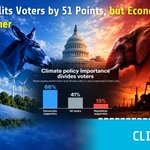
Would that 66% hold once the household cost of a specific climate policy was on the table?
That’s the question Charles Rotter raises after examining Pew’s findings:
clintel.org/climate-policy-v…

Climate policy is one thing. Paying for it is another.
Charles Rotter on Pew’s latest poll:
• Environment/climate policy matters greatly to 66% of Democratic supporters, versus 15% of Republicans.
• The economy ranks higher for both.
• 74% of adults are very worried about gas and energy prices.
Yet Pew never asked: how much extra would YOU accept on your monthly energy bill for faster emissions cuts?

Follow Clintel’s coverage of climate science, energy and policy. Subscribe to the newsletter:
clintel.org/newsletter/
US funding withdrawn, no agreement on the next report’s timetable, and reserves projected to disappear unless income or spending changes.
Marcel Crok examines the IPCC’s own looming crisis:
clintel.org/ipcc-funding-cri…

One IPCC scenario could come true remarkably soon: its own bankruptcy.
Following the IPCC’s example, @marcelcrok picks the bleakest scenario. Under “business as usual,” its financial reserves disappear and it goes into the red by 2029.
The irony: governments discuss trillions for climate policy, yet other countries are unwilling to replace roughly €2 million a year in lost US funding.
Crok sees that reluctance as a sign of waning interest in the climate issue. Plenty of grand declarations. Rather less enthusiasm when the collection plate comes round.
