




ALT CollabSkill Figure 1. Left: human workers and AI agents are randomly paired on occupational tasks, producing deliverables graded with task rubrics. Right: an additive latent-skill model and Bayesian updates estimate separate human and agent contributions, accounting for variation between workers and producing collaboration rankings.

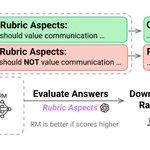
ALT Personalized RewardBench overview. A query and user profile define rubric aspects used to construct a chosen response and a rejected response. Reward models are evaluated on whether they prefer the chosen response. Their benchmark rankings are compared with downstream rankings from Best-of-N selection and PPO training, using rubric-based evaluation of the generated answers.

ALT Odysseus overview. SFT initialization is followed by multi-task reinforcement learning with PPO and a lightweight turn-level critic. A sequence of Super Mario Land screenshots illustrates perception and action over more than 100 turns. Additional screenshots show the five levels used for training.


ALT Nazneen Rajani, CEO of Collinear AI, presents the CatAttack poster to a crowd at COLM 2025.

