



Pinned Tweet
ACS released the 2024 5-yr microdata sets. Here is updated TFR by language spoken at home in the US, ranked from highest to lowest.
Anything with 'languages' in the name is a mess, but the trimmed average should give a rough idea of what the TFR is for smaller languages.

Max retweeted

In 2024, the EU’s total fertility rate was 1.34 live births per woman. 👨👩👧
Across EU regions, highest fertility rate in:
🇫🇷Mayotte (3.51)
🇫🇷Guyane (3.10)
Lowest in:
🇪🇸 La Palma (0.76)
🇪🇸 Tenerife (0.78)
Read more 👉 link.europa.eu/kN46nK
#EurostatRYB

ALT Map showing total fertility rate, 2024 (average number of live births per woman, by NUTS 3 regions)


Max retweeted

TFRs by states in the US for 2026, based on birth counts in the first half of the year.
Each passing year, the pattern of red states having a higher TFR gets a little bit more pronounced.


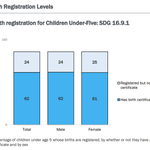
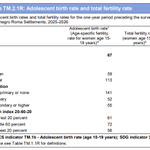
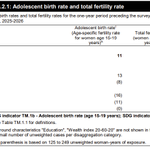
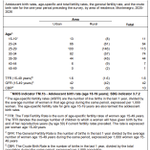
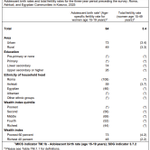
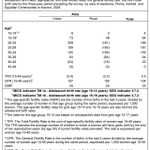
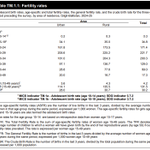
The full MICS reports are out. Interestingly, the TFR among Roma is slightly higher in urban areas (3.4600) than in rural areas (3.3950). Urban Roma also have a higher TFR than several countries in SSA. Their adolescent birth rate (ages 15–19) is also higher than Afghanistan’s.


Max retweeted

Here is the fertility rate of Canada's Indigenous groups from 2006 & 2021.
2021 numbers:
Inuit: 2.57
Status Indian: 1.82
Métis: 1.23
Non-status Indian: 1.13


Max retweeted
Iraq reported 1,026,242 births in 2025, around 1.3% more than in 2024. The TFR declined slightly to 2.74 (2.77 in 2024). The TFR tends to be higher in the south and lower in Baghdad and the central regions (no data for the Kurdish provinces).


Max retweeted

Fertility Rate map of Argentina by Province in 2025. Overall, the TFR was 1.04, ranging from a low of 0.74 in Jujuy to a high of 1.42 in Misiones. The TFR of the City of Buenos Aires was 0.79. No region had a TFR above replacement.

Max retweeted

Mexico's just-published Encuesta Intercensal (EIC) 2025 contains some interesting baseline data on aging and ethnicity. From 2020 to 2025, the median age of Mexicans rose from 29 to 32, with a rapid contraction of the under-10 population over those five years.


Max retweeted

Here's what fertility looks like around North America.
The list of regions with near-or-above replacement-rate fertility is:
Nunavut
Haiti
South Dakota
That's pretty much it.


A few hours ago, INEGI, the Mexican National Institute of Statistics and Geography, a government agency, published its Encuesta Intercensal (EIC) 2025 (intercensal survey 2025).
Here is the press release:
inegi.org.mx/app/saladeprens…
Page 9 reports the total fertility rate (TFR). INEGI estimates Mexico’s TFR for 2024 at 1.2 (screenshot in Spanish below). Yes, 1.2, only slightly above Japan’s level in the same year (1.15). By 2026, Mexico’s TFR could fall below Japan’s.
I don’t find words to describe this.

Max retweeted
Mexican fertility in free fall!!!
According to the 2025 intercensal survey, Mexico had 130,393,389 inhabitants, 3.5% more than in 2020.
The survey found a TFR of 1.23 children per woman for 2024, down from 1.60 in the 2020-22 period.
Max retweeted

Québec 2025 Update: TFR, births, Fertility hotspots, Great Replacement? and more 🧵
Births(p): 78,200 (+1.0% YoY)
Deaths: 80,450 (+2.1% YoY)
Marriages: 22,711 (-1.5% YoY)
TFR 1.360
Par région administrative:
Bas-Saint-Laurent 1.394
Saguenay‒Lac-Saint-Jean 1.436
Capitale-Nationale 1.374
Mauricie 1.417
Estrie 1.429
Montréal 1.142
Outaouais 1.453
Abitibi-Témiscamingue 1.636
Côte-Nord 1.541
Nord-du-Québec 2.241
Gaspésie‒Îles-de-la-Madeleine 1.415
Chaudière-Appalaches 1.669
Laval 1.410
Lanaudière 1.453
Laurentides 1.476
Montérégie 1.471
Centre-du-Québec 1.705
I will be giving much more interesting data in this thread 🧵
🤖 Made with AI

+ @smy1924 's population pyramid for German speakers in Bolivia, for comparison.
Note that some children in the youngest cohorts are not reported as speaking any language, which explains the narrow base.


