

Developmental Psychology PhD student @ Cornell, likes making stuff
Nipomo, California
Joined April 2013
- Tweets814
- Following909
- Followers413
- Likes6K






Pinned Tweet
I spent a year building playnarrator.com; today I shut it down.
Open source version now available on github.com/DavidNTompkins/na… (includes frontend/backend and instructions to run locally)
It was a good way to learn some code and lose a bunch of money. Thanks for playing!


RT @YiLu_lois: 📣 New paper out! 🎉
We often assume older adults are more risk-averse — but why? Our new study shows that age-related stereo…

Canva is so good - but its maximum size limits make it unusable for scientific posters (which can be as big as ~8ft in a dimension).
Any chance this limit could be removed? @canva
Something deeply inefficient in airport vending. A million kiosks in LAX and not a single Peach Vibe Celsius?
David Tompkins retweeted

“Action asymmetry hypothesis”: The way perceptual systems are organized in the brain depends on the way we perform actions with our hands, according to a new theory proposed by @CornellPsychDpt scholars. @APA @CornellCHE news.cornell.edu/stories/202…

When i left my job at Hasbro for grad school, I left a parting gift for my colleagues. Today, five years later, it remains on the wall.
The carpets have changed, the cubicles have changed, but I remain.

In developmental psychology, do interventions select for historically fragile phenomenon? I've been trying to figure this out!
If you'd like to hear more and see some early/prelim. data - I'm giving a '4th year' talk about this on March 5th, 12:20 EST, in person or on zoom (dm)

Openai's deep research - is it worth it? I switched over to anthropic a few months ago. Worth switching back?


This in a 2018 article in a flagship journal in developmental psychology. The article has 40 citations.
I am losing my mind.

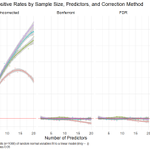
Do you correct for multiple testing in linear models with multiple predictors? If you're reporting individual predictors as significant - you should!
Here's a simulation. At 5 predictors, it's a 20% false positive rate 😱
(y ~ x1+x2+x3+x4+x5)

Yesterday at a talk, someone asked where we saw 'the future of child development / human ecology going'. I gave a pretty non-answer on the spot, but with the benefit of a day to think, here's a more thought out answer.
I think in the next ten or so years we're going to have to really defend and justify our field's existence. Yes - due to political pressure on social fields generally - but that's not the only reason.
I think as we continue to evaluate childhood and the child as a system, we are going to grapple more seriously with the implications of working in a complex dynamic system. Specifically, I think we'll question whether individual differences are more quantitative or qualitative, whether we can assume that similar outcomes/behaviors imply similar facilities, and whether mechanisms are reliably available in a population or emergent and rare.
I think this will make childhood look less like a series of relations we can understand and more like a mess of complexity we can only get the broad shape of. While we do currently speak of the complexity and systems of childhood - I don't think we really take that as seriously as we ought to in our studies. If we did, we would be less likely to attempt to manipulate behavior through clever interventions and nudge-like manipulations.
I think this will lead to a period where we return to caring more about simple, large scale manipulations. To use weather as an analogy - caring more about carbon than attempting to seed rain. I think this will look like renewed interest in sleep, nutrition, and home environment at large, and perhaps less interest in the minutiae of development and in the sort of clever approaches that are so interesting to read about. Alternatively, if we want to keep our clever tricks, we'll have to give up understanding of exact mechanisms in favor of something akin to deep learning approaches, bulk data, and individual interventions.
I think this is where we'll go - there are of course people doing this sort of work and taking some of these stances today, but I think as a field we'll shift much further in that direction. I'm probably wrong, but this is where my head's at and a more coherent answer than I can give on the spot.

I have a data set of paper abstracts that I wanted to read, but had no tool for it.
Thanks to Claude now I do. Kind of wild how easy it is to make things nowadays. This was 20 minutes and has been pretty stable

Where do you go with data that is merely suggestive of a problem? Data that is coherent with a problem but not explicitly indicative of it?
Is there a good format for papers that say "Maybe we should be concerned, but we don't have enough evidence yet"?
Anyone have tips for navigating secure/confidential data and cloud GPU providers? Working on a thing