










D retweeted

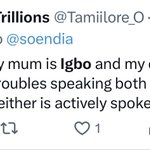
Where were your tweets when they were attacking Yoruba women like this? You never called them out for years while they piled on our women but it’s the pushback you are reaching to? @AremoGemini

D retweeted

Although I’m disappointed because I have known you for the longest as one of the brightest young literary minds out of Yoruba land and even in Nigeria
However, I have not seen you this passionate about the disparaging of Yoruba women, neither have you lent your voice against the several attempts to appropriate the Yoruba cultural heritage (which you’re a beneficiary).
In a tribal society like Nigeria, being tribally conscious isn’t a bad thing. You can criticise people for meddling into another man’s business of love but Making Yoruba the scapegoat of a Nigeria reality is dishonest.
Nigeria is a tribal country and as such, every tribe has two choices, survive or be erased. And every ethnic group in Nigeria is aware and all have thier agendas (except Yoruba people until recently). It’s only a problem if it’s the Yoruba doing it.
How many Hausa Fulani is marrying an Igbo on Saturday and vice versa? But hey! They’re not bigots, only Yorubas who have been doing that for decades.
You can do better Aremo! You’re smart enough to understand idealism vs realism.
Good night.

Bigotry is undoubtedly one of our biggest problems in this part of the world. That one Yorùbá cultural custodian, for instance, would have no problem with a fellow Yorùbá man marrying a woman from New York or Britain. But let that same man bring home a wife from Anambra, Enugu, or even Edo, and suddenly, all hell breaks loose. Apparently, marrying across continents is more acceptable than marrying across Nigerian ethnic lines. If your culture can accommodate a foreigner but not your fellow Nigerian, perhaps the problem isn't cultural preservation. Perhaps, it's ethnic chauvinism disguised in cultural attire.
D retweeted

There's no compound identity when it comes to Yoruba and Fulani.
You are either Yoruba, or you're not.
Fulani, in all form, is everything opposite of Yoruba.
Every countries that Fulani calls home in Africa has one thing in common; terrorism.
D retweeted

Please accept correction. Yoruba is an independent ethnic nation. We have no affinity for any other external ethnic civilization. There's nothing like Yoruba/Fulani. Fulani is Fulani, Yoruba is Yoruba. We are separate entities
D retweeted

Nobody is dragging you, I read most of the comments, most people corrected you and made you understand there's nothing like Yoruba-Fulani. Nobody is telling you not to associate with yoruba or any tribe you want to associate but don't create tribe that doesn't exist.


D retweeted

The way Islam is practised has hardened so much. I know it's easy to point the finger at northerners because it's obvious AF there.
But what's going on in the SW should concern Yoruba people. The extremism is quieter but it is growing.
D retweeted

All you have done is make assumptions. I was waiting for you to show us actual evidence of your assumptions but you dropped none.
Look! Yoruba had no contact with Ibos before the whites men came. Deal with it

This claim that the Yoruba and Igbo "never had anything in common" or "no contact" is so factually untrue, it impugns the credibility of this man's entire argument greatly. Anyone with a basic knowledge of history knows that the Igbos and the Yoruba have rich historical, anthropological, and biological connections and interactions.
The fear-mongering idea that "these people" are trying to infiltrate, grab a content creator, and "access our internal spiritual/traditional system" is entirely moot. The entire Yoruba traditional system — including its deepest, sacred world sense — is already fully documented, digitized, and sitting out in the open for the global public. In the late 1950s and 60s, American institutions and universities created extensive, unmatched documentation of Yoruba culture. They did far more than write shallow textbook summaries; they interviewed the most revered, highly knowledgeable Babalawos of that era and got them to directly deliver the Odùs, verses, and ritual breakdowns on record. It's all online now.
It is completely illogical to claim a neighbouring group needs an internet content creator to "steal secrets" that are already preserved in global public archives for anyone to study.
Labeling the Igbo as an "ahistorical society" to justify isolation is a massive display of intellectual laziness. Long before colonial boundaries were conceived, indigenous iron-smelting civilizations were thriving in places like Lejja around 2000 BC, matching the ancient technological timelines of southwestern Nigeria. The breathtaking 9th-century Igbo-Ukwu bronze casting discoveries prove a highly sophisticated, organized society existed long before European contact.
Furthermore, trying to isolate the Yoruba from the Igbo while suggesting comparisons to distant groups like the Congo or Zulu ignores deep biological realities. A 2024 genomic study published in the Journal of Medical Sciences/ ResearchGate analyzed major Nigerian ethnic groups and proved that the Yoruba and Igbo exhibit the highest genetic similarity, with a striking kinship index of 0.993 (with 1 being completely the same or twins). It is and Yorubas are sister populations that split from the exact same ancestral node around the Niger-Benue confluence roughly 3,000 years ago. This shared ancestry is why their core languages are packed with unmistakable cognates (eg. Ọnu/Ẹnu for mouth, Ejima/Ejire for twins, Ise/Àṣẹ for spiritual decree).
Even the inner workings of Yoruba Ifá and Igbo Afá divination share an ancient structural blueprint.
True preservation of identity does not mean retreating into a corner out of paranoia. The antidote to online revisionist propaganda claiming ownership of towns like Ife or Èkó is not cultural isolation — it is robust, confident education. Even the Ooni of Ife openly acknowledges the ancient pre-Oduduwa history of the aboriginal "Hebo" (Igbo) community in the Ife valley, celebrated to this day during the traditional Edi festival. Or will you claim to know more about this matter than Ọọ̀nirìsà?
Weaponizing historical figures like Azikiwe aand Soyinka to breed modern resentment completely misreads their legacies. Azikiwe’s Ogboni initiation should have been celebrated as an eternal fraternal bond. His adoption of Yoruba names should have cemented our solidarity, but today we are transmuting it into a different plot to "take over." Similarly, Soyinka’s historic sacrifices were driven by a fundamental stance against systemic injustice, not a transactional bid for permanent internet popularity.
Yoruba identity is globally revered and completely secure. It does not need to shrink itself or police creative collaborations out of a manufactured fear of its closest biological and cultural neighbour.

D retweeted

She's not a Yorùbá woman by marriage.
There's nowhere in the world where anyone becomes a member of an ethnicity by marriage, marriage doesn't change your ancestry.

D retweeted

The Yoruba identity was the only identity that refused to melt into their pan African black identity in North America and South America.
All the other ethnic nations from Africa who were enslaved melted into a “black culture “ but the Yoruba people in Brazil, Cuba etc refused to buy their bullshit.
So, it’s an unwritten code, for them to create their utopian black empire, the Yoruba identity must be erased.

D retweeted

Pan-Africanists hate the Yoruba identity more than anything in the world. They hate it because it's way bigger than their ideology and can't be subsumed.
D retweeted

“Ogho, popularly spelt as Owo.”
Let us start there, because presenting this as though you have uncovered some obscure linguistic secret does not inspire confidence in the argument you are making. Owo and its linguistic relationship with Yoruba have been the subject of scholarly research for years.
There is even a published linguistic study titled Question Formation and Focus Construction in Owo: A Yoruba Dialect by Boluwaji Oshodi. So this is hardly a discovery that should astonish anyone familiar with Yoruba linguistic scholarship.
You say Owo sounds nothing like Yoruba. My question is simple: what sounds like Yoruba?
Do you mean Standard Yoruba, the codified variety used in schools, broadcasting and formal writing? Do you mean the Oyo variety on which Standard Yoruba is substantially based? Or do you mean the full range of regional Yoruba varieties?
These categories aren't interchangeable. No.
Standard Yoruba is not the sole authentic expression of every Yoruba community. Owo, Ekiti, Ijesa, Ijebu, Ondo and other varieties have their own distinctive features. Some are harder for speakers of other varieties to understand than others. None of that, by itself, proves that they are unrelated languages.
You appear to assume that if two speech varieties are not readily mutually intelligible, they must be separate languages. That is far from an adequate linguistic argument, if you must know. Mutual intelligibility is relevant to classification, but it is not an absolute test.
Linguists also examine systematic correspondences in vocabulary, phonology, grammar and historical development. The relationship between language and dialect can be complicated, particularly at the boundaries (Owo is one!)
Your experience in Ara-Ekiti may be genuine. But an individual experience is not a systematic study of mutual intelligibility across Ekiti, let alone across Yorubaland.
Now, on Standard Yoruba being based substantially on Oyo: yes, that is a recognised historical fact. But what exactly do you think it proves?
The standardisation of a language is not the same as the creation of the language itself. And neither is the same as the creation of an ethnic identity.
Standard Yoruba developed through a historical process of codification, writing and public use. Its Oyo basis does not mean that the other Yoruba varieties were invented afterwards, or that their speakers had no meaningful historical, linguistic or cultural relationships before standardisation.
If your argument is that the standardisation process privileged Oyo, say so and demonstrate it. That would be a legitimate subject for scholarly discussion. But you cannot leap from the Oyo basis of Standard Yoruba to the conclusion that the Yoruba identity was fabricated for the benefit of outsiders.
Your argument about the origin of the name Yoruba suffers from the same problem.
Yes, the history of the name is complicated. Historical scholarship discusses external uses of the name, older regional identities and the consolidation of a broader Yoruba identity during the nineteenth century. But the external origin of a name does not establish the external invention of the people who eventually adopted it.
You need to distinguish between the history of a name and the ethnogenesis of a people.
Ethnogenesis is the historical process through which collective identities develop. It can involve older identities, political relationships, cultural connections, external influences and the active participation of the people who come to identify with the wider community. It does not require a people to have always used the same collective name, nor does it imply that an identity is fraudulent because it developed over time.
The Yoruba identity was not simply a finished, uniform identity handed down unchanged from antiquity. Nor does serious historical scholarship support the simplistic idea that outsiders merely invented a people who previously had no meaningful
D retweeted

I'm Ado-Ekiti. We don't even have the same dialect. Does that make Ekiti an engineered "identity" we shouldn't feel rooted in?


D retweeted

It’s the women asking for it, I assure you. Non-Yoruba woman want the Yoruba wedding style. It’s not the men asking for Alaga, it’s the women. The men are not deciding the processions, it’s the women.

D retweeted

What Uber does to their drivers is horrible

i’m deleting @Uber and moving to @Waymo absolutely
today, my uber driver told me he has four children living in a garage, and that of the $30 i paid for the ride, he was only getting $7.
it’s the 5th time an uber driver has confronted me about tipping him in cash. this time, he pointed to my diamond earrings and trench coat as evidence that i could obviously afford to pay him more.
it’s an astonishing masterclass in incentive design! make the worker desperate enough to go outside their boundaries, make the customer guilty enough to give in, and the company gets off scot-free.
these are deeply uncomfortable situations for customers to be put in. i empathize with the drivers, but being put on the spot and made to feel personally responsible for someone else’s livelihood is a difficult position to be in.
D retweeted

i’m deleting @Uber and moving to @Waymo absolutely
today, my uber driver told me he has four children living in a garage, and that of the $30 i paid for the ride, he was only getting $7.
it’s the 5th time an uber driver has confronted me about tipping him in cash. this time, he pointed to my diamond earrings and trench coat as evidence that i could obviously afford to pay him more.
it’s an astonishing masterclass in incentive design! make the worker desperate enough to go outside their boundaries, make the customer guilty enough to give in, and the company gets off scot-free.
these are deeply uncomfortable situations for customers to be put in. i empathize with the drivers, but being put on the spot and made to feel personally responsible for someone else’s livelihood is a difficult position to be in.


