
🇫🇷 Economist living in 🇺🇸. Raising 3 tiny humans with @ConstanceSoyres. Everything ever said on Twitter, by anyone, is my personal opinion.
Washington, DC
Joined January 2020
- Tweets773
- Following810
- Followers1.1K
- Likes2.8K





This is truly an amazing paper, with completely new and unexplored data. Congrats to the whole team!!!

New paper on extreme poverty: >12 million administrative records since 2017 from Les Restos du Cœur, one of Europe’s largest food charities.
dropbox.com/scl/fi/ddoy1nouc…
More to come: households’ longer-term trajectories and consumption patterns.
Key results below 👇👇

François de Soyres retweeted

With yen depreciation again in focus, BOJ Deputy Governor Himino recently pointed to higher earnings of Japanese global firms as one of its potential benefits. Our new paper (with Ryan Kim, Bin Ni, and @_ChoongYang) asks what these overseas earnings mean for activity at home.

This #IFDPPaper shows that when firms serve foreign markets through overseas affiliates, currency depreciation can raise income earned abroad without generating a comparable domestic production boom. federalreserve.gov/econres/i… #EconTwitter

ALT Figure 7: Foreign-Market Organization and Exchange-Rate Transmission
François de Soyres retweeted

Taxes on wealth or unrealized capital gains are a bad idea. Not just because of all the well-known implementation issues. But also in theory.
Our paper, now forthcoming in Econometrica:

When Jeff Bezos's Amazon stock doubles, should his tax bill? No, say Mark Aguiar, @ben_moll and @Florian_Scheuer: optimal taxes target realized net trades plus cash flows—not wealth or unrealized gains—while avoiding lock-in, whatever moves asset prices.
econometricsociety.org/publi…


François de Soyres retweeted
How exposed is the UK economy to the second China shock? ift.tt/27IyR1J

François de Soyres retweeted

“Economic Diversity and the Resilience of Cities” is now published at @JIntlEcon!
We derive a dynamic sufficient statistic with first- and second-order welfare effects and compare worker adjustment across French labor markets, showing how economic diversity provides insurance ↓

New at JIE: "Economic diversity and the resilience of cities" by François de Soyres, Simon Fuchs, Illenin O. Kondo, Helene Maghin
doi.org/10.1016/j.jinteco.20…

François de Soyres retweeted

I prepared piece below on RMB internationalization & reserve currency prospects in the 2026 OMFIF Global Public Investor report. I question if state-led RMB internationalization is viable & see internationalization gains as spotty & record mixed. 👇
omfif.org/2026/07/is-china-p…

1/ China's June trade data reinforce two stories that are happening at the same time.
First, China Shock 2.0 is still very much alive: China's export machine continues to move rapidly up the value chain.
🧵
@AmSantacreu
5/One implication is that China's trade surplus may have temporarily peaked (let's see by year end...!), not because exports are weakening, but because imports associated with the domestic AI investment boom are rising even faster.
If sustained, that would mechanically reduce the contribution of net exports to GDP growth.
@Brad_Setser @michaelxpettis
6/At the same time, the longer-run structural transformation of China's trade continues.
The composition of both exports and imports has been shifting steadily toward more sophisticated sectors, a trend we discussed about 18 months ago
federalreserve.gov/econres/n…

Brad is right here: a simple look at the data reveals that since 2018 China doubled down on export les strategy while also pursuing so-called "self-reliance", aiming to reduce it's import dependance.
1/2


We discussed it recently here for example:
federalreserve.gov/econres/n…
That said, over the past few months, I have to admit that the AI-related trade boom might have changed the story! China's trade surplusight have peaked (in the short term).

A fascinating paper that creatively combines biological knowledge and economic data to shed new light on one of the oldest debates in the social sciences: nature versus nurture!

Forthcoming in AER: Insights: "Nature, Nurture, and Socioeconomic Outcomes: New Evidence from Sib Pairs and Molecular Genetic Data" by Markel, Ahlskog, Ebeltoft, Mõttus, Oskarsson, Vainik, Ystrom, and Beauchamp. aeaweb.org/articles?id=10.12…

François de Soyres retweeted
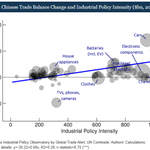
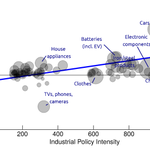
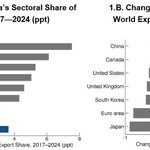
China Shock 2.0 is the most important trend in international macro! China is much larger than during the first China Shock, so a given proportional shift in trade flows implies a larger global reallocation. The shock is also broader geographically and in terms of sector it increasingl overlaps with advanced economies.
With Ece Fisgin, @AmSantacreu Eva Van Leemput and Kevin Vega.
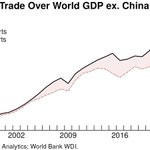
What is different about “China Shock 2.0”? It is not just an export surge: exports are rising much faster than imports, reflecting a more self-reliant strategy and pushing China’s trade surplus to unprecedented levels relative to the world economy. (1/2) federalreserve.gov/econres/n…
I know it’s old news, a point made by many, but China Shock 2.0 is *really* front and center in the global imbalances debate.


Latest Chinese activity data reinforces the view that China’s deeply imbalanced growth model is worsening further. The use of industrial policy & currency undervaluation contributes to large global imbalances that need to be addressed asap.
federalreserve.gov/econres/n…
As @Aligarciaherrer has already observed, May's data shows ongoing domestic weakness (even increasing domestic weakness) even as China's exports continue to outperform global trade. It is an explosive combination.
1/
Great simple thread from @Brad_Setser, agreeing with @sobel_mark — it’s hard to understand why one would downplay the role of Yen appreciation in diminishing imbalances back in late 80s.
But then again, the IMF has been underplaying RMB undervaluation for the past decade, only waking up over the past year, so it’s a common mistake.
