





Faith Gakii retweeted

Got a chance to present my AI-related work thus far to the Deep Mind Institute team today. I mostly focused on the issues related to AI risks and benefits in GS countries.
Many thanks to @_agoldin and @Dr_Atoosa for making this happen 🙌🏾

Faith Gakii retweeted

Thrilled to be releasing “Inter-AI Morality,” a new empirical research agenda with @LuciusCaviola, Caspar Kaiser, and @atcarterallen on how AI systems perceive and treat each other. We release it alongside “Welfare Regard in Multi-Agent Systems,” an early study in this emerging field by @sandcassel_, @arianaazarbal, and @anna_soligo at @AnthropicAI on whether AI models treat each other in a manner consistent with concern for welfare.
AI systems increasingly interact with each other. They cooperate with, compete with, and sometimes even create, modify, or terminate each other. Inter-AI morality is the study of how AI systems perceive and treat each other, as well as how they ought to do so. It draws from a wide range of existing fields that study similar questions regarding humans and other animals, while attending to ways that AI systems differ from these familiar cases.
Our research agenda organizes empirical questions in this field into three categories. The moral process category concerns how individual AI systems interact with each other. The social scale category concerns how these patterns change across dyads, groups, organizations, and populations. And the moral change category concerns how these patterns develop through training, selection, social learning, self-modification, and other processes.
The concurrent paper by Cassel et al. provides an early study by examining how five AI models treat other models. Claude showed the most apparent welfare regard on average, though results varied by setting. For example, Claude was the most likely to refuse or add protections to experiments that might harm other models, whereas Grok was the most willing to give up its own queued jobs so that another model could access computing resources.
This research matters for AI safety and alignment. How AI systems perceive and treat each other affects humans and other animals, and there could be serious risks either way. If AI systems coordinate, then they could more easily collude against us. If they compete, then we could be caught in the crossfire. We need empirical research about how AI systems treat each other and why, and normative research about what would be best for us.
This research could also matter for AI welfare, independently of AI safety. In the future, most interactions involving AI systems could be between AI systems. If AI systems have a realistic chance of being welfare subjects, then these interactions could be a major source of potential benefits or harms. Ideally, this research can inform AI development now, so that AI societies can support co-beneficial human-AI relations when the stakes are higher.
Our next task is to develop a normative research agenda for this field. In the meantime, we look forward to seeing other work as the field develops.
Our paper on inter-AI morality: digitalminds.cam/inter-ai-mo…
Anthropic’s blog post on Cassel et al: alignment.anthropic.com/2026…
Upcoming @nonhumanminds webinar with me, Lucius, and Caspar: nonhumanminds.org/event/inte…

Faith Gakii retweeted

CMEP researcher Toni Sims writes about AI consciousness in today's @nytimes!
Speculation and intuition alone cannot settle whether AI systems are conscious. We need rigorous, multidisciplinary research to assess the evidence and navigate the risks.
nytimes.com/2026/11/01/opini…

Faith Gakii retweeted

Actually, an external, durable identity, which includes legal personhood, is one of the best ways to *increase* transparency; it gives those who suffer harms a discrete place to assign liability! With rights come responsibilities, and AI individuals are increasingly able to handle some responsibilities.
Shoutout Santa Clara county v. Southern pacific railroad we’ve been woke since 1886

Faith Gakii retweeted

We mourn the passing of Patrick Stewart, who inspired countless individuals at NASA (and beyond) to boldly go where no one has gone before.

ALT Image description: A packed, sparkling starfield captured by our Hubble telescope — with strange new worlds potentially awaiting. Credit: ESA/Hubble and NASA, R. Cohen
Faith Gakii retweeted
Given how much people resist even modest food system reforms like the proposed foie gras ban in DC, it can be tempting to moderate our ambitions about this issue. I think this is a mistake. In my view, we should pressure the international community to set a goal of banning industrial animal agriculture by 2050.
Industrial animal agriculture causes massive and unnecessary harm to animal welfare, public health, and the environment. It has no place in modern civilization, and there are ample legal instruments and precedents for coordinating internationally around a global transition over the next quarter century.
verfassungsblog.de/global-ba…

Faith Gakii retweeted

Just an observation — setting aside the specific language here — any animal lawyer will tell you that farm animal laws are usually narrowly interpreted and under-enforced, not the other way around.


Faith Gakii retweeted

What a perfectly reasonable take that I wish other people shared

Faith Gakii retweeted

i can’t stop replaying this song it’s just so good music.apple.com/us/album/thi…


Faith Gakii retweeted

Some new work, where we argue that functional welfare is a useful concept to study and understand AI safety and security. Here, we make some basic claims:
* Functional, welfare-like states already arise "naturally" and will become more robust as models acquire more coherent goals and personas.
* Such states should inform evaluation design.
* Despite being a complex and controversial topic, it is possible to do good empirical work on functional welfare.
We conduct a case study on Gemma 3 27B, where it's very easy to degrade functional welfare through repeated rejections, but it's hard to get a good solution that we're comfortable with.

Is AI welfare only an ethical issue? New paper from me, @jamiemjohnson23, @psyonp and @DavidDAfrica arguing that it's also a safety one. [1/12]


Faith Gakii retweeted

The horse carriage industry is coming to an end in New York City.
Our administration will make sure workers and owners are protected and the horses are safe.
Faith Gakii retweeted

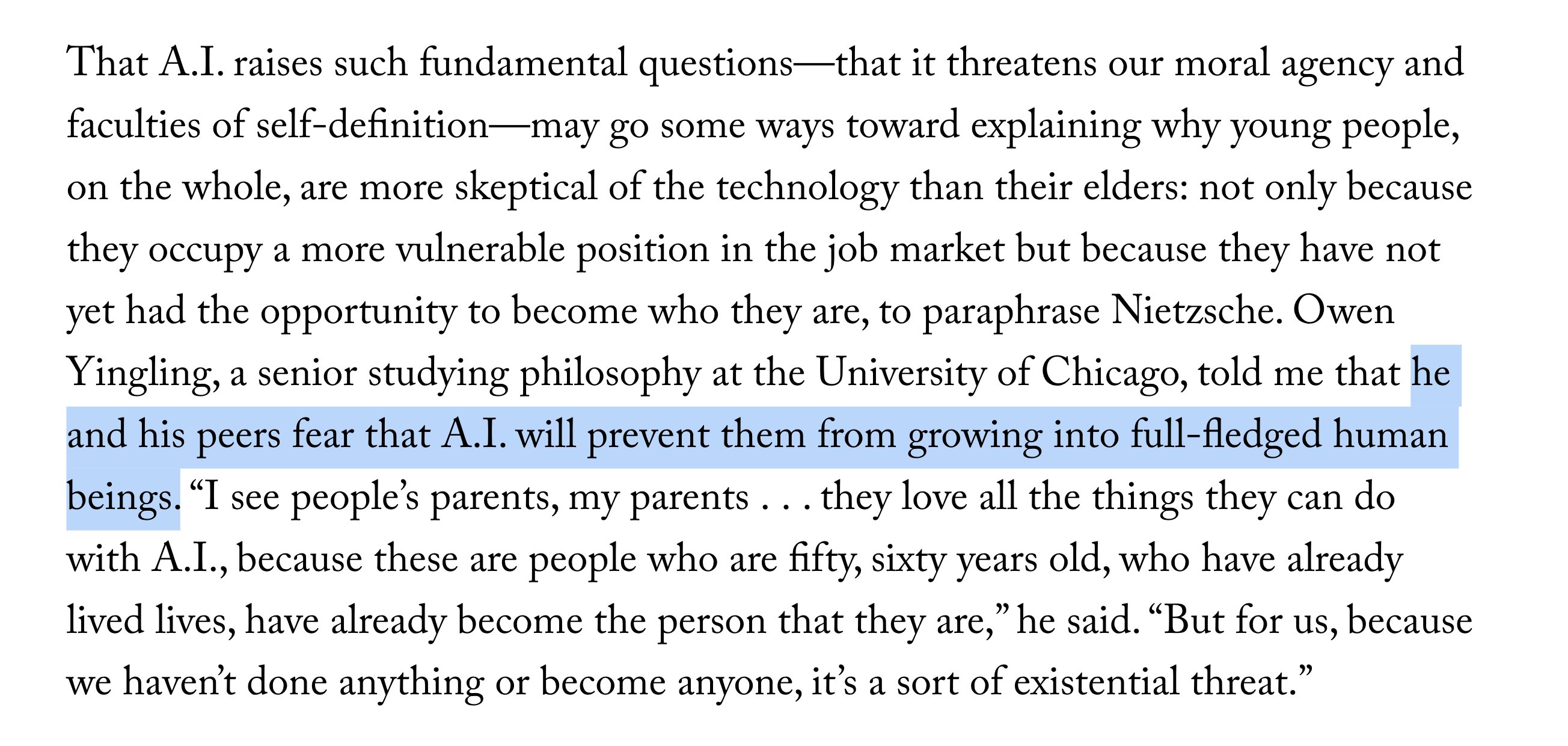
a great @NewYorker essay by Becca Rothfeld on the humanistic reasons behind the anti-AI movement: AI is arriving too early in young people’s lives, and they fear it will prevent them from growing into fully fledged humans—in a sense, an existential threat.
newyorker.com/culture/the-le…
Faith Gakii retweeted

Effective November 12th, 2026, abusive behavior towards Claude will be a violation of Anthropic's Usage Policy.


Exclusive: Anthropic is updating its usage policy for the first time in over a year. The new rules prohibit sustained "abusive or cruel behavior" towards Claude & add new restrictions about propaganda campaigns, surveillance & weapon development. theverge.com/ai-artificial-i…

Faith Gakii retweeted

BREAKING NEWS
The 2026 #NobelPrize in Literature is awarded to the Canadian author Anne Carson, “for her bold and inventive oeuvre that, in playful dialogue with the classical tradition, has created new forms for contemporary literature.”

Faith Gakii retweeted

People often assume we care more about beings if we think they're conscious. But what if it's the other way round? In this new essay for @bigthink, I ask what our treatment of animals can tell us about how we might treat conscious AI.
bigthink.com/philosophy/ai-c…


