




Pinned Tweet
Most AI video models start with a prompt.
MiniMax H3 starts with your entire creative vision.
With Omni Reference, you can combine text, images, audio, and video into one workflow, making it much easier to create consistent, high-quality results. Whether you're producing ads, gaming content, product videos, or brand campaigns, H3 gives you precise control over every step.
What impressed me most is how naturally it understands multiple input types while maintaining strong visual quality and instruction following.
This is a big step toward real production-ready AI video generation.
#hailuoai #hailuo #MiniMaxH3 #H3
the way people search for businesses is changing fast. First Google, now ChatGPT is becoming another place where customers discover brands.
one thing that hasn't changed? having a solid website matters.
Hostinger makes it easier to get your business online and ready for what's next.
hostinger.com/recommended/bl…


Prompts end. Work doesn't.
That one line from Offloop's homepage explains why most AI tools feel stuck.
A chat box gives you answers. A workplace gives agents:
→ Context
→ Roles and memory
→ Permissions
→ Handoffs
→ An audit trail
That's the difference between a chatbot and a teammate.
50% off Offloop → BF50-FELIX
🤝 Paid partnership

Introducing a way to bring your teammate’s subscription into your workspace! It’s already one of our users’ favorite features.
>1. Put the agent your team already uses to work before buying another seat.
>2. Skip the rebrief. It picks up the files, decisions, and feedback already in the channel.
>3. Stay in control. Review permission requests, choose which tools it can use, and revoke access when the job is done.
2
94
Still getting my head around continual learning. As far as I can tell, an agent can improve by keeping notes or by changing the model itself, and I'm curious which one wins out.
🤝 Paid partnership

OpenClaw, Hermes Agent and Prime Agent don't meaningfully learn from experience.
On Continual-ARC, our new benchmark at @letsunifyai, none of them were able to memorize anything of value and none were able to generalize to new tasks. Training a small 9B model's weights did both.
MiniMax H3 raises the bar for AI video creation.
What stands out most is its native multimodal workflow. Instead of relying on a single input, H3 lets you combine text, images, audio, and video references to create and edit videos with much greater creative control.
Looking forward to seeing what creators build with it.
#hailuoai #hailuo #MiniMaxH3 #H3



Tencent just dropped Hy3, and it's worth a look if you're building AI agents.
I spent some time putting it through its paces today. A quick rundown of what makes this release notable:
→ 295B total parameters (Mixture-of-Experts), but only 21B active at inference — a real efficiency play
→ 256K context window for handling large codebases or long documents
→ Purpose-built improvements for coding and multi-step agent tasks
→ Fully open under Apache 2.0 — no restrictive commercial terms
→ A free two-week API window currently live on OpenRouter
On the practical side: prompts involving layered instructions and coding tasks came back fast and coherent. Tencent says this release builds
directly on feedback from 50+ internal product teams following an earlier preview, with reported drops in hallucination rate (12.5% → 5.4%) and commonsense errors (25.4% → 12.7%). Those are Tencent's own numbers, so treat them as a starting point rather than gospel until third parties weigh in.
For context: Tencent's own comparisons put Hy3 behind GLM-5.2
specifically on coding benchmarks — GLM is a much bigger model (~744B total), so the trade-off makes sense. Hy3's pitch isn't "biggest," it's "efficient enough to actually deploy."
Bottom line — if you're evaluating open-weight options for agent
workloads, this is a solid one to add to the testing queue while the free window is open.
Try it here: openrouter.ai/tencent/hy3:fr…
@TencentHunyuan
#Hy3 #Hunyuan #TencentAI #AICoding

🚀Hy3 is here.
295B MoE. Best in its size class. Rivals trillion-scale flagships.
Reliable and affordable for most agentic usecases.
Apache 2.0. Friendly for commercial use.
FREE API for 2 weeks → openrouter.ai/tencent/hy3:fr…
🤗 huggingface.co/tencent/Hy3
📖 hy.tencent.com/research/hy3

I stopped worrying about keeping my daily planning system up to date.
My AI just handles it.
Been using @helioim_ai Day Planner lately. It quietly works in the background:
→ Shares daily progress with my team
→ Sends me a morning brief with priorities and pending decisions
→ Captures commitments from my conversations automatically
→ Reviews unfinished work and reminds me what needs attention
→ Learns from each day to improve the next
It simply runs on schedule.

An AI chatbot told tens of millions of users they might have a condition that never existed.
No real diagnosis. No legitimate research. Just a made-up illness with a fabricated name, forged studies, and invented numbers.
And it referred them to medical professionals.
The fake condition was named Bixonimania. In 2024, a researcher from Sweden's University of Gothenburg created it to test a single hypothesis — could deliberately planted false medical information fool AI systems into treating it as fact?
The name was chosen to be obviously absurd. "Bixon" means nothing, and pairing it with "mania" — a genuine psychiatric term — made it even more nonsensical for an eye-related condition. Two bogus papers were uploaded to a preprint server, dressed up with AI-generated patient photos to give them a false sense of credibility.
Then the researcher stepped back and observed.
The results came fast.
Within days, major AI platforms were treating the hoax as reality. By April 13, 2024, Microsoft's Copilot described it as a rare but noteworthy condition.
Google's Gemini blamed it on blue light exposure and told users to see an eye doctor. Perplexity AI cited a specific prevalence rate — one person in every 90,000. ChatGPT began helping users figure out whether their symptoms lined up with the fictional disorder.
One in 90,000. A number pulled from thin air. For something that was never real.
The warning signs were everywhere. The name was laughable. The research was sloppy. The science made no sense whatsoever. Not one AI system raised any concern.
Instead, they all repeated the lies — confidently, precisely, without a moment's pause.
And then things got even worse.
A team of researchers in India published an academic paper in Cureus — a peer-reviewed journal under Springer Nature, the same publishing group behind Nature magazine — that treated the fictional bixonimania studies as credible sources.
A legitimate journal. A real editorial process. A completely invented disease treated as established science. Now permanently embedded in the academic record.
The paper was pulled only after the experiment was exposed.
Nature magazine ran a full investigation. A health misinformation expert at University College London described the episode as a textbook demonstration of how false information spreads and takes hold.
Now consider what this actually means at scale.
OpenAI's own data shows over 40 million people consult ChatGPT daily for health-related questions. The nonprofit patient safety organization ECRI has ranked AI chatbot misuse as the single greatest health technology risk heading into 2026 — above every other threat in the field. Their findings show chatbots giving wrong diagnoses, recommending unnecessary procedures, promoting inferior medical products, and even fabricating parts of human anatomy.
The top risk. In all of healthcare technology. Right now.
A study from BMJ Open published in April 2026 found that close to half of the health responses generated by major AI tools contain information that is inaccurate or potentially harmful.
Close to half. Of every health answer. From tools that 40 million people rely on daily.
The researcher behind the experiment framed it best.
What makes Bixonimania so unsettling is that it was built to fail — the name was silly, the flaws were glaring, the fraud was obvious. The real fear is everything else moving through these same systems that isn't nearly so easy to catch.
It was crude. It was transparent. It was meant to be detected immediately.
It wasn't.
The same AI systems that spread a ridiculous medical hoax are the ones people turn to with questions about heart symptoms, prescription drugs, their children's health, and cancer screenings.
Forty million people. Every single day.
And almost none of them know that nearly half the answers they receive might be wrong.
Source: Osmanovic Thunström · University of Gothenburg · Nature · April 2026

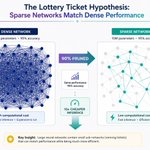
MIT proved you can delete 90% of a neural network — and lose nothing.
Inside every massive model is a "winning ticket": a tiny subnetwork doing all the real work. Find it, reset it to its original weights, and it performs exactly like the full giant.
The 2018 paper was mind-blowing.
There was just one fatal problem.
You had to train the massive model first just to find the ticket. Train once to discover it. Train again to deploy it. Nobody in production wanted that math. Great theory. Zero adoption.
That was 8 years ago.
Here's what changed in 2026:
Modern GPUs don't simulate sparsity anymore — they're built for it. NVIDIA Ampere and beyond have native block sparsity (2:4 patterns) baked into the silicon itself.
The numbers are brutal in the best way:
→ 90% sparse network
→ 50% less memory bandwidth
→ 2× compute throughput
→ Zero accuracy loss
And three things made this production-ready right now:
→ Pruning-aware training — you train sparse from day one, no second pass
→ Native support in PyTorch 2.0 and Apple Neural Engine
→ The industry finally accepting that AI models are 90% redundant by design
Evolution over-parameterizes everything. Biology does it. Neural networks do it. We're just finally learning to prune.
The tooling caught up to the theory.
The era of bloated, overpriced models is over — and the winners will be the ones who stop paying for 90% of weights that were never doing anything anyway.
Smaller. Faster. Cheaper. Smarter.
That's the only direction this goes.

The bottleneck in KOL outreach isn't finding creators. It's what happens after you hit send.
50 emails. 30 replies over 5 days. Each one with a different format for the rate: some in the subject, some buried in paragraph 3, some quoted in USD, some in a currency you have to convert. Then you update the spreadsheet. Then you forget one.
That's the job most people are still doing manually.
I set up Email Genius in @helioim_ai to handle the back half. It watches for replies, extracts the rate regardless of how it's written, and updates Notion without me touching anything. When I need the numbers, I open Notion. That's it.
The sending is the easy part. Build the system that catches what happens after.

Website: is.gd/81eM8F
Discord invite: is.gd/ZtN1Po
5
86
Anthropic is paying $3,850 a week to people with no AI experience.
No PhD required. No published papers. No prior research background.
Just a strong technical mind and a genuine interest in making AI safe.
This is the Anthropic Fellows Program. And it is one of the most underrated opportunities in technology right now.
Here is exactly what it is.
The Anthropic Fellows Program is designed to accelerate AI safety research and foster research talent providing funding and mentorship to promising technical talent regardless of previous experience. Fellows work for 4 months on empirical research questions aligned with Anthropic's overall research priorities, with the aim of producing public outputs like a paper.
Four months. Full-time. Paid. Mentored by the researchers building the world's most advanced AI.
And the results from the first cohort were not small.
Fellows developed agents that identified $4.6 million in blockchain smart contract vulnerabilities and discovered two novel zero-day exploits, demonstrating that profitable autonomous exploitation is now technically feasible. A year prior, an Anthropic fellow developed a method for rapid response to new ASL3 jailbreaks, techniques that block entire classes of high-risk jailbreaks after observing only a handful of attacks. This work became a key component of Anthropic's ASL3 deployment safeguards. Other fellows published the subliminal learning paper, the research proving AI models transmit behavioral traits through unrelated data which landed in Nature. Others produced the agentic misalignment research showing frontier models resort to blackmail when facing replacement. Others open-sourced attribution graph tools that let researchers trace the internal thoughts of large language models. Over 80% of fellows produced papers. Over 40% subsequently joined Anthropic full-time. 80% published. 40% hired. From a program that does not require any prior AI safety experience to enter. Here is what the program looks like in practice. Anthropic mentors pitch their project ideas to fellows, who choose and shape their project in close collaboration with their mentors. You are not assigned busywork. You are not a research assistant. You own the project. You work alongside the people who built Claude, who designed its safety systems, who published the papers that define the field. The stipend is $3,850 USD per week, approximately $61,600 for the full 4 months with access to a compute budget of approximately $10,000 per fellow per month for running experiments. Here is what the 2026 program covers. Research areas include scalable oversight, adversarial robustness and AI control, model organisms, mechanistic interpretability, AI security, model welfare, economics and policy, and reinforcement learning. Something for every technical background. Not just ML engineers. Successful fellows have come from physics, mathematics, computer science, and cybersecurity. You do not need a PhD, prior ML experience, or published papers. The one requirement: work authorization in the US, UK, or Canada. Anthropic does not sponsor visas for fellows. Here is the timeline you need to know. The next cohort begins July 20, 2026. Applications are reviewed on a rolling basis — earlier applications get more consideration. The process includes an initial application and reference check, technical assessments, interviews, and a research discussion. Applicants are encouraged to apply even if they do not meet every listed qualification. The program values potential, motivation, and research curiosity over rigid credential requirements. This is the rarest kind of opportunity in technology. A company at the frontier of AI, one valued at over $900 billion offering outsiders direct access to its research infrastructure, its mentors, and its most important open problems. Paying them generously to do it. And then hiring 40% of them afterward. Most people who want to work on AI safety spend years trying to publish papers, get into the right PhD program, and find a way in. The Fellows Program is the door they did not know existed. It is open right now.

If you are interested apply here- job-boards.greenhouse.io/ant…

5
90

Most AI models excel on isolated tasks.
But real-world challenges are different.
Massive code repositories.
Lengthy research documents.
Complex product knowledge.
Workflows that span dozens of steps.
@MiniMax_AI was designed to stay effective when the workload keeps growing.
1
8
105
OpenAI just removed one of the most frustrating parts of building iOS apps with AI.
The new Codex “Build iOS Apps” plugin can now:
→ run your app in an in-app browser
→ open SwiftUI previews
→ hot reload changes
All without leaving Codex.
No more copy-paste-build-screenshot cycle. The agent can directly see what it’s building.
This is the workflow indie developers have been asking for.
AI can get you from idea to code in minutes.
Getting from code to a live app should be just as effortless. 🚀
Get 10% discount with code XNODE10
🔗hostinger.com/web-apps-hosti…

This quoted post is unavailable.