

A prestigious journal for omics and bioinformatics areas. 20 years of excellence since 2003.
Beijing
Joined January 2020
- Tweets1.4K
- Following2.8K
- Followers557
- Likes721


1/5
New in GPB!
How do structural variants shape gene regulation in cattle?
Zhao, Peng and colleagues built pangenome graphs from 23 assemblies and 898 whole-genome sequences, then identified 80,328 high-quality SVs in 2,929 samples.
doi.org/10.1093/gpbjnl/qzag0…
@LingzhaoF

1
17
4/5
Forty-six of these SV-eQTLs were replicated in CattleGTEx by imputing SVs from a joint SNP-SV reference panel. Insertions in GHSR were significantly associated with its expression, a signal likely linked to heat-tolerance adaptation in Bos indicus cattle.
1
3
5/5
Together, this catalog maps how structural variation contributes to gene regulation in cattle and offers a resource for livestock genetics and genomics.
#Pangenome #CattleGenomics #Bioinformatics
1
Genomics Proteomics Bioinformatics retweeted

Protein arginine methylation promotes global 3′UTR shortening in proliferating cells dlvr.it/TWPxwv


Genomics Proteomics Bioinformatics retweeted

Nature research paper: Closest relatives of poxviruses prevail in human and animal guts worldwide
go.nature.com/4zEFKrz

Genomics Proteomics Bioinformatics retweeted
Nature research paper: Structural and regulatory evolution across the genus Hordeum
go.nature.com/48on7gq

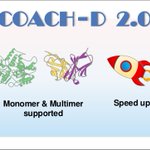
1/8 How can we predict where a ligand binds—not just a protein's fold?
COACH-D 2.0 combines template-based binding-site prediction with molecular docking, now supporting protein complexes.
Published in Genomics, Proteomics & Bioinformatics.
doi.org/10.1093/gpbjnl/qzag0…

1
3
55
7/8 Templates still matter. With the template components removed, leaving ConCavity, MCC fell from 0.580 to 0.356 on COACH420 and from 0.619 to 0.269 on HOLO1K. Predictions remain hypotheses for experimental validation—not proof of binding or affinity.
1
5
8/8 Try the free server: submit a monomer sequence/structure or a multimer structure, optionally add a ligand, and inspect the top five predicted complexes, binding residues and candidate ligands.
yanglab.qd.sdu.edu.cn/COACH-…
1
4
Genomics Proteomics Bioinformatics retweeted

Excited to share our new preprint: Cell-type-resolved DNA methylation analysis using bulk long-read sequencing across human tissues!
DNA methylation data of bulk tissues mix signal from many cell types. A change can mean a cell type shifted methylation internally, or that the mix of cells changed its composition. Bulk data usually can’t tell these apart.
Long reads offer a great opportunity. Each #PacBio or #Nanopore read carries methylation across many CpGs on a single molecule, which lets us assign the read to its cell type of origin, with no cell sorting or single-cell barcodes.
We applied this approach to 140 blood 🩸, 104 brain 🧠 and 59 colon ♋ samples, and used it to:
1. Estimate cell-type composition from shallow sequencing
2. Measure methylation inside repeat elements, such as LINE-1, by cell type
3. Find cell-type-specific methylation differences from deeper sequencing
Some key findings:
1. Blood 🩸: the epigenetic aging signal is largely driven by shifts in cell-type composition, not by methylation changes within cells.
2. Blood🩸, #APOE4: resilient carriers (aged 75 or older, no dementia diagnosis, normal plasma p-tau217 and NfL) look like non-carrier controls on composition and bulk methylation, unlike non-resilient carriers.
3. Brain 🧠: age-associated changes in cell-type composition were sex-biased. Male donors showed rising excitatory neuron proportion and falling oligodendrocyte and OPC proportions with age, while female donors showed no significant age associations.
4. Colon cancer ♋: tumors contain more fibroblasts than matched normal tissue, and LINE-1 repeats lose methylation, with the strongest signal in fibroblasts.
We call it COMET, Cell-of-Origin from METhylation, and the image below shows the idea: each colored tail is a different cell type, traced back from long reads in bulk sequencing.
Big congrats to @Kanochan_Hao, our talented postdoc and first author!
and to all our collaborators across Mount Sinai, Columbia, Einstein and UPenn: Edward A. Mead, Yanchun Zhang, Nikolaos Karvelas, Zhangying (Jennie) Chen, Emma Thorn, @fanyu48696214, @Fannimi2001, Casidhe-Nicole Bethancourt, David A. Cohen, Gordon Fan-Huang, Zi Yan, Eric Bouhassira, Salima Soualhi, Alexey Kozlenkov, Jamshid Abdul-Ghafar, @Sleemmzz , Ernesto Guccione, Stella Dracheva, Louis Cohen, Rachel Brody, Alexander Charney, @hao_wu_7, @KohliLab, @kurtmountain, @VijgJan, Joel Gabre, Deirdre Cohen, @FannyElahi, John Crary
Link to preprint: biorxiv.org/content/10.64898…
#LongReadSequencing #Epigenetics #DNAMethylation #Alzheimers #Aging #ColorectalCancer #SingleCell #Tauopathy #EpigeneticClock
@IcahnMountSinai @SinaiGenetics @PacBio @nanopore
🤖 Made with AI

Genomics Proteomics Bioinformatics retweeted

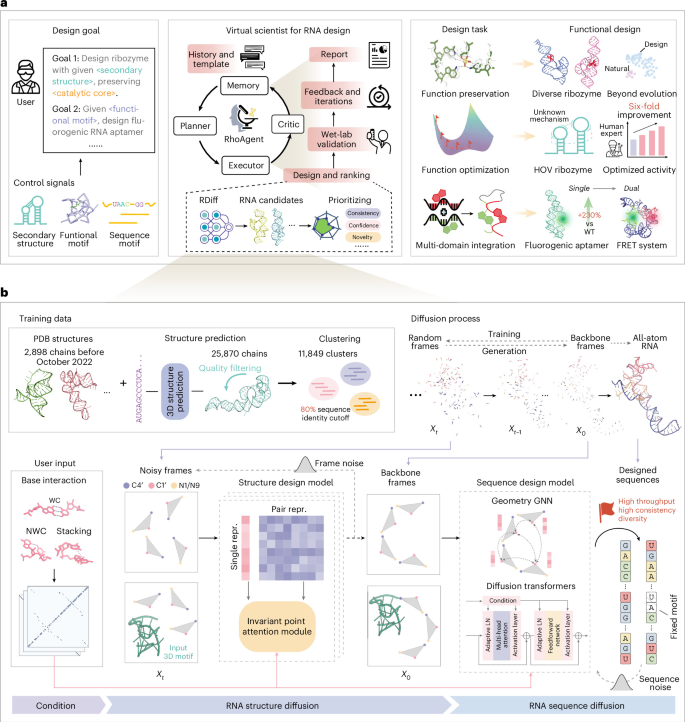
Programmable functional RNA design with a virtual scientist nature.com/articles/s41587-0…
Genomics Proteomics Bioinformatics retweeted
A unified and practical taxonomy for false discovery rate control in omics research nature.com/articles/s41587-0…
