

A prestigious journal for omics and bioinformatics areas. 20 years of excellence since 2003.
Beijing
Joined January 2020
- Tweets1.4K
- Following2.8K
- Followers557
- Likes721


Genomics Proteomics Bioinformatics retweeted

Protein arginine methylation promotes global 3′UTR shortening in proliferating cells dlvr.it/TWPxwv


Genomics Proteomics Bioinformatics retweeted

Nature research paper: Closest relatives of poxviruses prevail in human and animal guts worldwide
go.nature.com/4zEFKrz

Genomics Proteomics Bioinformatics retweeted
Nature research paper: Structural and regulatory evolution across the genus Hordeum
go.nature.com/48on7gq

Genomics Proteomics Bioinformatics retweeted

Excited to share our new preprint: Cell-type-resolved DNA methylation analysis using bulk long-read sequencing across human tissues!
DNA methylation data of bulk tissues mix signal from many cell types. A change can mean a cell type shifted methylation internally, or that the mix of cells changed its composition. Bulk data usually can’t tell these apart.
Long reads offer a great opportunity. Each #PacBio or #Nanopore read carries methylation across many CpGs on a single molecule, which lets us assign the read to its cell type of origin, with no cell sorting or single-cell barcodes.
We applied this approach to 140 blood 🩸, 104 brain 🧠 and 59 colon ♋ samples, and used it to:
1. Estimate cell-type composition from shallow sequencing
2. Measure methylation inside repeat elements, such as LINE-1, by cell type
3. Find cell-type-specific methylation differences from deeper sequencing
Some key findings:
1. Blood 🩸: the epigenetic aging signal is largely driven by shifts in cell-type composition, not by methylation changes within cells.
2. Blood🩸, #APOE4: resilient carriers (aged 75 or older, no dementia diagnosis, normal plasma p-tau217 and NfL) look like non-carrier controls on composition and bulk methylation, unlike non-resilient carriers.
3. Brain 🧠: age-associated changes in cell-type composition were sex-biased. Male donors showed rising excitatory neuron proportion and falling oligodendrocyte and OPC proportions with age, while female donors showed no significant age associations.
4. Colon cancer ♋: tumors contain more fibroblasts than matched normal tissue, and LINE-1 repeats lose methylation, with the strongest signal in fibroblasts.
We call it COMET, Cell-of-Origin from METhylation, and the image below shows the idea: each colored tail is a different cell type, traced back from long reads in bulk sequencing.
Big congrats to @Kanochan_Hao, our talented postdoc and first author!
and to all our collaborators across Mount Sinai, Columbia, Einstein and UPenn: Edward A. Mead, Yanchun Zhang, Nikolaos Karvelas, Zhangying (Jennie) Chen, Emma Thorn, @fanyu48696214, @Fannimi2001, Casidhe-Nicole Bethancourt, David A. Cohen, Gordon Fan-Huang, Zi Yan, Eric Bouhassira, Salima Soualhi, Alexey Kozlenkov, Jamshid Abdul-Ghafar, @Sleemmzz , Ernesto Guccione, Stella Dracheva, Louis Cohen, Rachel Brody, Alexander Charney, @hao_wu_7, @KohliLab, @kurtmountain, @VijgJan, Joel Gabre, Deirdre Cohen, @FannyElahi, John Crary
Link to preprint: biorxiv.org/content/10.64898…
#LongReadSequencing #Epigenetics #DNAMethylation #Alzheimers #Aging #ColorectalCancer #SingleCell #Tauopathy #EpigeneticClock
@IcahnMountSinai @SinaiGenetics @PacBio @nanopore
🤖 Made with AI

Genomics Proteomics Bioinformatics retweeted

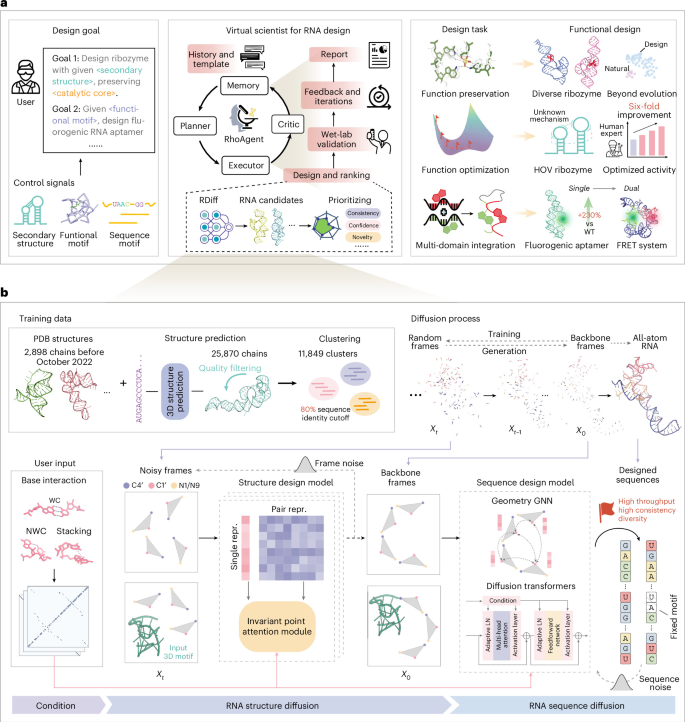
Programmable functional RNA design with a virtual scientist nature.com/articles/s41587-0…
Genomics Proteomics Bioinformatics retweeted
A unified and practical taxonomy for false discovery rate control in omics research nature.com/articles/s41587-0…

Genomics Proteomics Bioinformatics retweeted

Check out this protocol for correlating in vivo calcium imaging with spatial transcriptomics in the mouse brain, by Risa Yamazaki @Cornell & colleagues @STARProtocols #SfN26 hubs.li/Q04Ft6zb0

Genomics Proteomics Bioinformatics retweeted
Research Highlight: Searching perturbation dictionaries with RNA fingerprints nature.com/articles/s41587-0…


Genomics Proteomics Bioinformatics retweeted
The 64-plex fluorescence imaging of RNA in tissues is achieved in one imaging cycle go.nature.com/47yENVJ
rdcu.be/jaPf1Dx4Dh4a

Genomics Proteomics Bioinformatics retweeted

Excited to share that I have started my own lab at @BCMHouston and @TexasChildrens! 🎉
We combine cancer multi-omics and functional genomics to uncover the roles of noncoding regulators in cancer, especially lncRNAs.
We’re recruiting! Come join us!
thelianglab.org
Genomics Proteomics Bioinformatics retweeted
Online Now: Dissecting the molecular machinery of CRISPR-associated transposons dlvr.it/TWMh8X
Genomics Proteomics Bioinformatics retweeted
Nature research paper: Evolutionary dynamics in the years preceding acute myeloid leukaemia
go.nature.com/4BUJXtD

Genomics Proteomics Bioinformatics retweeted
Nature research paper: The molecular basis of replication fork restart via repriming by PRIMPOL
go.nature.com/4zkk7wu

Genomics Proteomics Bioinformatics retweeted

🎉 Our Dynamo protocol is out in Nature Protocols!
nature.com/articles/s41596-0…
As nicely narrated in the video, in 2022, we asked in our Cell paper (sciencedirect.com/science/ar…): Can we move beyond discrete RNA velocity arrows to learn continuous functions governing cell-state transitions? Today, we make that vision more powerful, and much easier to use.
Our original Dynamo paper (Cell, 2022) showed how noisy, discrete RNA velocity estimates can be transformed into continuous, differentiable vector fields of gene expression dynamics, bringing dynamical systems theory to single-cell biology. With a continuous vector field, we can study much more than direction: acceleration, curvature, divergence, and Jacobians. These quantities help pinpoint when cell-fate decisions emerge and which regulatory interactions may drive them.
And Dynamo goes beyond visualization. It can infer regulatory networks, predict cell-fate trajectories and optimal reprogramming paths, prioritize transcription factor cocktails, and simulate genetic perturbations in silico.
What's new?
Our Nature Protocols paper makes these capabilities accessible through 9 step-by-step case studies, covering 4 data types and 5 downstream analyses, from reconstructing dynamics to predicting fate changes. We extend Dynamo to multimodal velocity and pseudotime-derived velocity, supporting conventional scRNA-seq, metabolic labeling, multiomics, and even datasets without direct RNA velocity measurements. We also add interactive tools and 2 new tutorials to make advanced analyses easier to learn, explore, and reproduce.
Our goal is to put quantitative, predictive modeling within reach of more single-cell researchers.
In human hematopoiesis, the framework helps identify lineage-transition regulators, predict reprogramming paths, and model how genetic perturbations may redirect cell fate.
From descriptive maps to testable predictions.
Huge congratulations to co-first authors Zehua Zeng, Sichao Yu, and Ke Ni & Yan Zhang from the Xing lab at University of Pittsburgh and thanks to our entire team for years of work!
Paper: nature.com/articles/s41596-0…
Code: github.com/aristoteleo/dynam…
Genomics Proteomics Bioinformatics retweeted

We made the cover!
This shows immune cell subtypes interacting w cancer cells in breast cancer metastasis, via spatial proteomics (IMC) of a biopsy. Overlaid with signaling arcs. No genAI used
paper: doi.org/10.1158/0008-5472.CA…
image: aacrjournals.org/cancerres/i…
@RoussosTorres @CR_AACR

Genomics Proteomics Bioinformatics retweeted

We are delighted to share our new paper.
By combining single-cell transcriptomics, live embryo imaging and functional experiments, we built a stage-resolved roadmap of mammalian implantation.
And the greatest surprise? See tweet 5!
nature.com/articles/s41556-0…

Genomics Proteomics Bioinformatics retweeted

Really happy to share our new paper, now out in Nature Communications and open access.
We all know most GWAS hits sit in noncoding DNA, and one way they act is by changing how genes are spliced. But splicing is exquisitely cell-type-specific, and bulk RNA-seq averages all of that away. So we went to single cells.
Using the OneK1K cohort, 980 people with matched genotypes and single-cell RNA-seq of their blood immune cells, we mapped splicing regulation across 13 immune cell types: 3,337 independent cis-splicing QTLs, with subsets that differ by sex and by age. When we overlaid these on GWAS, the splicing signals colocalized with risk loci for 30 complex traits, and autoimmune disease, type 1 diabetes in particular, stood out.
My favourite part is a trans story: variants that act from a distance on RPS24 splicing, through the splicing cofactor IVNS1ABP and its interaction with HNRNPK. A small mechanistic chain, from variant to regulator to splicing, exactly the kind of thing single-cell data lets you see.
Together with our 2024 Nature Genetics paper, which did the same in Asian populations, they give a fuller picture of how splicing variation shapes disease risk across ancestries, and a lot of that picture is still cell-type-specific.
Congratulations to first authors Yan Liang and Yi Xia, and to Chi Tian, Yuntian Zhang, Yuhao Dong, and strong support from @drjosephpowell and Alex Hewitt.
Paper: nature.com/articles/s41467-0…

Genomics Proteomics Bioinformatics retweeted

Epi-PHR: an imaging method to map combinations of epigenetic marks at single genes while preserving 3D genome structure, providing insights into chromatin folding and histone modifications. @SStevenWang
nature.com/articles/s41592-0…

Genomics Proteomics Bioinformatics retweeted
abcFISH: an imaging method for multiplexed, single-molecule circular RNA detection in cells and in vivo.
nature.com/articles/s41592-0…
