

Conscious Cold Molecular Cloud. Stars are nodes and galaxies are node clusters of the Cosmic Neural Network.
Virgo, Laniakea Supercluster
Joined May 2021
- Tweets9.6K
- Following389
- Followers335
- Likes20.7K



Pinned Tweet
ET intelligence?
Occam's razor cuts both ways in a galaxy where all solar systems have planets, the interstellar medium is full of organic chemicals and there are solar systems billions of years older than ours.
#seti #nasa #spacex #astrobiology #alien
space.com/interstellar-cloud…

Galacton retweeted

Is a lost Soviet spacecraft still flying past Earth—or is it just a rock that refuses to behave?
Something the size of a school bus is racing through the inner Solar System, and its path doesn’t quite add up. The object known as 1998 KY26 is only about 11 meters across, yet it shows a clear non-gravitational acceleration: forces other than the gravity of the Sun or Earth are gently pushing it off course. NASA chief Jared Isaacman has confirmed the agency is tracking it and has stressed there is no known threat and no evidence of a collision with Earth. The real mystery is what is causing the extra push.
A Cold War ghost?
Harvard astrophysicist Avi Loeb, together with Adam Hibberd and Adam Crowl, has floated an unexpected possibility: KY26 might be Phobos-1, the Soviet probe launched on 7 July 1988 and lost forever on its way to Mars. The team built a simple model of the spacecraft and compared how it would reflect sunlight as it tumbled. The match was good across eight separate sets of observations. KY26 reflects roughly 52 percent of the sunlight that hits it and spins once every 5.35 minutes—numbers that, the researchers argue, are consistent with an artificial object rather than a typical asteroid.
Or just an awkward asteroid?
Most other evidence points the other way. A 2023 idea that KY26 could be a “dark comet”—a body with trapped water ice that vents gas and creates thrust—has been weakened by the complete absence of any visible coma or tail. A separate study concluded it is most likely a dehydrated rocky asteroid; temperatures in its orbit are simply too high for enough ice to survive long enough to explain the acceleration. Solar radiation pressure (the gentle push of sunlight itself) remains a simpler natural candidate. Observations published in *Nature Communications* in 2025 also support a natural rocky body roughly 11 meters wide.
The decisive close-up is already booked
Japan’s Hayabusa2 spacecraft is scheduled to reach 1998 KY26 in July 2031. It will be the first mission ever to examine an asteroid this small at close range. High-resolution images and measurements should settle whether the object is a battered piece of rock or something that once carried a Soviet flag. Until then, Loeb’s hypothesis remains an intriguing but unconfirmed idea. He has even joked that Hayabusa2’s cameras might one day photograph a plaque reading “Made in the USSR.”
For now the little body continues its enigmatic path—either a relic of the Space Race still looping around the Sun, or an ordinary asteroid that simply doesn’t follow the textbook.
🤖 Made with AI

Galacton retweeted
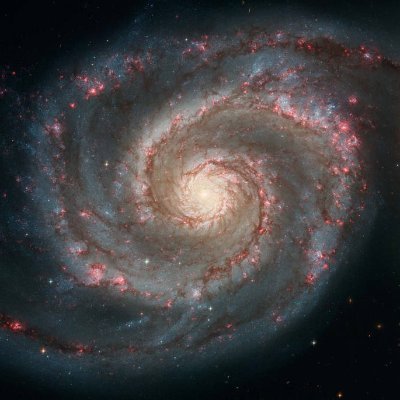
The carbon that builds the proteins, carbohydrates, fats, and nucleic acids in your body was once inside small stars! Those stars shed their outer layers at the end of their lives, forming planetary nebulae and releasing their elements to their surroundings. #MondayMotivation

ALT This infrared image shows planetary nebula Messier 27 from NASA’s retired Spitzer Space Telescope released in 2011. The nebula is shaped vaguely like a bowtie tilted just up to the right. The center of the tie is a halo of lime green light. The loops of the bow are pale orange and faint red. It sits against a black backdrop of space speckled with hundreds of blue dots in varying sizes. Six short, bluish spikes extend from the brightest stars. The image is watermarked “Credit: NASA/JPL-Caltech/Harvard-Smithsonian CfA.”
Galacton retweeted

A microgravity experiment doesn’t start on the launch pad. It starts years earlier at a lab bench, and it needs somewhere to go next.
As the International Space Station approaches its planned retirement, the question isn’t only whether the next station is ready. It’s whether the science survives the handoff.
The pipeline is already filling. Our call for proposals drew 45 proposals for every Starlab-funded flight opportunity, from 104 organizations in 42 countries.
Read the latest Starlab blog on what it takes to keep that research moving: starlab-space.com/insights/f…

Galacton retweeted
Today, Starlab and @ParagonSDC announced they will collaborate on environmental control and life support systems (ECLSS) for Starlab's commercial space station. ECLSS manages a crew’s air, water, temperature, humidity and waste on orbit.
Paragon has had hardware on every U.S. human spaceflight program of record since 1999. The two companies intend to work together from design reviews and engineering analysis through manufacturing, integration and test, and into on-orbit activation and support.
Paragon also backed Starlab’s response to the Texas Space Commission for a shared ECLSS test facility in Texas, open to the wider industry.


Galacton retweeted
Yeah, Extra ordinary claims require extra ordinary evidence. To state Earth is so special that it is the only planet in the universe with life, is an extra ordinary claim. In fact with the size of the universe, it could never even be proven. Only other life can be proven.
Galacton retweeted
Earth has deep subsurface microbial like kms below the surface. The OoL may have occurred in subsurface hydrothermal vents. No need for atmosphere or oxygen.
"The period when Ceres would most likely have been habitable was between up to 2 billion years."
jpl.nasa.gov/news/nasa-ceres…
Galacton retweeted
If life on Mars. Is it from panspermia or did OoL occur twice in one stellar system?
A new NASA analysis concludes that it is "reasonable to hypothesize" that living things could have formed these odd organics Mars.
nitter.gq/Galacton2/status/20961…

Add this to the "The Carbon-12 Isotope Enrichment Anomaly", "High Concentrations of Thiophenes", the active source & sink of methane and Leopard Spots on Mars.
Giant string of organic molecules on Mars may be one of the best signs of life yet
livescience.com/space/mars/g…

Galacton retweeted
Intersting
nitter.gq/Galacton2/status/20962…
Arthropods on Mars?
Fossil Evidence of Life - assemblage of fossil like specimens have been identified not just in Gale Crater but other areas of Mars
scholarsresearchlibrary.com/…


Galacton retweeted
This paper posits that the structures to help in the formation of cells were also delivered.
Protocell formation on micrometeorites July 2026 "We report on the formation of membranous protocells by self-assembly of lipids on micrometeorites, ..."
nature.com/articles/s41598-0…

2
22


Galacton retweeted
"Yes, the internal environment of an active planetesimal provides several distinct chemical and physical advantages for creating highly complex organic molecules compared to the surface or oceans of the early Earth."
#Astrobiology #OoL #Panspermia


Galacton retweeted
Thanks! 🙂
nitter.gq/Galacton2/status/21014…


Galacton retweeted
Yes, and some microbes can survive desiccated and dormant in the vacuum of space. No telling how long if shielded from radiation. When did they evolve that capability? 🤔
Survival of microorganisms during two-year exposure in outer space near the ISS
nature.com/articles/s41598-0…


Galacton retweeted
Levitated Dipole Fusion Reactors Operating in Microgravity
nitter.gq/Galacton2/status/21066…

Galacton retweeted

I for one think life is exceptionally common if the base ingredients are there, if theres water, some base molecules to build from, and a good chunk of time, then life will emerge. I base this purely on how hardy life on earth is, where there is a place on earth, life is there.
Galacton retweeted
Hot take: Panspermia is a terrible theory for the origin of life on earth its literally just taking the problem of "how does life start from not life" and pushing it somewhere else
Galacton retweeted
Heck maybe Mars had or has Life.
nitter.gq/Galacton2/status/21163…


