
Maths teacher, mentor teacher, ed consultant fascinated with discovery learning and inquiry, problem solving, assessment, visualization & making a difference.
Richmond, BC
Joined July 2009
- Tweets11.7K
- Following957
- Followers1.5K
- Likes7.8K
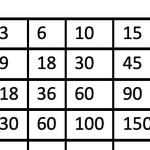


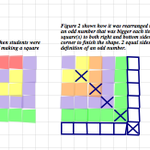

Correction to this excellent post: Every positive odd number can be written as the sum of two consecutive natural numbers, not the sum of the squares.
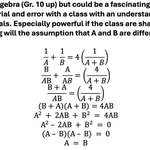
A lovely inquiry that seems to generate its own furthering questions in response to the "Wait! What? Really?" Extensions: can it work with three different factors? (1/n = 1/a + 1/b + 1/c ) Does the n have to be a good composite number?
If 50^2 is 2500 then 51^2 is two 50's and 1 in the corner bigger or 2601, then 52^2 is 103 bigger etc.
24524–12875 --> 24649 – 13000 = 11,649
Solved by pushing each up 125 as a constant shift has an identical difference.

I remember slapping my head problem solving the 50 gold coin problem from @pgliljedahl and saying, "Of course binary is a complete number system and can represent any number! How could I have missed this connection?"
And once a class makes this discovery, how many verifications will they need to do to believe their hypothesis?

Yes, one of our Apprenticeship & Workplace texts uses it as a counter-example to disprove something. My students just started at the right and carried over the 10's to continue the powers of 11.
1, 5, 10, 10, 5, 1 --> 161051
and so the pattern continues
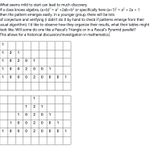
I have a favourite class discovery of it being 11^3 as all the rows of Pascal's are powers of 11 so 1, 3, 3, 1 is the fourth row of the triangle or pyramid.
1, 3, 3, 1, 3, 3, 1, ... in a +2, +0, -2 repeating cycle
1, 3, 3, 1, -3, -9, -17,... in a +2, 0, -2, -4, -6 ...pattern
Between the fourth and fifth lines, you're dividing both sides by (x – y) but since x = y, you're dividing by zero which isn't defined. I love using this to challenge students to find the flaw in the reasoning (if they've dealt with non-permissible values).
Loved the tree diagram explanation. I'd be converting 4^3 to 2^6 and 25^3 to 5^6 and then (6+1)(6+1) = 49. With younger students, we'd arrive at this number theory big idea by a patterned approach which is in the curriculum.
#MathStratChat 50% of 12 is 6
12% of 48 is the same as 48% of 12 which is less than 50% so less than 6. 50% of 6 is larger without calculating the actual size of 12% of 48.
(0, 0) for a trivial answer and (3/5, 3/10) for a more interesting solution. Easy with algebra but tough to uncover if they are using tables with calculators or spreadsheets. I'm curious what variations Ss would create. I love asking them to 'make their own'.
Missed the overlapping ones like even multiples of 3 and 5 and then 3x5 is an overlap. I like the wording of this for an inquiry. It would be a good "Thinking Classroom" vertical surface problem.
That 12385 is one less than a multiple of 11 is one conclusion (without resorting to Modular mathematics).
The alternating pos/neg test for divisibility by 11 is based on how the place values of the powers of 10 are consecutively 1 more or 1 less than a multiple of 11.
Probing questions: What do you notice about the second numbers? Do they have anything in common?
How does 9 relate to this pattern? Does the pattern work for others like 9+4, 9+16, etc? When doesn't it work?
Attached is my first thought for younger students (middle schoolers who know what a power of 2 is)...
