

Open-source AI orchestration framework by @deepset_ai. Build context-engineered agents & RAG systems in Python. Discord for support → https://xitter.cf/t.co/19wuHcilYP
Joined August 2023
- Tweets750
- Following55
- Followers2.2K
- Likes688






Haystack retweeted

🗽In NYC tonight? @DylanCouzon & @qdrant_engine are hosting a debate night, and @deepset_ai is teaming up
Hear some hot AI takes, get a chance to win prizes, and learn about @Haystack_AI and @qdrant_engine along the way!
luma.com/nyc-meetup-qdrant-0…

Haystack retweeted

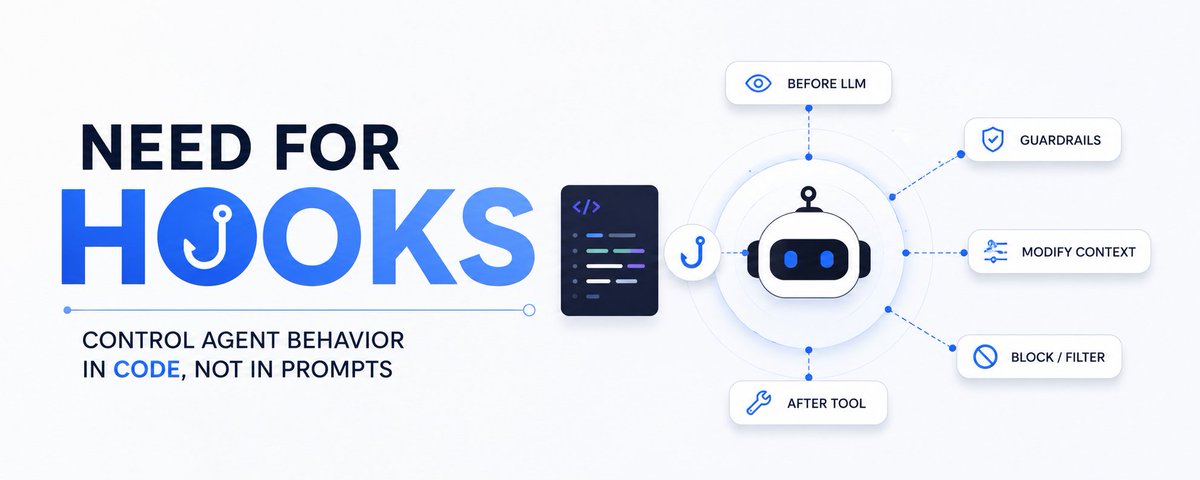
Need for Hooks in AI Agents.
> Controlling Agent behavior in code rather than the system prompt
Haystack retweeted

I have been exploring the latest release of the @Haystack_AI v3: github.com/deepset-ai/haysta…, experimenting with it, and trying to create use cases around it.
✨ Primary features include:
- Prebuilt agents
- Hooks-driven execution
- Agentic Skills
- Cost Monitoring

Haystack retweeted

Built a web research agent in 5 lines of Python.
Haystack 3.0 just shipped with agents as first-class citizens.
Agent Hooks & Skills give you granular control over tool execution:
- Pre-built Deep Research and Advanced RAG agents work out of the box
- Unified async pipelines with built-in introspection
Here's the complete build 🧵👇


Haystack retweeted
↔️ MCP works in both directions with @Haystack_AI
Your Haystack agent can consume tools from external MCP servers. And your Haystack pipelines/agents can be exposed as MCP tools for any MCP-compatible assistant.
I wrote a guide covering three approaches:
🔹 Haystack as an MCP client — use MCPTool, MCPToolset, or SearchableToolset to give your agent access to external tools
🔹 Haystack as an MCP server with Hayhooks — self-host your pipelines and agents and expose them to Claude, ChatGPT, Cursor, or any MCP-compatible client
🔹 Haystack as a managed MCP server on Haystack Enterprise Platform — production-grade MCP support with access control and observability built in. This is also how we built the Haystack Docs MCP Server at @deepset_ai
Read the full article here 👇
haystack.deepset.ai/blog/mcp…
Haystack retweeted
Can't wait to be back in Bologna for @pyconit this week!
I'm talking about why agents fail and how to fix them, with a live demo of our itinerary agent built using context-engineering patterns and @Haystack_AI!
See you all there 🙌

Haystack retweeted
🥳 My talk from @aiDotEngineer Europe is live on YT!!
this was my first ever talk on sovereignty so I'm quite excited to share 💗
I broke down AI sovereignty into 4 pillars to make it clearer and I shared a sovereign @Haystack_AI architecture + a checklist for AI systems

Haystack retweeted
FalkorDB is now available as a Document Store in Haystack. Use FalkorDBDocumentStore to store documents and vectors in a graph format, pair it with FalkorDBEmbeddingRetriever to retrieve documents by semantic similarity, and use FalkorDBCypherRetriever for graph-based queries.
This makes it easy to build retrieval pipelines that leverage both vector search and graph relationships. @falkordb is built as an extension of Redis, making it lightweight and efficient for applications that need real-time graph and vector capabilities.
🐍 pip install falkordb-haystack 🔗 haystack.deepset.ai/integrat…

Haystack retweeted

vLLM x Haystack 🤝
@vllm_project is the standard for serving LLMs on GPU
now @Haystack_AI ships a native integration
⚡ serve models fast: generative LLMs, embeddings and rerankers
🏗️ build AI apps and agents on top
🐍 pip install vllm-haystack
notebook + resources below 👇

ALT Haystack weather agent based on a Small Language Model served via vLLM
Haystack retweeted
WHAT AN EVENT!! 🎉
Last week we hosted an unconference as @deepset_ai with @NVIDIA at @balderton office in London.
🎙️ We kicked off with two short talks. @LukawskiKacper demoed a multi-agentic post-event report creator built with @Haystack_AI and Nemotron 3 Super, @KarinSevegnani walked us through Nemotron 3's performance and benchmarks.
💬 Then we split into three discussion groups and I led a session on memory and long running agents. One of the most interesting conversations I've had in a while. We started with memory and second brain concepts. People shared how they're building personal agents by transcribing YouTube videos and creating knowledge bases following @karpathy's wiki idea. We talked RAG vs filesystems, MCPs vs skills, AI sovereignty and security. At the end of the day, you don't want to lock your whole identity to an API, privacy and freedom of choice matter.
Thank you to every attendee for your energy, openness, and contributions. I'm already looking forward to coming back to London 💙
See you at Unconference #4 👀
Haystack retweeted
local Gemma 4 agent: drop in a map, get the location, live weather, and top spots to visit
put together a notebook with @googlegemma + @Haystack_AI covering the above and
1. GitHub Agent: discovers the right tools from MCP on the fly, keeping context lean (h/t @vladblagoje)
...

Haystack retweeted
How to build an Agentic RAG Application in simple steps?
In this thread, I’ll show you how to build an Agentic RAG with automatic web search fallback using @Haystack_AI
A step-by-step guide 👇🧵

Haystack retweeted
Hi, this is the POC on what a @Haystack_AI CLI would look like. Currently, we don't have one, but it would be a good starting point to see where we can take this idea/project further:
Repo: github.com/srini047/haystack…
Demo: youtu.be/-jLEQSeVL7o?si=7Owc…
Looking for reviews/suggestions.

Haystack retweeted
Looking forward to @aiDotEngineer next week! 🇪🇺
AI Engineer Paris was one of the best conferences I attended last year, and I'm so excited to be speaking at AI Engineer Europe this year alongside so many brilliant minds.
I'll be talking about something that doesn't get enough attention in engineering conversations: sovereignty constraints for technical folks.
I'll share real engineering trade-offs and what building under these constraints actually looks like in practice, drawing from my work at @deepset_ai.
Hope to see you there, come say hi if you're around! 👋

Haystack retweeted
Just published a notebook on @GeminiApp Cookbook
w/ @bilgeycl
📓 Cross-modal Retrieval with Gemini Embedding 2 and @Haystack_AI: github.com/google-gemini/coo…
🔎 Several examples of search:
text→text
text→any (PDF included)
image→text search
Thx @patloeber!
@googleaidevs

ALT Cross-modal Retrieval with Gemini Embedding 2 and Haystack - notebook
Haystack retweeted
📚 It had been a while since we published a technical blog post, and Gemini Embedding 2 from @GoogleDeepMind team felt like a good reason to write one together with @theanakin87 💙
It's Google's first fully multimodal embedding model, meaning you can embed text, images, audio, video, and PDFs into a single shared vector space.
What’s exciting about multimodal embedding models is that they enable cross-modal retrieval. For example, you can search a product catalog with a text query like “grey running shoes with white soles” 👟, or upload a photo of a monument to retrieve relevant articles describing it 🗽
In the post, we show how to use Gemini Embedding 2 with @Haystack_AI for both text and multimodal data, supported from day 0 🎉
Blog: haystack.deepset.ai/blog/mul…

Haystack retweeted

Start building with Gemini Embedding 2, our most capable and first fully multimodal embedding model built on the Gemini architecture. Now available in preview via the Gemini API and in Vertex AI.
Haystack retweeted

Didn't have to go far to find a great solution - @thomas_v_dongen's pyversity covers an impressive range of algorithms out of the box. Huge props for building something that thorough! Now fully integrated with @Haystack_AI
haystack.deepset.ai/integrat…

Haystack retweeted
“Open source” doesn’t mean much if you can’t actually understand or extend the code.
That’s one of the questions I’d ask before choosing any orchestration framework…and it’s not the only one.
Here are some of the things I’d consider TODAY:
- Is it *truly* open source? Not just public code, but understandable and extensible?
- Is the documentation actively maintained and reliable?
- Do the core concepts feel intuitive, or do you have to fight the abstractions?
- Is there a clear path from “this works” to production and scaling?
Those things don’t matter much when you’re experimenting, but they matter a lot once the system starts to grow.
To make the evaluation easier, we wrote a guide that maps the LangChain/LangGraph ecosystem to the @Haystack_AI ecosystem. It’s a concept-by-concept breakdown, plus why Haystack might be the right fit for you.
If you’re choosing an orchestration framework (or thinking about switching), this might save you a few days 👇
🔗 docs.haystack.deepset.ai/doc…
I’d love to hear how you think about choosing a framework and what matters most for you 🙌
P.S. The guide is open for contributions. If something is missing or you’d add a different perspective, you’re welcome to help us improve it.
