
Recent works: https://xitter.cf/t.co/82LW1wR1IL and https://xitter.cf/t.co/TGo7KGwknj Assistant Professor in quantum learning theory. He/Him
Coventry, UK
Joined November 2017
- Tweets696
- Following398
- Followers1.2K
- Likes7.2K






New paper out today! In arxiv.org/abs/2610.06737 , we add a new chapter to the recent literature on purifications of quantum states: What if you're not after a symmetric purification, but rather about mapping your mixed states to anti-symmetric pure states in a canonical way?

A big thank you to my amazing collaborators Adam Bene Watts, @JohnBostanci , @danielgrier_ , Sihan Liu, and @gauravmahajn ! This paper was long in the making, and took a winding road to get here, but I'm happy with the journey and the rep theory we learned along the way. ;)
If you find this interesting, please also take a look at the closely related work arxiv.org/abs/2610.02103 by Shrigyan Brahmachari, David Jakab, @HenryDPfister, and Iman Marvian that appeared on the arXiv a few days ago!

In our new work arxiv.org/abs/2610.04996 , we investigate the power of reverse-time evolution queries in quantum algorithms, with a focus on Hamiltonian property testing.

A huge thank you to my amazing collaborators Richard Allen, @Yanlin_Chen_ , @TomGur , and Angus Lowe!
Finally, if this sounds interesting to you, please also take a look at the independent and concurrent work arxiv.org/abs/2610.03205 by Francisco Escudero Gutiérrez, @Junseo_Lee_ , and Sebastian Zur, who approach some of the same questions using adversary methods.
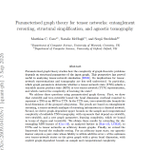
We have a new paper out today: scirate.com/arxiv/2609.04165 . Another title for the paper would be "how I learned to stop worrying and use graph parameters". ;)

And then we use the same angle for tomography of tensor network states, giving realisable and agnostic tomography algorithms, first for tree tensor networks, and then for general-graph tensor networks, with sample and runtime bounds in terms of suitable graph parameters.
Huge thanks to my collaborators Natalie and Sergii (@quantSS) for introducing me to the wide world of graph parameters! And extra congratulations to Natalie on the first paper of her PhD! 🎉
Are you a PhD student or postdoc doing outstanding work in the foundations of AI & machine learning, classical or quantum? Then apply to our Rising Stars Workshop organised by @WarwickDCS and the @UniofOxford @ELLISforEurope unit! See warwick.ac.uk/fac/sci/dcs/ev… for more information.

Today, my very first paper with my PhD student @QuantNik and our collaborator @gauravmahajn is out on the arXiv: arxiv.org/abs/2604.15269
If you are at QCTiP hosted at @UniofOxford next week, do attend Nikhil's talk about ""Cloning is as Hard as Learning for Stabilizer States""!


Can quantum cloning be easier than learning for structured classes of states❓
We ask this question for stabilizer states in our recent work: arxiv.org/abs/2604.15269.
1/⚛️

It was a bit nostalgic for me to go back to my mathematical physics roots with this project. Thanks a lot to @BlakajVjosa , Anouar, @danielmalz , and Michael for this fun collaboration, and for teaching me a lot about Gibbs states!

Vjosa Blakaj, et al.: Gibbs state postulate from dynamical stability -- Redundancy o... arxiv.org/abs/2512.13451 arxiv.org/pdf/2512.13451 arxiv.org/html/2512.13451
Matthias C. Caro retweeted

🚀 Happy to share the Quantum Learning Theory Zoo!
I’ve been curating a reference page that collects key papers and resources in this fast-growing field:
🔗 harris-junseo-lee.github.io/…
Always open to suggestions and missing papers—feel free to reach out!
