

Graduate student at @WarwickDCS || Previously: Physics Masters student @IiserMohali and Research Intern at IHPC, A*STAR || Exploring the Quantum World
Joined September 2021
- Tweets159
- Following911
- Followers361
- Likes1.9K




Pinned Tweet
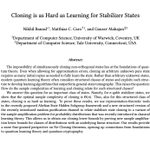
Can quantum cloning be easier than learning for structured classes of states❓
We ask this question for stabilizer states in our recent work: arxiv.org/abs/2604.15269.
1/⚛️

Nikhil Bansal retweeted

I am baffled at how many people on this site seem to enthusiastically embrace the idea of humans being replaced by AI.
I don't mean in maths, or any one job in particular, just...in general.
I like humans, and interacting with them.
I want AI to help humans, not replace them.
Nikhil Bansal retweeted
I know it's hard, but when reading try to be generous towards the author.
E.g. Fields medallists are not reactionary ego-driven luddites, but think a lot about mathematics, and are sincerely trying to do what they think is best for the subject they have devoted their lives to.
Nikhil Bansal retweeted

24 Fields Medal winners have written a letter of objection economist.com/science-and-te…

Nikhil Bansal retweeted

I resigned from Anthropic today. I spent the last three years doing pretraining research at both OpenAI and Anthropic. Neither company is acting responsibly. They are racing straight to self-improving superintelligence and gambling with our lives. More thoughts below.
Nikhil Bansal retweeted

We have a new paper out today: scirate.com/arxiv/2609.04165 . Another title for the paper would be "how I learned to stop worrying and use graph parameters". ;)

Nikhil Bansal retweeted

What are our jobs as researchers now that we have proof machines? The raw proofs that come from LLMs are difficult to understand, even if correct. So its now easy to quickly write many badly written papers that nevertheless contain correct proofs of interesting results.

[1/n] Recent OpenAI research has demonstrated the ability of LLMs to solve frontier problems in mathematics. We design a simple pipeline (using GPT 5.5 Pro and Claude Opus 4.8) that resolves 9 challenging open problems, including open problems from prominent theoretical computer science venues—4 from COLT open problem list and 1 from FOCS —as well as 4 problems from the commutative algebra.
Project link: github.com/Pengbinghui/pipel…, joint work with @runzhou_tao, Steven Wang & @HantaoYu_Theory

Nikhil Bansal retweeted

THIS IS NOT A PAPER ON ARXIV!
I want to spread more concern and awareness in our quantum information community about the current AI situation with examples, and try to stimulate important discussions that our community needs to have!
QIP will be a good time or will be too late?

Nikhil Bansal retweeted
Mathematics -is- a human endeavour.
There is something which maybe you're calling mathematics that has nothing to do with humans, some 'platonic otherworld' of abstract ideas. But what I call mathematics is the human attempt to explore and understand this world.

There are two main points in the Leiden declaration, one good, one bad imho:
> Good: science is underfunded, mathematics included. We need more researchers, not less, and with the advent of AGI we will need even more. If AGI is a magical wand, someone still needs to wield it. Researchers are the best prepared for this.
> Bad: 'mathematics is a human enterprise + it disturbs existing incentive structures'. Mathematics is a not a human endeavor per se. It is definitely so within academia, but science is free for all. If AI can make math progress faster, then it is only for good of mathematics. It definitely does disturb existing incentive structures (grants, who proves what first, peer review), but these are not optimal to begin with and it's a good time to rethink it.
Academic mathematicians in the last 50 years have started thinking that mathematics is done solely by university-affiliated academics. This was true for around the last 100 years, but wasn't true before, and it seems won't be true for long.
And this is a good change. Good for science, good for mathematics, but perhaps bad for existing academics within their status quo incentives. But they will adapt, and mathematics will only flourish more.
In the end the goal should be to expand mathematics (and generally science) as vastly as possible. Abundance of proofs, abundance of explanations, thanks to LLMs, is a great thing for progress.
Finally, I would like to thank the brilliant @IMathYou2 and @gauravmahajn for many many interesting discussions. I learnt a lot about classical and quantum learning theory throughout this project from them 😄.
⚛️/⚛️