






JoHn retweeted

Inspiration from @Cora_Mat 🙏
My new project, just started 30 mins in
1 v 1 fighting game
112,000 particles. Zero models. 100% Code
Normal speed, slow-mo, normal
Every punch and kick is GPU compute: 100k particles on springs riding a skeleton written in code, plus ribbon trails and sparkles.
#threejs #WebGPU #Code #GameDev
JoHn retweeted

My roommate and I built a wearable controller that lets you control a robot arm using your own arm movements!
The current build is three IMUs a raspberry pi, and an SO-101 robotic arm.
Still a work in progress but has been so fun.


JoHn retweeted

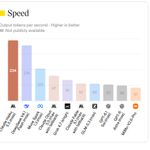
🔥 Same Qwen3.8-27B. Speeds from 16 to 1,279 tok/s.
22 hosts, same prompts. Cerebras 1,279. A rented H100 hit 241 (3rd). Slowest: 16.
Caveat: one day, one stream each. Stack still moves the needle a lot.
via Anup 👇
denv.ai

JoHn retweeted

A robot that weighs a third of a gram folds itself out of a flat plastic sheet, crawls, climbs and swims, then dissolves back into liquid.
MIT researchers built it, and the video shows the whole trip.
How it works: heat makes the flat sheet fold up into a 3D body. A tiny magnet embedded inside lets the team steer it from outside with a magnetic field, so there are no motors, wires or batteries on board.
That remote control is enough for the robot to swim, carry objects, clear obstacles and squeeze through confined spaces. When the job is done, it dissolves.
A machine that ships flat, assembles on demand and leaves no hardware behind is exactly what you want for places that are hard to reach or hard to clean up after.
Source: MIT
JoHn retweeted

199.4 vs 129.4 tok/s.
Qwen3.8-27B NVFP4, 8 users, one DGX Spark, MTP on both engines. Surogate vs vLLM: 1.54x.
Measured on real text, where 52-54% of drafts land. On repeated benchmark prose it's up to 95%.
Which text did your spec-decoding chart use?
JoHn retweeted

xiaomi's tiny OCR model claims #1. the leaderboard says #2
Xiaomi-OCR-0 is 0.8B params, open weights, apache-2.0. one model does doc parsing, OCR Q&A and pulling JSON fields out of stuff like receipts
their page says 95.24 on Real5-OmniDocBench, #1. paddlepaddle's own leaderboard for that benchmark lists it at 92.73, just behind PaddleOCR-VL-1.6 at 93.19. xiaomi reports its numbers with a two-stage pipeline, so dont read the headline as apples to apples
for builders thats not the point tho. the community bf16 build is about 1.8GB and runs locally via ollama. receipts and scans that never leave ur machine
all the numbers are self-reported. test it on ur own docs before u swap anything
JoHn retweeted

🤖 Researchers taught a robot to learn from mistakes it never actually made, by rewinding a simulated world and trying different actions.
Meet Rollback, a new robotics research project from @agibot_research, BUAA, and the National University of Singapore.
Instead of repeatedly failing in the physical world, the robot can return to earlier decisions inside a learned world model and explore alternative outcomes.
And in two real-world tasks, it eventually outperformed the average human participant.
🧠 How does Rollback work?
Traditional robotic reinforcement learning involves trial and error.
The robot performs an action, observes the outcome, and updates its behavior.
But physical experiments are expensive, slow, and sometimes destructive.
Rollback changes the process:
▪️ Record: Collect real-world robot trajectories, including successful and failed attempts.
▪️ Rewind: Restore an earlier state inside the GE-Sim 2.0 world model.
▪️ Branch: Try alternative action sequences from that same state.
▪️ Compare: Use Monte Carlo Tree Search to concentrate exploration on decisions that actually change the outcome.
▪️ Learn: Compare sibling branches and turn their results into action-level training signals.
No separately trained value model is required.
The system learns which actions are better by directly comparing alternative futures from the same starting point.
🔄 The world model improves too
There's another clever component.
As the real robot performs new tasks, its observations are fed back into the simulator.
The world model is updated through lightweight LoRA fine-tuning, making future simulated trajectories more realistic.
Better robot → Better world model → Better training → Better robot.
📊 Real-world results
The researchers tested Rollback on a dual-arm AGIBOT Genie-02 robot.
Success rates compared with the strongest baseline:
▪️ Jenga block extraction: 58.67% → 69.33%
▪️ Ball tossing: 28.89% → 40.00%
▪️ Tabletop curling: 52.59% → 64.44%
After eight hours of training, the robot also exceeded the average scores of three human participants:
▪️ Ball tossing: Robot 40.0% vs. humans 31.48%
▪️ Tabletop curling: Robot 64.44% vs. humans 58.39%
These are task-specific results reported by the researchers, not evidence of general human-level robotic ability.
🎮 The interactive demo is particularly cool
The project website lets you explore a real robot's decision tree.
You can watch the original trajectory, rewind to earlier points, and inspect simulated alternatives showing how different actions lead to wins or losses.
⚠️ Current limitations
The method still requires real robot data, including failed attempts, to initialize and improve the simulator.
It also relies on substantial distributed compute, and the Rollback implementation hasn't been publicly released yet.
💡 Why this matters
Physical robots can't rewind time.
But their world models can.
Rollback turns that capability into a new way to learn from counterfactual experience, reducing the need to physically test every alternative.
That could make robotic reinforcement learning more efficient, especially for tasks where mistakes are expensive.
🔗 Project: rollback-wm.github.io/
🔗 Paper: arxiv.org/abs/2610.36068
#Robotics #WorldModels #ReinforcementLearning #PhysicalAI

JoHn retweeted

DeepSeek-V4.1-Flash (oQ4e-ngram-mtp) - 1st Run
• Hardware: 4 x M3 Ultra 512GB (ultra4 engine)
• Benchmark: llmprobe 0.6.17 - Code
• Prefill: 2,027 tok/s
• Peak Decode: 119.5 tok/s
JoHn retweeted

ONE AI BRAIN. THREE HUMANOID BODIES. ZERO PUBLISHED SUCCESS RATES
Not because the demo looks bad.
Because the numbers that matter were never shown.
Watch the stack split:
S1 reads the camera and picks the next step
S0 holds balance and coordinates arms, legs and torso
a human steps in to correct every miss in training
Part of the footage is teleoperated. Intervention rate: not disclosed.
Lab demos sell one brain that clears the table.
The kitchen asks what happens on robot number four.
JoHn retweeted

Testing the new grasping motion with Microduck: trained in simulation using reinforcement learning, one-shot sim-to-real transfer.
JoHn retweeted

XIAOMI JUST SHOWED A ROBOT HAND THAT ROLLS A COIN ACROSS ITS FINGERS
most people can't do that trick
21 degrees of freedom. 26 motors. 1,500 touch sensors
all packed into something the size of your hand. and that's exactly why this matters more than any humanoid walking demo
walking is mostly a solved problem. legs need big motors and a good balance loop
hands are the hard part
a human hand has about 27 degrees of freedom in a space smaller than a phone
every joint needs an actuator, wiring and feedback
every gram you add slows the whole arm down
that's why so many humanoid hands are still basically grippers
rolling a coin means every finger moving in sequence with almost no margin for error
you can't fake that with a bigger model. you need better hardware
JoHn retweeted

Run Mistral Large 4 (1T parameters, 52B active) locally on just 256GB RAM, with 91.6% top-1 agreement with the original model.
Built for air-gapped European industries where data sovereignty is non-negotiable. Open to everyone. No gatekeeping.
huggingface.co/orcarouter/Mi…

JoHn retweeted

Holy crap. 802 tokens per second from ONE RTX 5090. vLLM did 346 on the same card.
That's the headline number from Surogate, an open-source C++/CUDA engine that does training AND serving in one toolkit. Apache 2.0.
The serving numbers from its README (all on RTX 5090s):
• Qwen3.5-0.8B GGUF, 1 user: 802 tok/s vs 346 for vLLM
• Same model, 8 users: 2,765 tok/s vs 683 for llama.cpp
• Qwen3.8-Flash-Next GGUF with experts parked in system RAM: 35.2 tok/s vs 20.8 for llama.cpp
• GLM-5.3-Flash across 8 cards, 16 users: 292.9 tok/s vs 41.9 for llama.cpp. That's 7x, damn.
What else is packed in:
• Native GGUF, NVFP4, FP8 and BF16
• OpenAI and Anthropic compatible APIs
• MTP speculative decoding, prefix caching, runtime LoRA swapping
• CPU offload and GPU expert caching for big MoE models
• LoRA, QLoRA, GRPO, DPO and distillation on the training side
How to try it:
curl -LsSf github.com/invergent-ai/suro… | bash
source .venv/bin/activate
surogate serve Qwen/Qwen3.5-0.8B --port 8080
Then point any OpenAI client at http://127.0.0.1:8080/v1
Honest caveat: it's not a win everywhere. The README keeps the rows where it loses, like Qwen3.8-27B single-user decode (70.1 vs 71.6 for vLLM). And it needs Linux, CUDA 13 and an RTX 40 series or newer for serving, so older cards sit this one out.
Bookmark this for later.
invergent-ai/surogate

JoHn retweeted

Nvidia just became the expensive way to run the biggest open model
Kimi K3 doesn’t fit in an Nvidia B200 server. It misses by about 24 GB. That gap now costs real money, and the October data says it's no longer the whole story
On October 31, SemiAnalysis published new InferenceX results for Kimi K3, Moonshot’s 2.8-trillion-parameter open model
The headline: AMD's MI355X serves it at up to 2.3x lower cost per token than Nvidia’s B200
at 100 tokens per second per user: $0.077 vs $0.179 per million tokens
The same day, Moonshot closed its older K2 models to new API users and pointed everyone to the K3 line. The biggest open model is becoming the default one. So the question of where it runs cheapest just became a question about money
Here's what’s behind the number, what it hides, and what it changes
The 24 GB problem
Start with simple arithmetic
Kimi K3 in 4-bit format: about 1.56 TB
8 × Nvidia B200 at 192 GB each: 1,536 GB
8 × AMD MI355X at 288 GB each: 2,304 GB
On B200, the model doesn't fit in one server. You split it across two, connected by network, and every token pays for that trip
On MI355X, it fits in one box with about 700 GB to spare for context and cache
When this first came up in August, that was the whole explanation: AMD didn't win on speed. It won because the model fit
Why 'it's just memory" no longer works
Nvidia has an answer to the memory problem: the B300, with 288 GB per GPU. The same capacity as the MI355X. Kimi K3 fits
So compare those two. Current InferenceX numbers on the agentic workload, cost per million tokens:
> At ~62 tok/s per user: B300 $0.118, MI355X $0.048
> At ~109 tok/s: B300 $0.166, MI355X $0.093
> At ~156 tok/s: B300 $0.304, MI355X $0.149
Same memory. AMD is still about 2x cheaper per token at every speed tier
Two things drive it:
1. The chip is cheaper to own. SemiAnalysis models $1.50/hour for MI355X vs $2.26 for B300
2. The software caught up. AMD tuned its AITER kernels and a MonoKernel decode path. At 50 tok/s per user, the MI355X pushes 10,918 tokens per second per GPU
By my own math from their numbers, at ~62 tok/s it’s about 8,700 tokens/s per GPU on MI355X vs about 5,300 on B300. That's a throughput gap, not just a price gap
For years the line was: AMD has the hardware, Nvidia has the software. On this model, on this workload, the second half stopped being true
What the headline doesn’t tell you
The prices are hyperscaler prices. $1.50/hour is SemiAnalysis's model of what it costs a giant cloud to own the chip. At retail ($2.90/hour on the same page), MI355X cost roughly doubles. It still beats B300 at hyperscaler pricing, but the gap you'll actually pay is smaller than the headline
It's one workload. These runs are agentic coding traces in FP4. Chat, long documents or other precisions can rank differently
The numbers move. Configs get re-tuned and re-run. Even this week the 100 tok/s figure on SemiAnalysis’s page differs from the one in early coverage
Cost isn't latency. Cheaper per token doesn't mean faster first response. Earlier tests reported slower cold prefill on AMD. If your users wait on the first token, measure that separately
One model isn't the market. Kimi K3 is huge and memory-hungry, which is exactly where AMD's 288 GB shines. Smaller models that fit anywhere won't show this gap
What it means if you build or invest
If you run open models:
Check if the model fits in one node before you check the chip. Splitting across servers can cost more than the GPU itself
Compare tokens per dollar at YOUR speed target. The winner changes with tokens/s per user
Get quotes for MI355X. Many teams still default to Nvidia out of habit, not math.
If you watch the AI hardware market:
Memory per server is becoming the spec that matters for frontier open models. Watch HBM capacity, not just FLOPS
AMD's case here is capacity plus software, not raw chip speed. That's a stronger case than "cheaper alternative', because it's harder to copy with a price cut
One benchmark isn't market share. CUDA tooling, supply and existing contracts still lock in most buyers. This is a crack, not a collapse.
Not financial advice. One workload, one model, one month of data
How to read any GPU cost benchmark (save this)
Does the model fit in one node? If not, you're benchmarking the network
Whose price per hour? Hyperscaler TCO and retail rental can differ 2x
At what speed per user? Cost per token at 30 tok/s and 150 tok/s are different stories
Which workload and precision? Agentic FP4 ≠ chat FP8
When was it run? Kernels improve monthly. Last quarter's winner may already be out of date
Cost or latency? Check time to first token separately
In August, AMD's win on Kimi K3 looked like an accident of memory: the model fit in one box and missed Nvidia's by 24 GB
In October, AMD beats Nvidia's own 288 GB chip too, on cost and on throughput per GPU
For the biggest open models, the cheapest server is no longer automatically Nvidia. Most teams haven't run that math yet
Which do you watch first when picking GPUs: price per hour, or tokens per dollar?
JoHn retweeted

fable 5.5: detailed minecraft one-shot
don’t think any other model could one-shot minecraft with this much detail in an hour or two
play here: model-tests.vercel.app/


JoHn retweeted

GOOGLE 🔥: An upcoming AI agent for Antigravity will get Gemini Live support!
"Chief of Stuff" (the current name of the Antigravity agent) will be able to operate Antigravity on its own, spawn other agents to execute subtasks, and more.
> Review pending conversations - Check pending conversations in the last 3 days that require action from me.
> Address CLs needing attention - Check CLs that require my attention and fix them in their respective conversations.
> Generate personalized rules - Learn from my conversation history to write a personalized set of rules for future agentic interactions.
> Discover helpful skills & plugins - Use my conversation history to tell me which skills and plugins would be helpful for me.
* Not available to the public yet.
h/t @lberondroth
JoHn retweeted

Hex
anoma.ly/hex
Local Voice Dictation for Desktop Apps
Hex is an open source Rust dictation app for macOS, Windows, and Linux. Hold a shortcut, speak, and release to paste locally transcribed text.
Apple silicon Macs use Metal, Windows x64 uses Vulkan, Windows ARM64 runs on CPU, and Linux offers Vulkan or CPU inference.
With Vulkan on Windows x64, Parakeet Unified English streams on the GPU while you speak. Text arrives about 100ms after release.
Hex 3.0 reduced local model memory use from about 900MB to 160MB. Optional OpenCode rewriting runs before pasting.
github.com/anomalyco/hex
