
PhD student @HumboldtUni and @MindaBrain | studying active perception and cognition in the @rolfslab | 1st Gen | he/him
Joined November 2014
- Tweets49
- Following201
- Followers71
- Likes327


If you're at @VSSMtg and curious abt the follow-up to our recently published paper (👇), come find me at my poster "Feeling of agency in visual actions? No evidence for effect binding in microsaccades" tomorrow!
📍 Poster 53.405, Pavilion
🗓️ May 20, 2025 | 8:30 am – 12:30 pm

1/n Very happy to share that our new paper was just published in @CognitionJourn:
“Sensorimotor awareness requires intention: Evidence from minuscule eye movements.”
Dive into the details here 👉 sciencedirect.com/science/ar…
199
9/n Bottom line: Intention acts as a gate to sensorimotor awareness. Even at the scale of microsaccades, simply intending to move (or to hold still) boosts our ability to notice the action—while visual consequences alone don’t help.
43
8/n Awareness of the eye movement itself, however, was low for spontaneous microsaccades but higher when a movement was intended or occurred despite attempts to fixate.

1
161
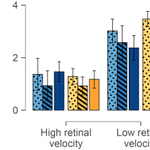
7/n We found that visual sensitivity was high whenever a microsaccade (real or replayed) slowed the stimulus on the retina—regardless of whether the action was intended, unintended, or spontaneous.

1
41
6/n After each trial, participants reported whether they saw the stimulus, whether they thought they made a microsaccade, and how confident they were that their eye movement caused what they saw.
1
13
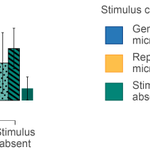
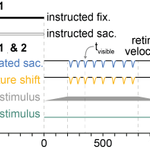
5/n To tease apart motor commands from visual feedback, we used a rapidly phase-shifting stimulus that’s invisible during steady gaze but pops into view when retinal motion slows—either due to a real microsaccade or a replay of its retinal trace. No-stim trials acted as controls.

1
56
4/n Our approach involved directly comparing three types of microsaccades:
• Intended (consciously planned)
• Unintended (executed despite intention to fixate)
• Spontaneous (uncontrolled or automatic)

1
35
3/n We developed a novel paradigm that allowed us to dissociate the role of action intention and sensory consequences for awareness.
1
70
2/n @svenohl, @MartinRolfs, and I investigated how intention modulates awareness of one of the smallest human actions: microsaccades—tiny eye movements typically generated spontaneously during fixation.
1
1
101
1/n Very happy to share that our new paper was just published in @CognitionJourn:
“Sensorimotor awareness requires intention: Evidence from minuscule eye movements.”
Dive into the details here 👉 sciencedirect.com/science/ar…
I won a prize for my poster at this year's ECVP! :) If you want to check it out, you can find it on my ResearchGate profile: researchgate.net/publication…


If you are interested in microsaccades and eye movement awareness, come see me at my poster @VSSMtg today :D

@JanKlanke will present his poster on “Different levels of awareness for spontaneous, involuntary, and voluntary microsaccades” (#63.426) at Pavilion on Wednesday, May 24, from 8:30 am to 12:30 pm.
5
385


Jan Klanke retweeted

Who's at the #DGPs2022 this week? 👀Today at 14:00, @JanKlanke will give a talk on "Effect binding for undetected spontaneous micromovements" in the "Action and time perception" session. Looking forward to meeting you at the talk! #dgpskongress
Jan Klanke retweeted
@JanKlanke will give a talk on limited awareness for involuntary microsaccades in Eye Movements: Models, localization, pursuit session, between 10:45 am-12:30 pm in Talk Room 2.
Jan Klanke retweeted
We would like to offer a couple of paid internships to refugees from Ukraine. Students enrolled in a Ukrainian university who would like to help us with data collection/with an interest in vision science, reach us here: rolfslab.org/2022/03/11/ukr-… #AcademicTwitter #ScienceForUkraine


