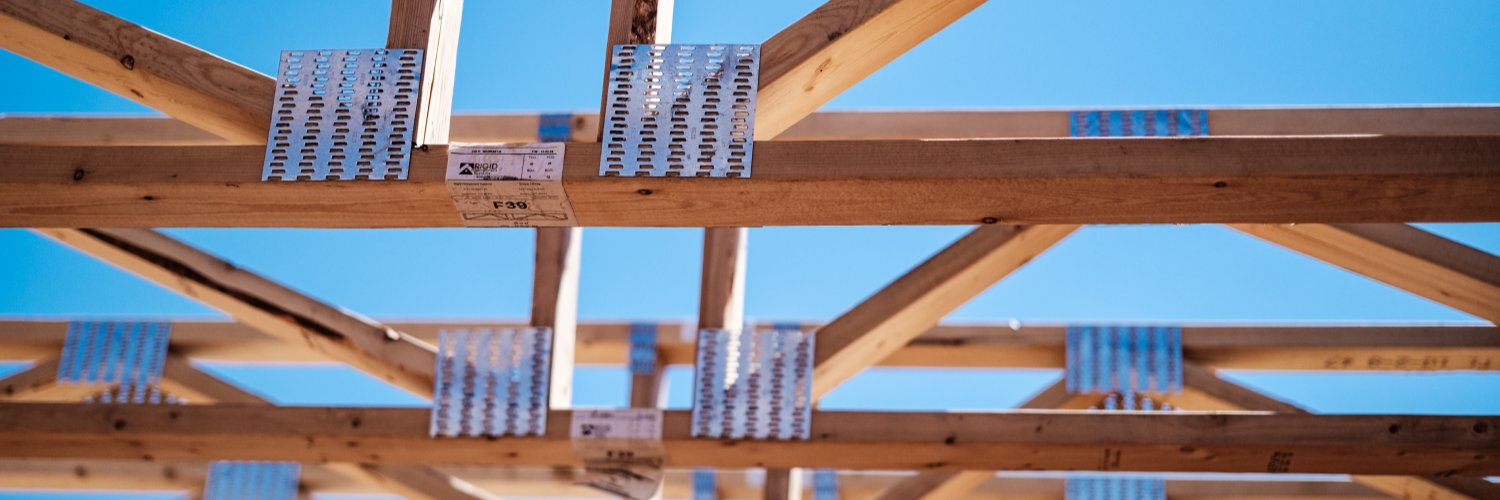

MBA → consulting → prefab framing @ SimpleHomes→ manufacturing roof trusses. The obvious career path. Currently focused on building https://nitter.gq/t.co/fYAz9R98kC
Denver, CO
Joined November 2011
- Tweets275
- Following314
- Followers1.9K
- Likes402









Pinned Tweet
Hi I'm Jeff 👋.
In 2019 I left McKinsey convinced I had a pretty good idea how to build a modern construction & manufacturing company.
Since then, I founded Simple Homes, grew it real quick, acquired a 50-year-old truss manufacturer, and accumulated a fairly extensive (and frequently expensive) collection of business lessons along the way.
Six years later, I'm much less certain about a lot of things - and probably (hopefully?) a better operator because of it.
The ride has been nothing like I would have expected. Looking forward to share more

ALT Wall panels being delivered in Denver Colorado
I just found out that my friend @josephlogan died. He texted me that morning to punt on our planned meeting. I reached out a few times afterwards, but never heard back (which was strange). And I knew he was going through a tough time.
Joseph was deeply connected to the CO startup community. He had a huge impact on my life, and many others. He helped me through some the most difficult parts of my journey and some of my darkest days.
Thank you, Joseph, for everything. You will be missed.

Our framing solver keeps getting better at a pretty insane pace.
A few weeks ago we moved all of our internal single-family estimating onto it.
Now it’s handling jobs like this: ~70,000 SF, five stories of Type III multifamily. And we're now wanting to get feedback from folks outside our company.
Over the next few weeks, we’re going to run a handful of external projects.
Scope: structural wood framing
Send us your plans, specs and whatever estimating instructions matter to you (item master, naming conventions, waste factors, etc.).
We’ll send back:
- Full Excel takeoff, including assumptions and drawing references
- Browser-based 3D model like the one shown here
- IFC export you can bring into your own BIM/CAD tools
Like the results? Pay us whatever you think they were worth. Or nothing.
Don’t? Pay nothing.
Link below if you want to give us a set of plans to try.
@framerchris @TheFortressInc @GrulkeLamonte @LumberTrading @dig_deeper1 would love to see what ya got!
Send us your plans here.
A bit of background on this; The foundation came out of some R&D we did under a U.S. DOE grant a few years ago, but what it can do today is well past where that work left off. Excited to see where it goes from here!
framecast.rooftruss.com/


There aren’t too many days where I’m 100% happy to live in the age of social media.
But today is firmly one of those days. Incredible work by all

Jeff Hopfenbeck retweeted

I live in Texas and 4 unarmed community crisis alternative responders just pulled me out of my F350 and beat me up for listening to a Morgan Wallen song
Jeff Hopfenbeck retweeted

RIP MAGA. You were retarded and bad and made us all stupider and poorer and wasted a decade+ of our lives, but at least you pardoned a bunch of criminals.
Jeff Hopfenbeck retweeted

For anyone outside of our industry, here's a quick primer explaining why real estate development is so expensive & why some developers make $0 on projects.
First, there are many different types of costs that go into development-- each category has its own set of complexities and nuances.
Coordinating all of these cost buckets is complex and, on its own, is costly. Thes are the main development cost categories, and below is a breakdown of each.
Cost of land acquisition
Cost of capital
Jurisdictional requirements and fees
Soft costs (pre-construction)
Hard costs (construction)
COST OF LAND: Development starts with land acquisition, which is often the biggest cost. In desirable areas, land values reflect not just current use but "highest and best use" potential, meaning developers pay premiums based on what MIGHT be buildable there.
Misunderstanding what might be the highest and best use, or miscalculating the price of what that is, is the biggest mistake a developer can make.
COST OF CAPITAL: Development requires enormous capital over long periods. Investors and lenders demand returns commensurate with risk. Every month added to the timeline directly increases these carrying costs.
Most projects are leveraged 60-75% with debt, creating a time pressure to execute before interest costs erode profits. This is why successful projects that take twice as long often make zero profit despite selling for target prices.
JURISDICTIONAL REQUIREMENTS: Every jurisdiction adds layers of costs: impact fees, permit fees, required infrastructure improvements, affordable housing mandates, and design requirements that may not align with market demands.
The opacity and unpredictability of the approval process create both direct costs (consultants, legal fees, design revisions) and indirect costs (extended timelines, increased capital expenses).
SOFT & HARD COSTS: Soft costs include all pre-construction expenses: architecture, engineering, legal, accounting, market studies, environmental assessments, financing fees, and many other consultants.
Hard costs are the actual construction, which requires coordinating dozens of specialized trades, each with their own supply chains, labor pools, and scheduling constraints. The complexity of coordinating these parties is extraordinary. Each has different priorities, timelines, and contractual obligations.
Communication failures between any links in this chain cause costly rework, and extend timelines. Even when communication is good, coordinating that many parties simply takes time.
THE REALITY: In development you can do everything right and still lose money due to factors beyond your control: market shifts, interest rate changes, unexpected site conditions, material price fluctuations, or unexpected jurisdictional changes.
And that's without considering any slips in execution over the life of the project-- from design to sale/lease-up.
Contrary to popular belief, many developers can make very little on projects. The big players with in-house teams and economies of scale have advantages that smaller developers can't match. So, when you hear about a "$300mm project," that doesn't mean the developer is making $300mm.
That's the total cost of land, construction, fees, financing, and everything else.
The developer's profit margin is typically a small sliver of that total, IF everything goes perfectly.
Remember: most developers are simply small business owners juggling massive risk.
Jeff Hopfenbeck retweeted

This post is making waves and everything that he said lines up with what I'm seeing and hearing from friends in the industry. I'm going to go over some salient points but mostly focus on the biggest issues facing multifamily: deferred maintenance and building science.

Dinner with an exec/friend at a large national property management company tonight. This person oversees ~150k apartments; access to an insane amount of data.
Current multifamily market in most of the country is worse than S&L, .com bust, or the GFC. Worst they’ve seen.
Class A mostly fine, decent rent growth. However:
- credit scores at class A have gone down meaningfully over the past 3 years.
- more people are paying rent via credit card.
- average bank account balance noticeably lower than even 2 years ago
- class A tenants stretched thin, living beyond their means. 20k comes in, 20k goes out every month.
- starting to see these renters move down a tier
Class B:
- simply too many apartments, we built too much new stuff. Ripple effect is enormous.
- fewer renters tomorrow than today. Same store foot traffic noticeably down year over year. Some markets down 40-50%
- considering dropping rents below $700 a month on some 1beds in major southern markets.
Class C:
- looking at degrading NOI. Rents aren’t growing for a long time, but expenses keep creeping up
- more renters are one missed paycheck away from disaster than they can remember seeing in decades
- tenants aren’t paying rent because they simply don’t have it
- wage growth has not kept up
Lenders:
- some major investment funds, household names, haven’t paid their mortgages in 2-3 years. Banks won’t foreclose because “X is a big client.” Mexican standoff.
- a roof leak gets ignored, becomes water damage, then mold, then a down building. Buildings are rapidly deteriorating as some owners choose cash preservation over funding losses.
- number of pre-foreclosure and REO deals is the highest as a % of total units they can recall.
- data providers know it’s bad, but they’re paid to sell optimism to owners/lenders. So every forecast is “it will probably get a little better next year maybe” and that gets regurgitated at investment committees all over.
I asked “how do you think this ends?”
“Not sure. My gut says slowly then suddenly, and things will get really bad. Been doing this 40 years, you can feel it in the air. But, there’s a chance it’s just a decade of tolerable pain. I’m praying for that.”
just left a dinner with a number of large multifamily devs/operators. Less data but same story
Dinner with an exec/friend at a large national property management company tonight. This person oversees ~150k apartments; access to an insane amount of data.
Current multifamily market in most of the country is worse than S&L, .com bust, or the GFC. Worst they’ve seen.
Class A mostly fine, decent rent growth. However:
- credit scores at class A have gone down meaningfully over the past 3 years.
- more people are paying rent via credit card.
- average bank account balance noticeably lower than even 2 years ago
- class A tenants stretched thin, living beyond their means. 20k comes in, 20k goes out every month.
- starting to see these renters move down a tier
Class B:
- simply too many apartments, we built too much new stuff. Ripple effect is enormous.
- fewer renters tomorrow than today. Same store foot traffic noticeably down year over year. Some markets down 40-50%
- considering dropping rents below $700 a month on some 1beds in major southern markets.
Class C:
- looking at degrading NOI. Rents aren’t growing for a long time, but expenses keep creeping up
- more renters are one missed paycheck away from disaster than they can remember seeing in decades
- tenants aren’t paying rent because they simply don’t have it
- wage growth has not kept up
Lenders:
- some major investment funds, household names, haven’t paid their mortgages in 2-3 years. Banks won’t foreclose because “X is a big client.” Mexican standoff.
- a roof leak gets ignored, becomes water damage, then mold, then a down building. Buildings are rapidly deteriorating as some owners choose cash preservation over funding losses.
- number of pre-foreclosure and REO deals is the highest as a % of total units they can recall.
- data providers know it’s bad, but they’re paid to sell optimism to owners/lenders. So every forecast is “it will probably get a little better next year maybe” and that gets regurgitated at investment committees all over.
I asked “how do you think this ends?”
“Not sure. My gut says slowly then suddenly, and things will get really bad. Been doing this 40 years, you can feel it in the air. But, there’s a chance it’s just a decade of tolerable pain. I’m praying for that.”
Jeff Hopfenbeck retweeted

“After everything I’ve seen throughout my career, I can confidently say this: scaling too fast can be just as dangerous as not scaling at all. It's important to grow smart and strategically.”
- Kyle, 23, Junior Analyst at McKinsey
Jeff Hopfenbeck retweeted

Today a group of us launched Founded Colorado - a policy and advocacy group for companies based in Colorado. It grew out of the two-year fight to fix SB 24-205, Colorado's first AI law.
feld.com/archives/2026/10/fo…

I listened to this interview yesterday and it is absolutely worth the hour.
The passion he has for the topic is clear. And is something I feel like we are seeing generally - the people who know most about this technology are generally the most fearful.
I have no idea what the answer is here. The impact this technology is having in our business is mind boggling. It is fundamentally changing our trajectory.
But at the same time: the more we use it, the more I see its power, the more fearful I get about the future. What the hell does this mean for our country's future? My kids future? And I'm about 1000 steps behind the folks at the labs who actually know the technology and are seeing the true frontier.

Bill Gates says relying on lawsuits for AI safety is absurd when an open model could help kill 100 million people
“I almost can’t believe you’re asking that. This is the most dangerous thing that humans have ever gone near."
"In other areas, do we just say, ‘Hey, release your drugs. There’s no FDA. There’s no airline safety board. There’s no requirements that cars use seat belts. Do we just use the liability laws to try and keep humans safe? You know, oh, you’re shipping opioids. Somebody should just sue you.’"
"I mean, we’ve created a society that tries to keep people safe, not by saying, ‘Oh, we can bankrupt the person who does that.’ The harms here, and you say there’s filtering. There’s not filtering."
"You can take an open-source model that can create bioweapons and disable any monitoring of any kind. And this exists today."
"So, no, there is no filtering of any kind. And so, say you kill 100 million, you want to use a lawsuit? I almost can’t keep a straight face.”
I’m getting fed a constant stream of these ads.
Can someone explain: how do the economics of these companies work? I don’t understand how the math maths
Not going to do it but there is an intriguing aspect - we have 5 TB of plans from the years. On the other hand it makes me wonder how we could train our own tools on this dataset.


Some folks getting smoked on ZIRP-era Airbnb’s in Colorado.
I’ve been watching this listing…because it’s such a unique property (40 acres…incredible views!)
Bought October 2022: $1.23M
Listed April 2026. Multiple price drops.
Now under contract after the price dropped to $995k. Ouch.
Neat property…though I wouldn’t want to be the one maintaining that driveway


Software founder:
“We spent 3 years and tens of thousands of engineering hours building this framing solver.”
Astra:
“lol”
ChatGPT Astra is blowing my mind.
I gave it a residential plan set, pointed it at some framing logic we’d built for a completely different application, and asked it to build the house in SketchUp through the Ruby console.
I spent less than 10 minutes on it.
First pass was probably 90–95% right.
Stud spacing was right. Window ROs were right. Kings/trimmers/headers were right. Floor framing was there. Most of the roof framing was there. It even broke the walls into individual panels and tagged the framing members with attributes.
This 10-minute experiment is not replacing our production software tight now.
But a month from now? Six months? A year?
I honestly have no idea anymore.
If this isn’t superintelligence, I frankly don’t know what is.


Can’t believe this dude is likely to win statewide office in Texas.
This photo is incredible. And shows exactly what makes our country f’ing great. Makes me proud to be an American 🇺🇸.
Go away racist assholes.


Jeff Hopfenbeck retweeted

ma’am we are vehicles for liability, we don’t care about this

🚨Architects are going to hate this.
Someone just open-sourced a full 3D building editor that runs entirely in your browser.
No AutoCAD. No Revit. No $5,000/year licenses.
It's called Pascal Editor.
Built with React Three Fiber and WebGPU -- meaning it renders directly on your GPU at near-native speed.
Here's what's inside this thing:
→ A full building/level/wall/zone hierarchy you can edit in real time
→ An ECS-style architecture where every object updates through GPU-powered systems
→ Zustand state management with full undo/redo built in
→ Next.js frontend so it deploys as a web app, not a desktop install
→ Dirty node tracking -- only re-renders what changed, not the whole scene
Here's the wildest part:
You can stack, explode, or solo individual building levels. Select a zone, drag a wall, reshape a slab -- all in 3D, all in the browser.
Architecture firms pay $50K+ per seat for BIM software that does this workflow.
This is free.
100% Open Source.
No matter my net worth, I don’t think I’ll ever understand the appeal of luxury watches 🤷♂️

Congrats to $NVDA
Shout out to @JensenHuang wearing the super rare RM27-05 Rafael Nadal
Limited to 80 Pieces
Price - $3,000,000

