
Pinned Tweet
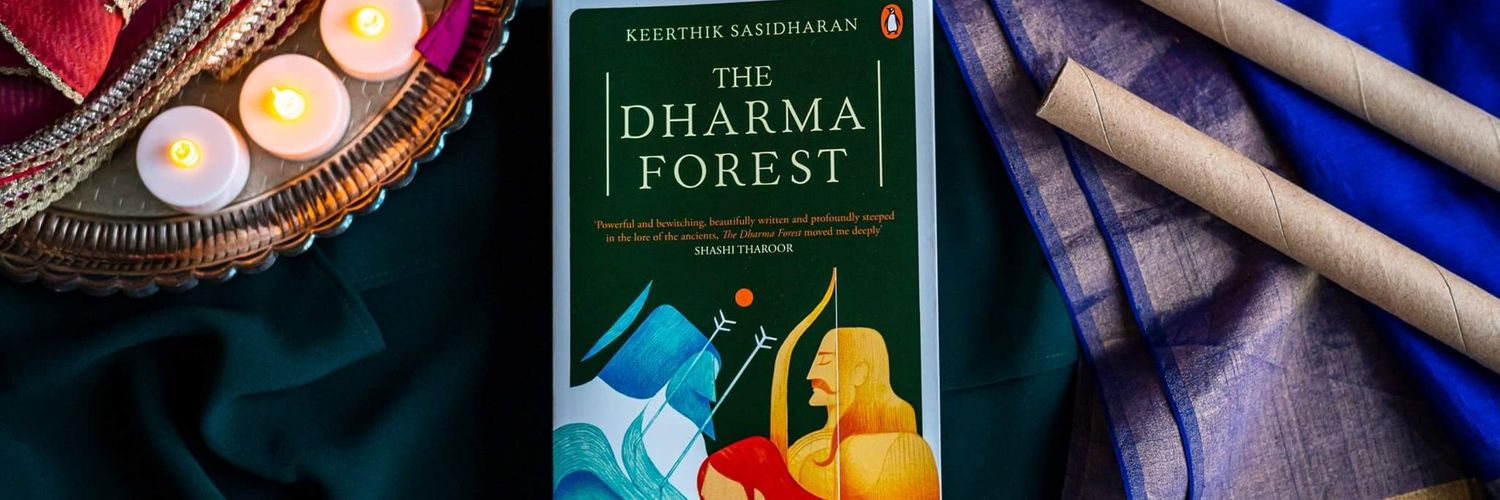
deleted the old pinned tweet by mistake!! but wanted to share & savor this most generous review of my book 'The Dharma Forest' by Pratap Bhanu Mehta here. indianexpress.com/article/bo…

on how ideas percolate, enter the subconscious of writers, and reemerge decades later in new forms:
1. Nabokov's opening lines in 'Speak, Memory", 1951
"THE cradle rocks above an abyss, and common sense tells us that our existence is but a brief crack of light between two eternities of darkness."
2. Pamuk's opening page in 'My Name is Red', translated by Erdağ Göknar, 2001
"Before my birth there was infinite time, and after my death, inexhaustible time. I never thought of it before: I'd been living luminously between two eternities of darkness."
[Shakespeare in Macbeth: "Out, out, brief candle! Life's but a walking shadow..."]


I went to see an exhibit on time and the Ottoman Empire. Some notes that I read there:
"In the Ottoman Empire, the officials responsible for measuring time and thus determining prayer schedules were called muvakkit. They generally worked at muvakkithânes, one of many chambers within külliyes, or mosque complexes. In these muvakkithânes -namely, observatories- day and night cycles, zodiac positions, sunrise, noon, and evening times down to the degree and minute were measured. To carry out their work, they relied on astronomical tools like sundials, astrolabes, and sine quadrants. Shaped like semi-circles, and used to measure the height of stars above the horizon line, astrolabes served various mathematical functions as well such as measuring land plots and the height of the mountains. Inspired by astrolabes, sine quadrants were used to solve time and direction problems and to calculate distance, angles, gradients, and trigonometry.
Sultan Mehmed the Conqueror (r. 1444-1446, 1451-1481) had clocks brought in from Europe as well as invited their makers to come with them. The imperial artisans' logbook (Ehl-i Hiref-i Hâssa) dated 17th-century refers to clock masters of the palace as the Cemâat-i Saatçıyân (the Clockmaker's Guild). Besides these artisans, there were some pashas who were taught clock/watchmaking at Enderûn (the Palace School). More notable ones included Hasan Pasha (a 16th-century grand vizier and janissary agha) and Mehmed Pasha (a 17th-century grand vizier and governor). Both dually held the title of "saatçi" (clock master) – which shows how highly the Ottoman Empire revered what they did as a profession.
In the 18th century, clock masters who weren't official royal staff began serving the palace too. In the first half of the 18th century, Issac Rousseau - father of the famous philosopher Jean-Jacques Rousseau – had been summoned to Istanbul to look after the palace's clockwork. Others included two Turkish clockmakers, Şeyh Dede and Edirneli İbrahim, both of whom not only repaired and maintained but produced clocks for the palace.
The world of clockmaking witnessed multiple developments in the 19th century, including the revival of Turkish clockmaking by Ahmed Eflâkî Dede, a Sufi watchmaker. He, alongside Süleyman Leziz, Hüseyin Hakî, Mehmed Şükrü, Mustafa Refik, and Johann Meyer (of Germany) made precious clocks for the palace and served as royal clock masters. They all played a major role in ensuring that the palace's rarest clocks and watches would survive well into the modern era."


"THE first reference to Ottoman interest in European clocks and watches occurs in a Franciscan account of the pilgrimage to the Holy Land, Il Trattato di Terra Santa e dell'Oriente by Francesco Suriano, who states that, following the peace treaty of 1479 with Venice, Mehmed the Conqueror requested the Signoria of Venice to send to Istanbul craftsmen capable of making christallini (probably, eye-glasses), striking clocks and good paint-ings. The 1505 inventory of the Treasury of Bayazīd II lists a clock, along with hourglasses and the conventional Muslim astronomical instruments which would have served as well for telling the time. But the first considerable interest in clocks, presaging a veritable chronomania, in the later sixteenth century, appears early in the reign of Süleyman the Magnificent. Marino Sanuto in his Diarii for 1531 states that he had just seen in Venice a gold ring incorporating a watch; the piece, made by Giorgio Capobianco of Vicenza, was to be sent to Istanbul for the Sultan. Capobianco had also made a clockwork ship (which served as a table decoration) and a mechanical dancing doll, though it is unclear whether the Sultan also bought those.
...
In addition to the foreign clockmakers called in occasionally to repair a particularly valued clock in the Topkapı Saray, there also seems to have been, from the late sixteenth century onwards, a small colony of German, Italian, French or English craftsmen in Galata, just across the Golden Horn; these were mostly young men who had gone out to Istanbul to earn money and amass enough capital to set themselves up in Europe when they returned there after a few years. This was the
nucleus of the colony of clock and watchmakers in Galata, dominated by Calvinist craftsmen from Geneva, which flourished there in the seventeenth and eigh-teenth centuries. They sold imported watches or set imported movements, but they also made watches on the spot. They were probably never in a position to compete with the grand European time-pieces which continued to pour into Turkey as diplomatic gifts, but the Topkapı collections include watches signed by craftsmen in Galata, some of them with Muslim names. These include an example of a plate clock a type (Telleruhr) that was fashionable in Germany in the seventeenth century signed by Şahin, featuring an enamelled dial and encrusted jewelling; the decora-tion and workmanship are, however, in Ottoman Court style and show that the taste of the Palace was not entirely shackled to novelties imported from Europe.11
The Galata colony does not appear to have survived the competition of massive English exports of watches and movements, and pendulum clocks as well, which grew in volume from the early eighteenth century onwards. These imports were mostly for the mass market, but English clocks were also made for the Palace. It is symptomatic that the lavish dagger (cf. ill. 44) ordered by Mahmud I as a present for Nadir Shah, the Afghan conqueror of India and ruler of Persia, should have set into the hilt a small watch made in London an idea, however, which is ingenious rather than practical. The longstanding taste for foreign-produced automaton clocks must have had some effect upon the development of Ottoman style in the decora-tive arts, but this is now very difficult to trace. The effect must have been all the greater, however, in that the Ottoman system of time-keeping depended not upon hours of standard, equal length, but upon the tra-ditional Islamic division of the day and the night into twelve equal parts each, with the inevitable result that the day hours were shorter in winter than in summer. European time-pieces would have been quite satisfac-tory for astronomical observation but were otherwise perfectly useless in Ottoman society. This makes the craze for them in the sixteenth and seventeenth cen-turies even more irrational, and the term 'chronomania' strictly appropriate."


remembered these lines while reading this wonderful memoir…
“The end of history will be a very sad time. The struggle for recognition, the willingness to risk one’s life for a purely abstract goal, the worldwide ideological struggle that called forth daring, courage, imagination, and idealism, will be replaced by economic calculation, the endless solving of technical problems, environmental concerns, and the satisfaction of sophisticated consumer demands. In the post-historical period there will be neither art nor philosophy, just the perpetual caretaking of the museum of human history. I can feel in myself, and see in others around me, a powerful nostalgia for the time when history existed. Such nostalgia, in fact, will continue to fuel competition and conflict even in the post-historical world for some time to come. Even though I recognize its inevitability, I have the most ambivalent feelings for the civilization that has been created in Europe since 1945, with its North Atlantic and Asian offshoots. Perhaps this very prospect of centuries of boredom at the end of history will serve to get history started once again.”
— Francis Fukuyama

After nearly 1.5 years of wait -- arrived today: the great William T. Vollmann's four part novel set in the world of American and Cold War intelligence. A Table for Fortune.


“The Count is a philosopher—“a philosopher,” he will tell you deprecatingly in his faultless English or lapidary French, “a philosopher who only sits and listens.” He speaks always with the most casual frankness about his own life and interests, his rather fine dark eyes fixed calmly upon his audience. He is filled with what Zarian (who is a born hero-worshipper and who finds a philosopher under every stone) calls “a speculative calm.” It is rather the calm of one in whom the romantic is dead; and in whom the harder cutting-edge of experience has reached the inner man. Despite the sweetness and repose he is a prey to metaphysical incertitudes such as the artist only encounters; this you may guess from the fine sets of much-thumbed European philosophers which line his bedroom. “Philosophy,” he said once, “is a doubt which lives in one like hookworm, causing pallor and lack of appetite. Suddenly one day you awake and realize with complete certainty that ninety-five per cent of the activities of the human race—to which you supposed you belonged—have no relevance whatsoever for you. What is to become of you?””
— Lawrence Durrell


Fascinating, even if Elliptical…

CLAUDE FOUND THE SEEDS
anthropic.com/research/ecdsa…

keerthik śaśidharan retweeted

Seamus Heaney reciting TS Eliot's 'Ash Wednesday.'
'Because I do not hope to turn again
Because I do not hope
Because I do not hope to turn
Desiring this man's gift and that man's scope
I no longer strive to strive towards such things
(Why should the agèd eagle stretch its wings?)
Why should I mourn
The vanished power of the usual reign?'
keerthik śaśidharan retweeted

The tomb of Nikos Kazantzakis, the cross askew. His views didn't sit well with the church who denied him a church burial. Still, he got a lofty resting place atop a bastion of Heraklion's Venetian walls.
The inscription is his own:
I hope for nothing.
I fear nothing.
I am free.


"A man needs to love and to hate at the same moment,
to laugh and cry with the same eyes,
with the same hands to throw stones and to gather them,
to make love in war and war in love.
And to hate and forgive and remember and forget,
to arrange and confuse, to eat and to digest
what history takes years and years to do."
Yehuda Amichai, ‘A Man in His Life’
📷 @ The Sea of Marmara

masumiyet müzesi~museum of innocence
"The anxious adherence to the forms of deference that we associate with traditional families – sitting straight and never crossing one’s legs or smoking or drinking in front of one’s father – had over time slowly disappeared."
📷 @ Beyoğlu

Paul Valéry of Languedoc looked deep into the stream
and became Narcissus. The flat earth was flat, the round
earth was round, the river flowed, the sun shone.
Midi le juste y compose de feux . . .
(Impartial noon patterns the sea in flame)—"
- Raja Rao
📷 @ Sea of Marmara


keerthik śaśidharan retweeted

2026 Nobel Peace Prize laureate Navi Pillay’s commitment to universal legal principles and her firm moral compass are constants in a long career. Born into a family of Indian Tamil origin under apartheid in Durban, South Africa, Pillay became a lawyer and legal pioneer, confronting deep structural discrimination, segregation and exclusion. A common thread runs from her early work defending Nelson Mandela and others who stood up against apartheid to her service as a judge in some of the key international court cases of our time.
This year’s laureate has significantly enlarged the scope and impact of international law. She has served as a judge on the High Court in South Africa, the International Criminal Tribunal for Rwanda and the International Criminal Court. She was the United Nations High Commissioner for Human Rights and, until recently, she chaired the UN Independent International Commission of Inquiry on the Occupied Palestinian Territory. Today Navi Pillay is a judge on the International Court of Justice in the case where Myanmar stands accused of genocide.
In historic international court cases, she has shown that legal measures can help prevent acts of war and violence. Navi Pillay has also contributed to strengthen the institutions of international law. Her independence, expertise and steadfastness have made her one of the most respected international jurists of our time.
Learn more about the 2026 #NobelPeacePrize: bit.ly/4xjOJ03
#NobelPeacePrize #NobelPrize


keerthik śaśidharan retweeted

What did the AI actually prove? We explain top 25 results from OpenAI's new math repo in simple words.
NUMBER THEORY
1. The Quasi-Riemann Hypothesis
The Riemann hypothesis says all the important zeros of the zeta function sit on the line with real part 1/2, and those zeros control how primes are spread out. This proves no zeros lie beyond 7/8, so prime counts can never drift far from their predicted values.
2. Hilbert's Tenth Problem over the Rationals
Is there an algorithm that tells you whether any polynomial equation, like x³ + y³ = 7, has a solution in fractions? No. Matiyasevich proved this for whole numbers in 1970; fractions stayed open for 50+ years.
3. The Birch–Swinnerton-Dyer Conjecture (ranks 0 and 1)
An elliptic curve is an equation like y² = x³ + ax + b. BSD, a $1M Millennium Prize problem, predicts how many fraction solutions it has from a single function. Proved in full for the typical curves, the ones of rank 0 and 1.
4. Goldfeld's Conjecture
Take one elliptic curve and all its "twists." Exactly half have finitely many fraction solutions and half have infinitely many.
5. The Two-Point Chowla Conjecture
Label each whole number +1 if it has an even number of prime factors and −1 if odd. Knowing the label of n tells you nothing about the label of n+1. Primes really do behave like coin flips.
6. Artin's Primitive Root Conjecture (1927)
1/7 = 0.142857 repeats every 6 digits, the longest possible for 7. Artin guessed that infinitely many primes behave this way in base 10, and in every base except perfect squares and −1. Before this, it was only known by assuming other unproved conjectures.
7. The Erdős–Turán Conjecture on Arithmetic Progressions
If the reciprocals of a set of whole numbers add up to infinity, the set contains evenly spaced runs (like 5, 11, 17, 23) of any length. This was one of Erdős's most famous prize problems.
8. Irrationality of Catalan's Constant
1 − 1/9 + 1/25 − 1/49 + ... ≈ 0.9159. Studied since the 1800s, but nobody could prove it isn't a fraction. Now proved.
9. The Irrationality Exponent of π Is 2
How well can fractions like 22/7 and 355/113 approximate π? No better than they approximate a typical algbraic number.
ALGEBRAIC GEOMETRY
10. The Hodge Conjecture for CM Abelian Varieties
The Hodge conjecture, another $1M Millennium problem, says certain shapes you detect with topology always come from actual polynomial equations. Proved for a central family of spaces where it had been stuck for decades.
COMPUTER SCIENCE
11. The Unique Games Conjecture (Khot, 2002)
For hard problems like Max-Cut or vertex cover, simple algorithms get within a fixed percentage of the best answer. This proves you can't do better unless P = NP. Dozens of "conditionally optimal" results become unconditional.
12. L = RL = BPL
Anything a memory-starved program can do by flipping coins, it can do without randomness. This is the low-memory version of one of complexity theory's central questions, open since the 1970s.
13. Matrix Multiplication Exponent ω ≤ 9/4
Multiplying two n×n matrices is the core operation of AI and graphics. Fifty years of human work moved the record from n^2.376 to n^2.371. This claims n^2.25.
GEOMETRY AND COMBINATORICS
14. The Mahler Conjecture (1939)
Every symmetric convex shape has a "dual" shape. Their volumes can't both be small, and the cube is the worst case. Proved in every dimension.
15. The Kakeya Conjecture in 4D
What's the least space you need to point a needle in every direction? You can't shrink it to nothing. Wang and Zahl solved 3D in 2025. This claims 4D.
16. The Hadwiger–Nelson Problem
Color every point in the plane so that any two points exactly 1 unit apart get different colors. You need at least 6 colors, up from the 2018 bound of 5.
17. Borsuk's Conjecture (1933), dimension 9
Can every bounded shape in n dimensions be cut into n+1 pieces, each narrower than the original? It was known to fail in dimension 64. It fails in dimension 9.
18. Zarankiewicz's and Hill's Crossing-Number Conjectures
Connect every town to every other town by roads. What's the fewest road crossings possible? Turán asked while pushing brick carts in a WWII labor camp. The guessed formulas are proved.
19. The Hot Spots Conjecture (Rauch, 1974)
Heat a flat metal plate with no holes and let it cool. The hottest and coldest points end up on the edge, never in the middle. Now proved.
20. Seymour's Second Neighborhood Conjecture
On a social network with only one-way follows, somebody's "follows of follows" are at least as many as their direct follows.
ALGEBRA AND GROUPS
21. Thompson's Group F Is Nonamenable
A famous group of zig-zag functions on [0, 1]. Is there a fair way to "average" over it? No. Open since the 1970s, with several famous retracted proofs.
22. Kaplansky's Zero-Divisor Conjecture Is False
In algebra built from a group with no repeating loops, can two nonzero things multiply to zero? Kaplansky guessed no in the 1950s. A counterexample says yes.
23. Isomorphism of Free Group Factors
Are the operator algebras built from the free group on 2 generators and on 3 generators secretly the same? Yes, and so are all the others. This settles a famous operator-algebra question from the 1940s.
PHYSICS
24. Global Smoothness of the Relativistic Vlasov–Maxwell System
The equations for a hot plasma: charged particles plus their electromagnetic fields, the physics of fusion reactors and stars. Smooth starting conditions stay smooth forever in 3D.
25. Spontaneous Magnetization in the Quantum Heisenberg Ferromagnet
In the quantum model of a magnet, at low temperature in 3D, the spins line up on their own. Physicists assumed it for 90 years; now it's proved.

We ranked the 50 biggest math results of the last 20 years. AI found 27 of them, all in 2026.
From 2006 to 2025, humans landed one to four top results a year: Viazovska's sphere packing, bounded gaps between primes, geometric Langlands, Kakeya in 3D, etc...
Then 2026 happened:
• May: an OpenAI model disproves Erdős's unit distance conjecture, open since 1946
• July: Levent Alpöge and Claude find a counterexample to the Jacobian conjecture, open since 1939
• Sept: OpenAI claims blow-up for Navier–Stokes, a Millennium Prize problem, in the forced case
• Today: OpenAI posts 722 manuscripts across 372 results, including the quasi-Riemann hypothesis, the Unique Games Conjecture and Hilbert's 10th problem over the rationals
That's more famous open problems in one GitHub repo than most decades produce.


keerthik śaśidharan retweeted

Suddenly, AI has solved 90 of the 500 most important open problems in mathematics
Highest ranked problems:
#2 Riemann Hypothesis — PARTIAL
#4 Hodge Conjecture — PARTIAL
#5 Birch and Swinnerton-Dyer Conjecture — PARTIAL
#10 Extended Riemann hypothesis for Dedekind zeta functions — PARTIAL
#12 Generalized Riemann Hypothesis for Dirichlet L-functions — PARTIAL
#15 Tate Conjecture for Algebraic Cycles — PARTIAL
#22 Hilbert's Tenth Problem over the Rationals — FULL CLAIM
#24 Grothendiecks Generalized Hodge Conjecture — PARTIAL
#28 Matrix-Multiplication Exponent Equals Two — PARTIAL
#29 Unique Games Conjecture — FULL CLAIM
#31 Anderson Model Extended States in Dimension at Least Three — FULL CLAIM
#37 Prove the Penrose inequality or present a counterexample — FULL CLAIM
#38 Higher-dimensional Euclidean Kakeya conjecture — PARTIAL
#39 Modularity of Elliptic Curves over Number Fields (End_K(E)=Z) — PARTIAL
#40 Hilbert's Sixteenth Problem, Second Part — PARTIAL
#46 Fourier restriction conjecture — PARTIAL
#47 The Fontaine-Mazur Conjecture on Geometric Galois Representations — PARTIAL
#48 Nonexistence of Landau–Siegel zeros for quadratic Dirichlet L-functions — FULL CLAIM
#52 The Baum-Connes Conjecture for the K-Theory of Reduced Group C*-Algebras — FULL CLAIM
#62 Permanent versus Determinant over C — PARTIAL
#69 Finiteness of the Tate-Shafarevich Group for Elliptic Curves — PARTIAL
#72 Termination of Flips Conjecture in the Minimal Model Program — PARTIAL
#77 Chowla conjecture on correlations of the Liouville function — PARTIAL
#78 Abundance Conjecture for the minimal model program — FULL CLAIM
#80 Hadwiger Conjecture — FULL CLAIM
#83 Zilber-Pink Conjecture on Unlikely Intersections — PARTIAL
#87 Bose-Einstein Condensation in Interacting Continuous Bose Gases — FULL CLAIM
#92 Entanglement Area Law for 2D Gapped Quantum Systems — FULL CLAIM
#94 Grothendieck Standard Conjecture of Hodge Type — PARTIAL
#95 Kannan-Lovasz-Simonovits conjecture on isoperimetry of log-concave measures — PARTIAL
#99 Grothendiecks Section Conjecture in Anabelian Geometry — PARTIAL
#112 The Haldane Conjecture on Spectral Gaps of Antiferromagnetic Quantum Spin Chains — PARTIAL
#114 Iitaka conjecture C_{n,m} on subadditivity of Kodaira dimension — FULL CLAIM
#119 The Borel Conjecture on Topological Rigidity of Aspherical Manifolds — FULL CLAIM
#124 Aspherical Manifolds Admit No Metric of Positive Scalar Curvature — FULL CLAIM
#130 Polynomial Bound for Limit Cycles of Planar Polynomial Vector Fields — PARTIAL
#136 Erdős problem 3: divergent harmonic series and long arithmetic progressions — FULL CLAIM
#139 Cannon's conjecture — FULL CLAIM
#145 Residual Finiteness of Hyperbolic Groups — FULL CLAIM
#153 Congruent Number Problem — PARTIAL
#161 BPL = L (Derandomizing Bounded-Error Logspace) — FULL CLAIM
#163 NP versus the Existential Theory of the Reals — PARTIAL
#169 The Free Group Factor Isomorphism Problem — FULL CLAIM
#172 Conformal Invariance of the Critical Random-Cluster Model with q <= 4 — FULL CLAIM
#179 Arnold Conjecture on Hamiltonian Fixed Points — FULL CLAIM
#181 Polyakov Conjecture: Absence of a Phase Transition for Planar O(n) Models with n >= 3 — FULL CLAIM
#183 Smooth anisotropic Calderón uniqueness from full boundary data — FULL CLAIM
#193 Nonvanishing conjecture for projective log canonical pairs — FULL CLAIM
#195 Parity conjecture for elliptic curves — PARTIAL
#198 Long-Range Order in the Quantum Heisenberg Ferromagnet — FULL CLAIM
#203 Bochner-Riesz conjecture — PARTIAL
#205 Local Smoothing Conjecture for Wave Equations — PARTIAL
#206 Kaplansky's Zero-Divisor Conjecture for Torsion-Free Groups — FULL CLAIM
#210 Artin's primitive root conjecture — PARTIAL
#211 Hilbert-Smith Conjecture — FULL CLAIM
#213 Falconer distance set conjecture — FULL CLAIM
#222 Virasoro Conjecture for Gromov–Witten Invariants — PARTIAL
#224 Wall's Poincare Duality Group Conjecture — FULL CLAIM
#225 K(pi,1) conjecture for Artin groups — FULL CLAIM
#234 Unconditional 2−epsilon Inapproximability of Minimum Vertex Cover — FULL CLAIM
#235 Chromatic Number of the Plane (Hadwiger--Nelson Problem) — PARTIAL
#237 Global Existence of Classical Solutions to the Relativistic Vlasov-Maxwell System — PARTIAL
#239 Universal Optimality of the Hexagonal Lattice in Dimension Two — FULL CLAIM
#246 De Giorgi Conjecture for the Allen-Cahn Equation in Dimensions 4 to 8 — FULL CLAIM
#254 Exact satisfiability threshold for random k-SAT for small k (k = 3) — PARTIAL
#256 Polynomial-Time Decidability of Semidefinite Programming Feasibility — PARTIAL
#260 RL versus L — FULL CLAIM
#261 Kadison Similarity Problem for C*-Algebras — FULL CLAIM
#267 Sidorenko Conjecture on Bipartite Homomorphism Densities — FULL CLAIM
#268 Shafarevich Holomorphic-Convexity Conjecture — FULL CLAIM
#270 Kuznetsov Rationality Conjecture for Cubic Fourfolds — FULL CLAIM
#271 All groups are good: the four-dimensional disc-embedding conjecture — FULL CLAIM
#278 Planar homogeneous Mumford–Shah local-structure conjecture — PARTIAL
#284 Nearby Lagrangian Conjecture — FULL CLAIM
#285 Cartan-Hadamard isoperimetric conjecture — FULL CLAIM
#289 Sharp Upper Bound in Yau's Conjecture on Nodal Sets of Laplace Eigenfunctions — FULL CLAIM
#290 Kaplansky's Idempotent Conjecture — FULL CLAIM
#291 Calderón uniqueness for bounded measurable real isotropic conductivities — FULL CLAIM
#292 Global Attractor Conjecture for Complex-Balanced Mass-Action Systems — FULL CLAIM
#295 Zariski Multiplicity Conjecture for Hypersurface Singularities — FULL CLAIM
#297 Amenability of Thompson's Group F — FULL CLAIM
#298 Griffiths Positivity Conjecture for Ample Vector Bundles — FULL CLAIM
#300 The Singer Conjecture on Vanishing of L2-Cohomology of Aspherical Manifolds — PARTIAL
#305 Birkhoff Conjecture (Near-Boundary Continuous Invariant Foliation) — FULL CLAIM
#306 Secret key from all entangled states — FULL CLAIM
#311 Mahler Conjecture on the Volume Product of a Convex Body — FULL CLAIM
#321 Finiteness of Finitely Presented Periodic Groups — FULL CLAIM
#328 Sinai's Positive Metric Entropy Conjecture for the Chirikov Standard Map — FULL CLAIM
#334 Unrestricted Linear-Circuit Lower Bound for the Discrete Fourier Transform — FULL CLAIM
#343 Koebe circle-domain uniformization conjecture — FULL CLAIM
#351 Kobayashi Conjecture: Hyperbolic Compact Kähler Manifolds Have Ample Canonical Bundle — FULL CLAIM
#356 Bott Conjecture: nonnegatively curved simply connected manifolds are rationally elliptic — PARTIAL
#357 Strong Hyperplane Conjecture for Isotropic Constants — FULL CLAIM
#358 CAT(0) Models for All Word-Hyperbolic Groups — FULL CLAIM
#359 Hopf Conjecture: no metric of positive sectional curvature on S^2 x S^2 — PARTIAL
#361 Alperins Weight Conjecture for Modular Representations of Finite Groups — FULL CLAIM
#364 Log-Brunn-Minkowski Inequality for Symmetric Convex Bodies — FULL CLAIM
#366 Hyperkähler SYZ (Lagrangian Fibration) Conjecture — FULL CLAIM
#368 Benjamini-Schramm conjecture p_c<p_u for non-amenable Cayley graphs — FULL CLAIM
#369 Dixmier unitarisability problem for discrete groups — FULL CLAIM
#374 Fujita Freeness Conjecture — FULL CLAIM
#375 Nagata Conjecture on Plane Curve Linear Systems — FULL CLAIM
#378 Toms–Winter: Strict Comparison Implies Z-Stability — FULL CLAIM
#379 Margulis–Platonov normal-subgroup conjecture — FULL CLAIM
#388 Shelah's Categoricity Conjecture for L_omega1,omega — PARTIAL
#392 Measure-zero singular set of stationary integral varifolds — FULL CLAIM
#401 Serres Positivity Conjecture for Intersection Multiplicities over Regular Local Rings — FULL CLAIM
#403 Rokhlin problem on multiple mixing — FULL CLAIM
#419 Lück's Determinant Conjecture for Discrete Groups — FULL CLAIM
#420 Absolute continuity of Bernoulli convolutions outside reciprocal Pisot parameters — FULL CLAIM
#421 GNRS Conjecture — PARTIAL
#424 Irrationality of Catalan's Constant — FULL CLAIM
#425 Separable Quotient Problem for Banach Spaces — FULL CLAIM
#430 Long-Time Existence of the Calabi Flow on Compact Kaehler Manifolds — FULL CLAIM
#432 Combinatorial Invariance of Kazhdan-Lusztig Polynomials — FULL CLAIM
#434 Realizable Limit Shapes in Two-Dimensional First-Passage Percolation — PARTIAL
#438 Zariski Cancellation Problem (characteristic zero, dimension ≥ 3) — FULL CLAIM
#440 Stein's Conjecture on the Hilbert Transform along Lipschitz Vector Fields — FULL CLAIM
#448 Smooth Realization of Finite-Entropy Ergodic Transformations — FULL CLAIM
#450 Deligne–Drinfeld Freeness Conjecture for grt_1 — FULL CLAIM
#453 Shub entropy conjecture — FULL CLAIM
#456 Maximal Number of Mutually Unbiased Bases in Composite Dimensions — PARTIAL
#458 LeBrun-Salamon Conjecture: positive quaternion-Kahler manifolds are symmetric spaces — FULL CLAIM
#461 Kaplansky's Direct Finiteness Conjecture — FULL CLAIM
#465 David–Semmes Riesz-transform problem in intermediate dimensions — FULL CLAIM
#467 Small Cohen-Macaulay Conjecture — FULL CLAIM
#468 Ergodicity of Irrational Triangular Billiards — FULL CLAIM
#472 CAT(0) Conjecture for All Artin Groups — FULL CLAIM
#475 Katok entropy rigidity conjecture — FULL CLAIM
#476 Polynomial-Time Solvability of Condon's Simple Stochastic Games — PARTIAL
#480 Furstenberg No-Bigeodesics (Planar FPP, Standard Minimum Moment) — FULL CLAIM
#483 Gaboriau's Fixed Price Problem for Countable Groups — FULL CLAIM
#484 Persistence Conjecture for Weakly Reversible Mass-Action Systems — FULL CLAIM
#486 Campana-Peternell Conjecture — PARTIAL
#497 Maximum Number of k-sets and Complexity of k-levels — PARTIAL


We’re releasing a broad range of new mathematical results produced by an internal frontier model.
We’ve been consulting with the independent Advisory Group on Mathematics and Artificial Intelligence at the Institute for Advanced Study, and we have drawn on their advice and public recommendations to inform how we release these results.
github.com/openai/math

keerthik śaśidharan retweeted

And this was Escher’s very last piece, when he was already sick with cancer, 1969.
These will be on display at @MoMath1 through January, don’t miss them!!
