

Co-Founder/Chief Connector @SANGevents. Speaker. Proud Uncle to 4 adorable nieces. FSU alum. Love music, books and movies. https://nitter.gq/t.co/DDF1scXmoF
Bali, Indonesia
Joined June 2008
- Tweets8.2K
- Following6.4K
- Followers12.1K
- Likes2.3K





If Kirk cousins agent ever teaches a class on negotiating, I want in. Kudos to him and his agent.

Kirk Cousins' agent is the best bag-getter in NFL history.
$2,572,688.00 - Washington - 4 years
$19,953,000.00 - Washington - 1 year
$23,943,600.00 - Washington - 1 year
$84,000,000.00 - Minnesota - 3 years
$66,000,000.00 - Minnesota - 2 years
$35,000,000.00 - Minnesota - 1 year
$180,000,000.00 - Atlanta - 4 years
$172,000,000.00 - Las Vegas - 5 years
1 playoff win. $333 million in earnings 💵

120
Truly one of the best to ever do it @TurnerSportsEJ announces his retirement, his poem every year at @NBA all star weekend for the legends brunch is the highlight for me. You may get sweaty eyeballs watching this.
1
65
If your a @JerrySeinfeld @BeingLarryDavid or a Seinfeld fan, this is a must watch

59

Great insights on AI, founders and San Fran tech ecosystem

I spent 48 hours in SF hanging out with billionaires, data labs and AI founders and execs running $1B to $100B companies.
My observations:
1. Sooo MANY stories of data brokers making like $2M a WEEK selling company data to labs. I can't tell if it's the beginning or a bubble, and I kept wondering which niches are left. Digging into it actively.
2. At dinner, someone asked the table, "If a new model drops next month, does your company get better or worse?" HALF the table went quiet! I think that's the best question to ask about any AI startup right now.
3. The bar people talk about now is hitting $1B in revenue in 12 months (I guess that's the new unicorn?). What I didn't hear much about is retention. AI revenue can come in fast and leave fast, and I think we're going to see a lot of stories of AI companies with huge revenue and terrible retention.
4. It's pretty clear we're living through the reinvention of the computer. The model is the CPU, the harness is the operating system, and skills and plugins are the apps. Thinking about it that way makes it easier to see where the whitespace is.
5. We're maybe 12 months from an agent that can watch you work for a week and then do your job without any instructions. The screen recording plus agent memory plus local model combination makes this possible right now.
6. Agent harnesses feel like the new GPT wrappers, in a good way, especially vertical ones. The best teams I talked to treat the model as swappable. One founder walked me through routing different models to different jobs: one for taste and visuals, a cheaper one for the everyday stuff, another for text.
They use prompts they can move across models over fine-tuning, and A/B test the output on what users actually do with it: do they edit it, export it, share it? A vertical harness is basically four things: the connectors for that industry's data, evals written by people who know the work, rules for what the agent can and can't touch, and a clean screen for a human to review. The model is maybe 20% of it.
7. There's a lot of reverse engineering going on/cloning going on more than I've ever seen. People are decompiling software and rebuilding it with agents, and someone showed a suite of like 10 apps that are worth $5B+ each all that he cloned open source. Me and everyone are still thinking through what it means when software gets this easy to copy.
8. My guess is the value moves to data. If the software can be rebuilt quickly, what's worth paying for in a legacy SaaS company is the years of customer data and workflows inside it. Some SaaS companies are secretly data companies.
Gets me thinking about how do you truly value data for this saas companies? Like if we were buying these dying saas companies at 2x ARR before (as example), maybe there is a better metric. Idk, just thinking out loud here.
9. It feels like a good chunk of legacy software won't make it to the agentic era, especially anything built around people clicking through a lot of screens.
10. Every company I talked to wants to pipe its internal data into one place and expose it to agents through MCP. Then they look at the data and realize it's a mess: five versions of the same customer, old Slack channels, PDFs nobody can search. Cleaning that up feels like a big consulting opportunity!
11. A lot of founders are building the basic building blocks for agents: APIs, data layers and tools. Some of the companies I saw barely have a UI because the main user is an agent. I really believe the startups that build primitives to this agentic era will do extremely well. Building blocks is the best way to think about it.
12. Labs can get plenty of training data, but it's harder to get real examples of agents failing inside companies. Whoever has those logs has something valuable.
13. Someone running a big consumer company told me the next fight is over memory. The model that remembers the most about you wins, and the smartest model matters less than people think.
14. Physical AI came up a lot. Astra I think was the first model that got people into AI can actually do CAD, and I think a lot of people are thinking what does vibe manufacturing really look like. The line I keep thinking about came from a robotics founder: the hardest problems in AI are deployment problems now, not research problems. Their robots work on their own, call a human when they get stuck, and every one of those calls becomes training data.
15. Cybersecurity companies are having a moment and are actually cool companies to build now, especially the ones that clean up after a breach. Every agent with access to your systems is a new door into your company, and a lot of those doors were left open.
16. Some startups are worth more dead than alive now. A shutdown company with 5 years of Slack, email and code can get paid for licensing all of it. I wouldn't be surprised if founders start factoring that into when they shut down.
17. People are starting to talk about monetizing the agent web. It feels really early, but when the most popular user of the internet is an agent, what startups should you be building?
18. I think agent insurance is coming. Once an agent makes an expensive mistake, insurers will want audits before they cover anyone.
19. Several people said the hire they want most is someone with taste who can write evals. The models are getting good at generating ideas, so the hard part is judging which ones are good.
20. New trend I observed: startup raises VC, uses venture dollars to become a creator, startup fails, founder falls back on being a full-time creator and incubates other products bootstrapped.
21. Getting SIGNIFICANT distribution is HARD right now. Founders are sponsoring buses, buying billboards like crazy and throwing parties with famous DJs to get noticed. Kinda feels dotcom era in that sense.
Attention is what's scarce! The growth guy going viral sharing his UGC strategy from Wispr Flow is a good example. It's the sauce everyone wants, and I truly believe there are probably only 50 people on the planet who know how to scale these types of businesses efficiently in this era.
Always good to get that dose of SF. I felt sooo lucky to have such an incredible trip during such an incredible time in building businesses. Surreal in so many ways.
Happy to be home and locked in.
Until next time!


31
There is something very wrong when no one at the big banks or on Wall Street ever go to jail for criminal activities.

Dear Secretary Bessent @SecScottBessent,
My name is Everett Stern. In 2010 I was a compliance officer at @HSBC. From a back office in New Castle, Delaware, I watched billions of dollars move to drug cartels, sanctioned regimes, and terrorist organizations. The enemies of the United States. I documented it, I escalated it, and when the bank would not act, I took it to the @FBI, the @CIA, and eventually the @SECGov.
The result was a $1.92 billion settlement. At the time, it was one of the largest in American history. It was also about five weeks of the bank’s profit. Not one banker was charged. Not one went to prison.
I paid a different price. I lost my career, my savings, and my place in the industry I had trained for. I was blacklisted. Every door in American finance closed at once. I slept on a camping cot in a 300 square foot apartment because I could not afford a bed, and I waited tables at @PFChangs to eat. I tell you this not for sympathy, but so you understand that I know exactly what it costs to do the right thing in American finance, and exactly how little the system does in return.
I made that sacrifice because I believed it would change something.
Yesterday, your department fined @BankofAmerica $1.2 billion for failing to report more than $5 billion in suspicious transactions, some of it tied by your own findings to Chinese laundering networks, narcotics, and the southwest border, alongside 475 apparent sanctions violations touching Russia, Iran, and global terrorism. The bank admitted it willfully violated the Bank Secrecy Act.
Fourteen years after HSBC. A bank with “America” in its name. And once again, not one individual charged.
Secretary Bessent, I want to say plainly what I believe you already know. The fines are not working.
A fine is paid by shareholders, absorbed by the balance sheet, and forgotten by the next earnings call. Bank of America reported earnings this morning. Nobody who set the alert thresholds, nobody who decided the 2024 cease and desist could wait, nobody who chose the backlog over the law will lose a single thing they value. Their lives are untouched. That is the entire reason the behavior repeats.
This is money laundering. This is blood money. Money that reaches a cartel buys fentanyl that kills Americans. Money that reaches a terrorist organization buys the next attack. This country has fought a war on drugs and a war on terror for decades, at enormous cost in lives and treasure, and all the while we have allowed the financing to flow through institutions we charter and regulate. Cut off the money and we win. We have never seriously tried.
There is also a question of equal justice that I cannot let go.
Before I walked into the FBI building to report HSBC, I stopped in front of the Great Seal on the wall and read the words engraved beneath it: “Justice is the defense of our liberty.” I believed that. I still want to. But every day in this country, people go to prison for crimes that are nothing next to moving money for the people who want Americans dead. A suit, a title, and a corporate badge should not be a shield from the consequences that apply to everyone else. If a street dealer goes to prison for what he sells, the banker who moved the cartel’s money should be standing next to him.
I also want to raise something that is rarely said in these conversations. Why has no one inside Bank of America come forward the way I did? The answer is that everyone in American banking knows what happened to me, and to the whistleblowers who came after. The last person who spoke up is the only policy anyone believes. That is a culture problem, and it starts with leadership, in the banks and in the agencies that regulate them.
This is not a political issue. It has spanned administrations of both parties. It is a national security issue, and I am asking you to treat it as one.
Three things would change the math overnight.
Refer individuals for criminal prosecution. Not the analyst in the queue. The executives who set the thresholds and chose the risk. One banker in handcuffs would do more than every fine in Treasury’s history combined.
End “too big to jail.” An institution cannot be too big to fail and too big to jail at the same time. If it is the first, it must be held to a higher standard, not a lower one.
And if Bank of America will not act as America’s bank, review its charter. A national charter is a privilege granted on behalf of the American people. It should be conditioned on not moving money for the people trying to kill them.
Secretary Bessent, you said yesterday that these actions send a clear message that even the biggest institutions are not above the law. With respect, the institution was never the problem. The people inside it are above the law, and they know it. Until that changes, I will keep writing letters like this one, and the next bank will keep paying the next fine.
I gave up everything I had to stop this. I am asking you to use the power you have to finish it.
Respectfully,
Everett A. Stern
HSBC Whistleblower
Founder and Intelligence Director, Tactical Rabbit
83
Charlie ward is a world class human being.

Charlie Ward's parents met on the campus of Florida A&M more than 65 years ago.
He went to Florida State, won the Heisman Trophy, and not one NFL team drafted him.
He turns 56 today, and he is the head basketball coach at Florida A&M.
Here is the whole thing.
His father played football for the Florida A&M Rattlers under Jake Gaither. His older sister Lita went there too.
Ward grew up on that campus with his dad, at Rattlers football games and Rattlers basketball games.
Here is how he puts it.
"I was born a Rattler."
Then he went to Florida State and played quarterback.
In 1993 he won the Heisman, the Maxwell Award, the Davey O'Brien Award and the Sullivan Award, which goes to the best amateur athlete in the country in any sport.
He took the Seminoles to their first national championship, 18 to 16 over Nebraska in the Orange Bowl. Their only loss all year was to Notre Dame.
Then the NFL Draft came and went and nobody took him.
He had told teams he would only consider the NFL if he went in the first round. Tony Dungy has said that Dennis Green thought about spending a first rounder on him and decided he could not risk Ward refusing to sign.
So Ward went undrafted, and he is still the only Heisman winner that ever happened to.
Here is what Green said afterward, offering him a free agent deal.
"A free agent contract is not very lucrative, but what it gives you is opportunity."
Ward said no.
Two baseball teams had already taken him. The Milwaukee Brewers in the 59th round in 1993, the New York Yankees in the 18th round the next year. He did not sign with either one.
He played basketball instead.
The New York Knicks took him 26th overall. He became their starting point guard, started all 82 games one season, and went to the Finals in 1999, where the Knicks lost to the San Antonio Spurs in five.
He played 11 seasons. 3,947 points, 2,539 assists, 744 steals.
Now the part most people do not know.
In June of 2018, on a church trip to Mexico, Ward had a stroke.
He recovered completely. He went vegan and changed the way he trains so it would not happen again.
He coached high school basketball in Tallahassee for seven years after that.
Then in April of last year, Florida A&M called.
Here is what he said about taking it.
"This is the only collegiate job that I was willing to take."
He went 15 and 16 in his first season there.
Charlie Ward is the only person who has won a Heisman Trophy and played in the NBA.
He spends his days now at the school where his parents met.
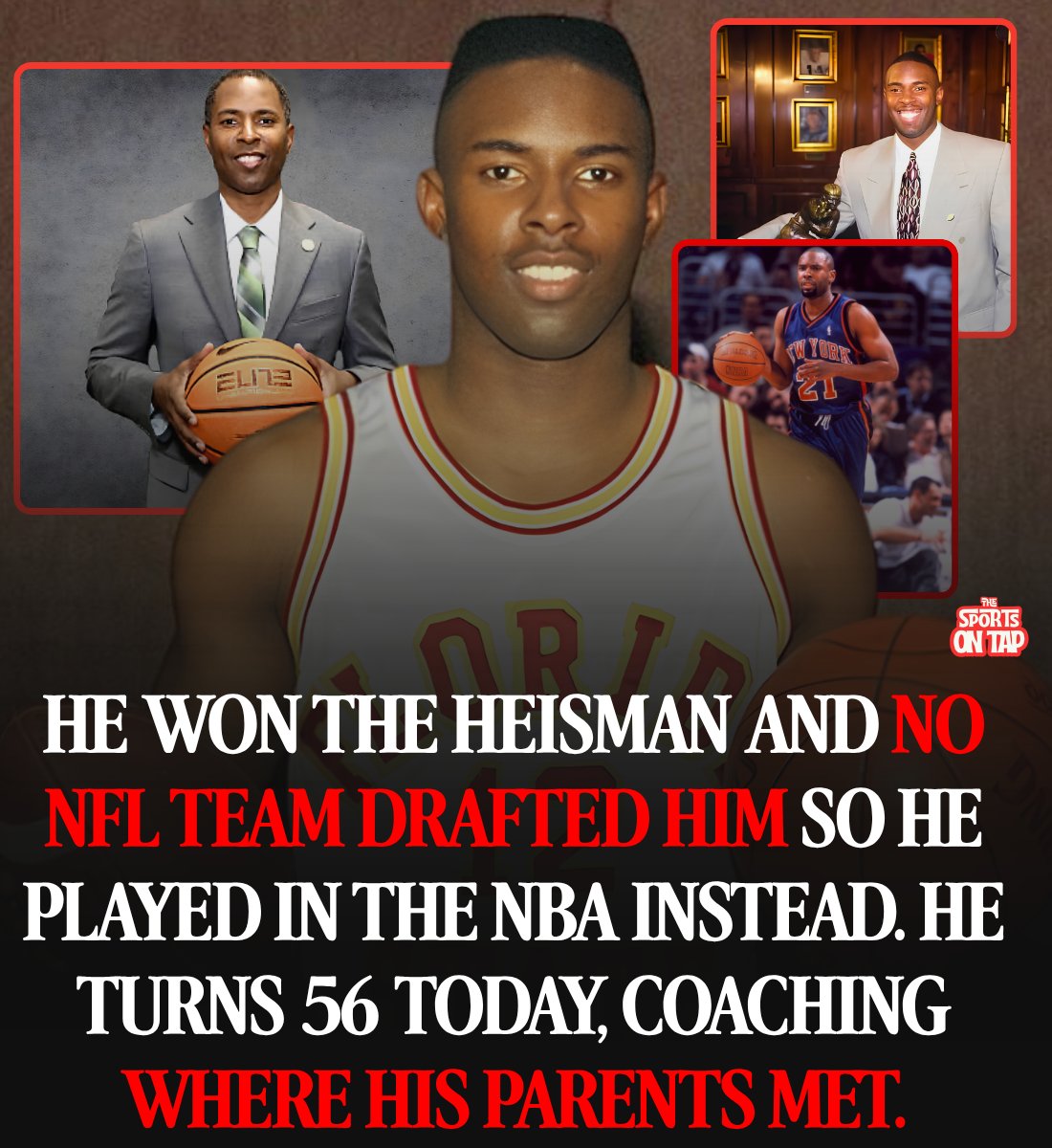
32
@APompliano always puts out amazing content, check out his new book

Dear friends - I need your help today.
My new book is being published this morning. It contains 50 life-changing ideas that impacted me personally, professionally, or financially.
I promise if you read the book, you will still be thinking about these ideas for months to come.
Order a copy here: amazon.com/How-Live-Extraord…
I don't have a large, traditional publisher. I am not doing a bunch of mainstream media interviews to promote the book.
Instead, I am counting on the power of the internet, plus the high-quality nature of the book, to kickstart viral word-of-mouth.
If you have ever received value from anything I have done, please consider buying a physical copy or getting the audiobook.
I appreciate your support in advance.
Get the book: amazon.com/How-Live-Extraord…

13
Great advice from @ferrazzi as the network grows try to invite multiple people to attend the different events, dinners, workouts ect that you do so you can connect with your network and maximize limited time you have.

The busier you get, the more relationships you lose.
Here's how I keep up with everyone I care about, no matter how busy I am. 🧵

45
Congrats to @PalmerLuckey & anduril for this incredible accomplishment

Congrats to @PalmerLuckey and Anduril for winning the Wildfire XPRIZE - for detecting and suppressing a wildfire within 10 minutes of ignition!

1
71
Love @CoachGoldsmith and @kenblanchard

You can believe in yourself be humble at the same time.
Ken Blanchard is a great thinker, teacher and human being. He also believes in himself.
The greatest leaders that I have ever met all believed in themselves. They knew they deserved to be where they were.
They were also not fixated on themselves. They were focused on serving others. They asked for feedback from their stakeholders. They worked on personal improvement. They believed in themselves enough to know that it was OK to admit to being human.
In Ken's terms, they did not think less of themselves - they thought about themselves less!
Humility is often misunderstood. Too many people think it means putting yourself down, minimizing your strengths, or pretending you aren’t talented. That’s not humility - that’s insecurity.
Humility isn’t weakness. It’s wisdom. And it’s one of the most powerful strengths a leader can develop.
Life is good.
Marshall

72
Crazy

My project manager came into my office this morning to tell me she’s stepping down to become a stay-at-home mom.
She makes $68,000 a year.
Her husband earns $72,000.
They just had their second child, so she called licensed local daycare centers to get quotes for an infant and a toddler.
Average cost: $2,650 a month. That’s $31,800 every year straight out of their post-tax income.
After federal taxes, state taxes, and healthcare deductions, her take-home pay was roughly $3,700 a month.
After paying $2,650 for daycare, she was working 40 hours a week to net $1,050 a month…..or about $6.50 an hour.
She looked at me and said: "I’m literally spending 160 hours a month away from my kids just to clear $250 a week after childcare costs."
We didn't just build an expensive economy.
We built a system where holding down a mid-class job as a second earner costs more than staying home.
110
It would be a lot better.

How much better would America be if members of Congress adopted the West Point Standard?
1. You cannot lie.
2. You cannot cheat.
3. You cannot steal.
(Or tolerate anyone who does.)
@WestPoint_USMA can't get involved in politics, but politicians should live by West Point values.
136
No words.

And so here we are. This statement from Trump blows my mind. That a sitting president would not let any renovations to a public building go on unless he gets to first put his name in the said building… What a sad state of affairs. What a tragedy. Actually, how small minded, how narcissistic. Actually
great men, devoted to public service and the public good do not act like this.
It seems that this man will not rest until his name is permanently connected to the name of a great president, whose memory this building was dedicated to. Imagine spending your time and your days focused on this, as everyday Americans struggle with healthcare, gas prices, rent, and food. Imagine spending your days focused on this, while a war rages under your leadership.
Enough said. Thank you for your attention to this matter.

102
Can’t wait to read @AriEmanuel book Roll the call, here is an excerpt from the @WSJ , absolutely fascinating and so well written. wsj.com/arts-culture/books/a…

We’re taking the calls on the road. 🎟️ Book tour dates + tickets at the link below 👇
linktr.ee/ariemanuel


151
Pretty sad what happened for such an iconic brand

Toys R Us was profitable. Private equity bought it anyway, and 33,000 people lost their jobs with nothing.
In 2005, Bain Capital, KKR, and Vornado Realty Trust bought Toys R Us in a leveraged buyout for $6.6 billion.
Here's the part that gets skipped: the company itself was making money. It wasn't failing. It wasn't asking to be saved.
But in a leveraged buyout, the firms don't pay with their own money. They borrow against the company they're buying, and the debt becomes the company's problem, not theirs.
Toys R Us went from having almost no debt to carrying over $5 billion in loans it never asked for and never benefited from.
Every year after that, a huge share of the company's profit went straight to interest payments instead of stores, inventory, or staff. The stores got run down. Amazon and Walmart kept eating market share. Toys R Us couldn't invest its way out because there was nothing left after the debt.
In 2017 it filed for bankruptcy. In 2018 it liquidated completely.
33,000 employees lost their jobs. Store closures. No severance for most of them.
Giovanna De La Rosa worked there for years. She testified before Congress on November 19, 2019, describing what it meant to lose her income with nothing after decades of loyalty to a company that had been profitable the entire time she worked there.
The firms that bought it walked away having collected management fees for over a decade, regardless of outcome.
Here's the sentence that explains the entire model: the buyers cannot lose. The debt belongs to the company. The fees get collected either way.
They didn't buy a business to grow it.
They bought a business to extract from it, and left 33,000 people holding what was left.
112
Great post by @DanielPink & Harvard study on #1 characteristic on thriving later in life

Harvard has been following the same group of men since 1938.
Eighty-plus years of data on who thrives at 80. The number one predictor was not IQ, income, or fame. 🧵
93
I’m not sure who @Normsmusic is but, what he wrote , I think everyone can agree with. We have to get back to some common sense for America. Check out his post.

Jason Duchin
We want our fucking country back. Your neighbor is not your enemy. The teacher down the street. The farmer in Iowa. The Black mother in the Bronx. The white guy driving a pickup truck in Kentucky. The immigrant pouring concrete in August. The boy holding another boys hand. The MAHA mom reading the ingredients on a cereal box. None of them is your enemy.
We have been sold a magnificent steaming pile of bullshit. We have been told that America is two hungry tribes crouched on opposite sides of a river, sharpening knives, waiting for the opportunity to wade across and murder one another.
The great political scam of our time was convincing 340 million people who share a country, schools, roads, rivers, grocery stores, hospitals, fears, children, mortgages, illnesses, dreams and funerals that we have nothing in common. That we are enemies.
There is an enormous amount we agree on. We want clean water. Clean air. We don’t want corporations filling our children’s bodies with poison. We don’t want plastic in our oceans, our soil, our blood and our babies. We want food that is actually fucking food. We want our children educated. We want to be able to go to the doctor without wondering whether the bill will bankrupt us.
We want a decent job. We want Social Security when we’re old. We want politicians to stop using public office as an ATM. We don’t want political violence. We don’t want our government owned by billionaires. We want our votes to matter. We want a country where the law applies to the rich bastard in the penthouse as surely as it applies to the poor bastard standing before a judge.
And while we’re being made afraid of one another, somebody is picking our fucking pockets. The billionaires figured something out before the rest of us did: Anger, fear, loneliness, and resentment are business models. And Donald Trump understood the product better than anybody. Grievance. Barrels and barrels of grievance. Bottle it. Brand it. Sell it.
Tell a man whose factory disappeared that an immigrant stole his country. Tell a struggling mother that some other struggling mother is getting something she isn’t. Tell rural America the cities despise them. Tell the cities rural America wants to destroy them. Tell white people Black people are coming for them. Tell Black people every white neighbor is secretly waiting to put them back in chains.
Keep everybody suspicious. Keep everybody angry. Keep everybody separated. Rape us one by one. Then watch as Trump and the billionaires walk through the wreckage taking everything. We all see it.
Democracy will be saved by finding the places where we already agree and building from there. Citizenship is not a subscription service. Democracy is not something delivered to your doorstep. You don’t get to order it from Amazon. You don’t get to complain that democracy is dying while sitting on the toilet scrolling Instagram. Democracy requires something from us. Time. Courage. Attention. Neighbors. Argument. Forgiveness. Work.
And sometimes the willingness to stand up and say No. No, you will not make me hate my neighbor. No, you will not make me afraid of somebody because they pray differently or vote differently or love differently or were born somewhere else. You will not convince me that cruelty is strength. You will not convince me that corruption is patriotism. You will not convince me that billionaires need another tax break while teachers buy their own fucking pencils. No, you will not divide us and then sell off the pieces to the oligarchs.
Reimagine the country. Rebuild the democracy. Rework the communities. Find each other again. Fight like hell for the enormous territory we share. Because beneath all the noise and bullshit and algorithms and campaign advertisements, there is still a country here. Ours
1
1
152
Love this advice

Today is Tim Cook's last day as CEO at Apple.
I first met Tim in 2014 and I've been fortunate to call him a mentor and friend ever since. I want to share something about him that I've found remarkable.
He's the best example I've seen of an old Zen saying:
"What do you do before enlightenment? Chop wood, carry water. What do you do after enlightenment? Chop wood, carry water."
When we met, I was just starting my career in finance. I was getting to the gym at 4:45am so I could get to the office by 6:30. Tim happened to be one of a tiny group of others who showed up every morning at that early hour.
For the first six months, I had no idea who he was. I wasn't in tech and, having played college sports, I was frankly quite oblivious to the entire business world.
I remember being shocked after someone told me that the guy I was talking to in the mornings was the CEO of Apple.
For two reasons:
1. He had zero pretension about him. I never would have known how important or powerful he was.
2. He was already successful. Why the hell was he waking up at 4am to go to the gym?
Now, to be fair, in 2014, there were still questions about whether he was going to be an impactful successor to the legend that was Steve Jobs. A lot of people weren't sure he would be able to fill those enormous shoes.
But a few years later, he was still there. He had created a trillion dollars of value. People were calling him one of the best CEOs in the world. And he was still showing up at 4:45am. Still doing the same thing.
Chop wood, carry water.
As you start to experience success, notoriety, and achievement, it’s easy to lose sight of the work that got you those things in the first place. It’s easy to get distracted by results. By recognition. By the illusion that success somehow exempts you from the basics.
It doesn’t.
The outcomes may change. The titles may change. The scale may change. But the work doesn’t.
Chopping wood and carrying water means showing up when no one is watching. Doing the boring work well. Being reliable. Executing consistently. Returning to fundamentals even when you think you’re above them. Especially then.
Tim has been an example of that in my life. I'm grateful for having been able to see it up close.
And I also know that whatever he does next, the same thing will apply.
Chop wood, carry water.

1
116
Great insights about contacts connections and relationships from @Airbnb founder brian Chesky and @BarackObama

Airbnb co-founder and CEO Brian Chesky explains the one thing Barack Obama told him that changed how he thinks about relationships:
Chesky went to Obama at a point when he thought what he was missing was romance.
"I remember telling him, I think I need to be in another relationship. And he said, I don't think you yet need to be in a relationship. I think what you need are friends."
Chesky's first reaction was defensive:
"And I thought to myself, but I have friends. What do you mean?"
Then Obama explained what he actually meant.
He described his own circle, a small fixed set of people, most of whom predated the presidency:
"He had these like 15 people in his life, many of them... mostly before he was president. And they were totally connected."
Fifteen people who were current on his life at all times.
That's when the distinction landed for Chesky. He had people, but not connection, and there was a simple test that separated the two:
"I realized I had all these people in my life. But if I call them first, they [say] what's going on? Like what's new with you? And I have to get them all up to speed in my life."
@bchesky states the rule directly:
"If you have someone in your life where if you were to call them or text them, you have to get them up to speed, then you're not connected. People you're connected to are already up to speed."
The measure isn't how many people you know or how often you see them. It's whether you have to brief them before you can say anything real.
From there Chesky makes a claim that cuts against how most people experience loneliness:
"I actually think that most of us being alone or being lonely is an illusion. Or maybe the illusion is that like people don't love us. And the fact is we have all these people, but we're not reaching out to them. And they're also not reaching out to us. And everyone's waiting for someone else to take some initiative."
What's missing is anyone willing to move first. And the friction is close to zero:
"And it seems crazy cuz we're just a text message away from our entire life."
So why doesn't it happen? Chesky points at the substitute we reach for instead:
"And yet what do we do? We open the phone and instead of texting people or facetiming them or like seeing them, we — what do we do? Open social media."
Then he gives the image that makes the whole thing click:
"So opening social media is like going to a dinner party except you don't go inside. You're looking in the window."
He's careful not to write the platforms off entirely:
"It's great if it's a way station to meet people but if you're just look in the window and that's your social life then you're going to feel really sad."
The trouble starts when the window becomes the room. You see who's there, who's laughing, who's with whom, and none of it counts as attendance. You put the phone down feeling like you were social, and somehow worse.
Chesky ends with an instruction rather than an observation:
"So knock on the door and walk in."
1
178