"Lesson 3: The need for #macroprudential supervision" -- Stanley Fischer 2011 @BIS_org bis.org/review/r110414f.pdf
6
67
2
108
#Bubbles "It Has Become Acceptable for Economists to Talk About Bubbles" bloomberg.com/news/articles/…
1
2
331
To put the recent US equity market SELL-OFF into perspective: The Shiller P/E ratio is down to 37.9x, from a 41.0x cycle high, now at its 3rd-highest level since the 2000 Dot-Com Bubble burst. Following the 2020 Crash and the 2022 Bear Market, the ratio stood below 30.0x. The Shiller P/E ratio measures stock market valuations using inflation-adjusted average earnings over the last 10 years. This makes it a more reliable long-term valuation metric by smoothing out cyclical earnings fluctuations. The US equity market remains richly valued by historical standards.
15
32
4
181
31,434
MacroPru😷 retweeted
Every bubble is built through leverage. Looks like the AI bubble flows through hedge funds. nitter.gq/matthewstoller/status/…
Here's the financial crisis tinder, hedge funds have $4 trillion of assets and $13 trillion of exposure. That's a lot of gambling with other people's money! federalreserve.gov/publicati…
5
15
78
3,995
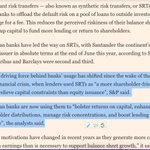
European banks’ risk transfer boom raises exposure to ‘forced deleveraging’ #Banks increasingly reliant on SRTs to boost returns and lending capacity, says S&P report ft.com/content/3b6cccb1-cac2… #SystemicRisk
1
3
317
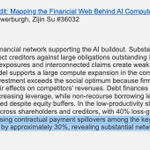
"Suppressing contractual payment #spillovers among the key firms reduces private losses by approximately 30%, revealing substantial network propagation." nber.org/papers/w36032
1
358
Very interesting: BIS just released a macro research agent: github.com/bis-med-it/marco-… You open the folder in an AI coding agent, ask a macroeconometrics question in plain language, and the agent estimates the model step by step: VARs, BVARs, local projections, factor models, sign restrictions and so on. At each important choice (which model, which variables, how many lags, how to identify shocks, which sample) it stops and asks you to confirm. Three use cases: 1) You can ask it to replicate a classic paper it already knows (e.g. "replicate the Sims (1980) VAR with FRED data"). 2) You can also hand it the PDF of a newer paper. it reads the model, asks you to check the setup, and runs it. 3) you can just ask an open question you would like to answer and it proposes a design, tells you where each choice came from (you, the literature, or its own judgment), and warns you about red flags like a price puzzle or weak instruments.
Really cool! "MaRCo@BIS: AI-agentic econometric analysis for central bankers" by Marco Lombardi, Taejin Park, and Fernando Perez-Cruz. "Over the past half-century, econometric software has greatly reduced the burden of implementation, while leaving substantive choices about model specification, identification and sample largely to the researcher. Agentic AI can propose specifications and explain their economic rationale, while earlier automated selection methods could simply searched across candidate specifications using statistical criteria. This paper introduces MaRCo@BIS, the MAcroeconometric Research Companion: a framework of plain-text workflow files, a verified dictionary of canonical model specifications and a tested reference library, read by an off-the-shelf agentic coding environment. MaRCo@BIS proposes specifications and provides their rationale, retrieves and harmonises data, estimates, checks results against economic priors and logs every choice for replication, while the researcher confirms or overrides each (consequential) decision. We document the design, benchmark the agent’s replications of three widely-used structural VARs against the originals, and illustrate the framework across five exercises ranging from a verified replication to an open design question. We also discuss the necessity of human supervision, the risks of specification search and automation bias, and the safeguards against these risks. The framework is released as a public good for the central banking community and macroeconomic researchers more broadly." bis.org/publications/working…
9
55
2,846
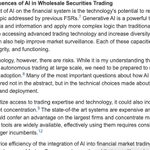
.@federalreserve: "Some Potential Financial Stability Implications of Artificial Intelligence" federalreserve.gov/newsevent… #FinancialStability
1
1
440
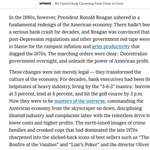
#Viewpoint: "The Financial Bubbles are Getting Worse" nytimes.com/2026/11/16/opini… (gift link) @nytimes
2
405
Now available: The Financial Stability report which presents the Federal Reserve Board’s current assessment of the stability of the U.S. financial system. Financial stability supports the objectives assigned to the Federal Reserve, including full employment and stable prices, a safe and sound banking system, and an efficient payments system. federalreserve.gov/publicati…
25
52
26
183
50,309
MacroPru😷 retweeted
In today's post, the authors provide an update on the vulnerability of the U.S. banking system using four analytical models. They update their analysis with data through Q2 2026 and discuss how the vulnerability measures have changed since the last update one year ago. nyfed.org/4sSFX8I
6
10
1
32
8,495
Meet MaRCo@BIS: an agentic AI framework to support macroeconometric research, from model specification and data retrieval to estimation and diagnostics, while keeping consequential decisions in the researcher’s hands. bit.ly/4sSaUd8
7
29
3
136
7,762
BIS makroiktisat/ekonometri araştırmaları için bir ajan yayınlamış. baştan sona analiz pipeline yaklaşımı ama birkaç dokunuşla (ekstra veri seti vs.) daha da iyi hale getirilebilir. github.com/bis-med-it/marco-…
3
75
3
509
22,507
"paper examines whether borrower-based #macroprudential policies can mitigate credit-fuelled housing booms and busts" erenedo.github.io/assets/pap…
2
3
6
730
Still, “not a bank” is not a free pass. Both papers point to watching for: opaque valuations, liquidity provision, links to banks and PE, and who ultimately absorbs losses. Boring plumbing—until it isn’t. But so far, it appears that private credit has moved risk out of banks.
3
5
476
How resilient are banks to liquidity shocks? Our interactive toolkit covers nearly 13,000 banks across 100+ economies since 2006, with scenarios and a novel break-even stress factor, signalling banks’ liquidity capacity. bit.ly/4ApYz2G
18
90
17
351
20,277
MacroPru😷 retweeted
I had Claude and Gemini work together on analyzing the size of the AI bubble (including the circular-funding circus), the exposure of retirement savings to AI-linked stocks, and a comparison to the size of the 2008 subprime mortgage crisis -- then had Claude cross-check everything and write a combined report. Claude's executive summary: -- The AI bubble by the numbers (Nov 6, 2026) SIZE • AI-linked stocks: ~$30T, ~40% of the US stock market • Value above long-run trend: ~$12-14T (central estimate; range $2-22T) • Funded AI debt: ~$1-2T, plus ~$4-5T of purchase and lease commitments BUBBLE INDICATORS • S&P 500 CAPE: 41 (dot-com peak: 44) • US market cap/GDP: ~229%, near its 240% all-time record (dot-com peak: 144%) • Top 10 stocks = 40% of the S&P 500 (16% in 2016) • AI revenue covers at most 20% of the $1T+ spent on AI infrastructure in 2026 • Big Tech capex ($1T in 2026) exceeds operating cash flow ($804B); hyperscaler free cash flow projected negative by early 2027 • Circular financing: IMF counts $300B equity + $650B debt flowing between AI firms, tied to $1.4T of revenue commitments back to the investors • Suppliers guaranteeing their customers' debt: ~$260B of explicit backstops (Broadcom alone up to $43B) • Profits flattered: $160B of $285B in Q2 profit at 5 megacaps came from marking up private AI stakes; longer server depreciation lives add billions per year • Credit stress: Nvidia CDS hit a record in July; neocloud borrowing now costs ~10% • Nov 5: Nasdaq -5.5% into correction; chip stocks -12%, worst day since March 2020 RETIREMENT SAVINGS EXPOSURE • Total US retirement assets: $51.2T (IRAs $19.9T, 401(k)/DC plans $15.0T, pensions $13.6T, annuities $2.7T) • Invested in AI-linked stocks: ~$10T (range $6-16T), or 12-32% of all retirement assets • Retirement accounts and pensions hold ~1/3 of all US stocks • An S&P 500 index fund puts ~40 cents of every dollar into the top 10 stocks, mostly AI-linked • 80%+ of 401(k) plans default savers into target-date funds; the 10 largest active 401(k) funds hold an average 38% in tech and communication stocks • Stocks are 34% of US household wealth (dot-com peak: 26.7%) • Estimated retirement losses: Magnificent 7 fall 25%: ~$1.7T. AI stocks return to trend: ~$4-5T (range $0.7-7.3T). Broad market reversion: ~$12-15T VS. THE 2008 SUBPRIME CRASH (today's dollars) • Subprime debt outstanding: $2.1T. AI funded debt: ~0.5-1x that. Including commitments: ~2.4-3.3x • Housing bubble excess value: $13.4T. AI excess value: ~$12-14T, about the same • Household wealth lost 2007-09: $22-28T. AI stocks returning to trend: ~$12-14T lost. A broad market reversion: $35-45T KEY DIFFERENCE: 2008 was leveraged household mortgage debt held by banks. The AI boom is mostly equity, so losses land on shareholders and retirement savers; default risk is concentrated in neoclouds, AI labs and their off-balance-sheet financing vehicles. -- Full report with sources: claude.ai/artifact/AFTSWS8gN…
16
26
11
133
38,805