

PhD in Economics🎓 • Public policy, energy and climate • Previously @UAM_Madrid @EsadeEcPol @UCRiverside @MemorialU @UV_EG
Madrid, Comunidad de Madrid
Joined February 2011
- Tweets5.2K
- Following838
- Followers4.3K
- Likes7.5K





Una verdad muy incómoda.
Dicho esto, si no hubiera coincidido con l ascenso del precio de la vivienda, y problemas de accesibilidad, el conflicto generacional habría pasado desapercibido aún por bastante tiempo…

The ugly truth about France and some of the other European countries currently in turmoil - and which none of the politicians want to admit because it'd be political suicide - is that you can't solve the problem by going after immigrants (as the right asserts) or the rich (as the left asserts), but you could solve it by going after the old.
One extraordinary statistic for you: people over 60 in France, a quarter of the population, own 60% of France's wealth, non-financial and financial (ofce.fr/pdf/revue/2025/3-192…).
And here is another crazy statistic:
that same quarter of the population, those above 60, receive nearly two-thirds of all social spending by the French government (previssima.fr/actualite/prot…) - which is famously among the highest in the world (France's government spending is an insane 57.3% of GDP).
Last statistic: they make up about 40% of voters because they're a third of registered voters (insee.fr/fr/statistiques/266…), and they turn out far more than anyone else (franceinfo.fr/elections/sond…).
Put our 3 statistics together and there's almost a bit of an apartheid situation here: the old own most of the country's wealth, collect most of the social spending and have the political power to keep it that way.
Which makes them a de-facto rentier class, living off assets and transfers paid for by younger generations.
And, of course, at the risk of stating a truism, the future is built by the young. Yet France keeps effectively taking money away from them to give it to those whose working lives are already behind them - and need the money far less since they already own the country's wealth.
What about inheritance, I hear you ask? That's the funniest/saddest aspect: given that life expectancy has kept rising, the French now inherit a home at 54 on average. The most common case is someone in their 80s leaving it to heirs in their 50s, in effect the very old transferring wealth to the about-to-be old (insee.fr/fr/statistiques/fic…).
You can add this to our earlier apartheid statement: on top of all the rest, even when the old finally let go of their wealth, it stays within their own "camp".
That's my personal situation, incidentally: I'm 42, my father is 71 and he is starting to look at ways to pass things on to me and my siblings, when our professional lives are already well settled, so it'll arrive when it changes things the least, which is pretty much the French system in a nutshell.
Now, I get that there'd be some unfairness in going after them: they paid into the system their entire working lives, playing by the rules of a social contract that told them if they paid up they'd collect at the end. Changing the rules now means breaking that promise, which is admittedly unfair.
But there's no magic wealth tree in any society: you can only take it where it is. That's the way most major societal transformations end up happening. They're often triggered by a catastrophic event (the so-called "four horsemen": mass-mobilisation war, revolution, state collapse, plague) BUT what really drives change is a transfer: wealth gets pried from the privileged class who've been sitting on it and handed to those who'll build what comes next.
So, in theory and in an ideal world, you can do without the catastrophic event and directly proceed with the transfer...
The fact that in France, and elsewhere in Europe, it's the youth protesting is probably no coincidence - even though they don't frame it as a generational fight. And even though, cruel irony, the left politicians many of them march behind promise to bring the retirement age back to 60 (lcp.fr/actualites/legislativ…), which would make the situation even worse.
Let's say they understand intuitively that the system is stacked against them, even if they haven't yet figured out how. And politicians are obviously doing what politicians do, meaning pandering to the people who actually vote, while pointing the young towards easier - and politically convenient - scapegoats.
To be clear I'm not saying it's the only problem in France, VERY far from it. I'm also not saying that all old people in France live a lavish lifestyle at the expense of younger generations: there are also plenty of very poor retirees who, if anything, would deserve more.
What I am saying is that it's probably the biggest elephant in the room: everyone can see it, nobody dares mention it - no politician, from any side, wants to run on cutting grandma's pension - and it makes every other problem harder to fix.
Por no hablar del tufillo machista. ¿Estaríamos comentando cómo le queda el modelito si fuera un hombre?

A ver que entienda. Que lo importante es cómo se vistan, aunque luego tuvieran serrín en la cabeza.
Oye, que igual a estas chicas les gusta leer, aprender y estar informadas antes que pasar 15h a la semana buscando modelitos…


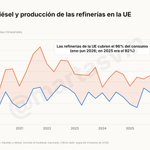
Europa depende menos del diésel importado de lo que se suele pensar. Con datos de Eurostat, las refinerías de la UE cubrieron el 96 % del consumo en el primer semestre de 2026, en parte porque el consumo ha caído más que el refino


Matemáticas de primaria
100 millones de dotación.
🏠 Escenario superoptimista: piso medio de 250.000 € en Cataluña.
→ Generalitat la mitad: 125.000 € por piso.
🧮 100.000.000 ÷ 125.000 = 800 viviendas.
👥 Población de 40 a 55 años en Cataluña: más de 2 MILLONES (Idescat)

🔴URGENTE | La Generalitat pagará la mitad de la compra de la primera vivienda de los mayores de 40 años con ingresos estables | Por @CesarMartinezAg
20minutos.es/cataluna/barcel…

En nada nos vemos!

Hoy a mediodía, a las 12h, celebramos el webinar de presentación de la nueva edición del Informe Económico y Financiero, elaborado con el apoyo del @BancSabadell. ¿Te unes?
Participarán Sofía Rodríguez, @g_escribano (@rielcano), @P_Linares (@ucomillas), @Martasvm (BdE), Enrico Bergamini (@esade) y nuestro director @jorgegalindo.
Inscríbete aquí → esade.me/informeeconomicoyfi…
Aquí estaremos el próximo jueves!
👏🏻
El próximo martes 14 a las 12h nos vemos para el webinar de presentación de la siguiente edición del Informe Económico y Financiero que realizamos con el apoyo del @BancSabadell.
Nos acompañarán Sofía Rodríguez, @g_escribano (@rielcano), @P_Linares (@ucomillas), @Martasvm (BdE), Enrico Bergamini (@esade) y nuestro director @jorgegalindo.
Inscríbete aquí → esade.me/informeeconomicoyfi…

Marta Suárez-Varela retweeted

Vivo en Madrid desde hace (bastantes) años.
Y sinceramente, me encanta cuando oigo a alguien con cualquiera de las 'decenas' de acentos andaluces. Sobre todo a un alto directivo/a, a una inversora, a un fundador potente...
A alguien que podría tener la tentación (quizá más tentación) de cambiarlo, de ocultarlo. Por prejuicios o por lo que sea. Y no hablo de que se suavice con el paso del tiempo. Hablo de forzar la corrección.
Y me encanta porque creo que demuestra personalidad. No se trata de chovinismo barato. Nada de eso. Se trata de respetar las raíces y de defender con los hechos que el acento no significa nada más que riqueza cultural.
Marta Suárez-Varela retweeted

Esta es para mí la foto real de cómo se distribuyen las viviendas en alquiler que están en manos de propietarios particulares: 1 de cada 7 en manos de hogares con cinco o más, 1 de cada 28 en manos de hogares con diez o más.
Os cuento la radiografía completa 👇🧵

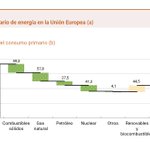
⚡️ La pandemia y la invasión de Ucrania obligaron a una profunda reconfiguración del sistema energético europeo.
En este nuevo Documento Ocasional del @BancoDeEspana analizamos qué fortalezas y vulnerabilidades emergieron en ese proceso, hoy aún más visibles con Ormuz. 🌍

📉 Como resultado, España ganó entre 2 y 3 p. p. de competitividad-precio en la industria intensiva en energía frente a Alemania y Francia.
La principal conclusión es que Europa ha ganado resiliencia, pero el ajuste sigue siendo incompleto.

📊 Comparto aquí el trabajo, en coautoría con Mar Delgado y Mónica Correa.
bde.es/wbe/es/publicaciones/…
Un documento lleno de datos y gráficos sobre cómo ha cambiado el sistema energético europeo y por qué esa transformación sigue importando hoy.
