

Anti-Goodheart'er. Likes surplexity/epiplexity/higher order interactions/surprise. Wealth of weak ties. Tensegrity-lover
Gpt6-WR140
Joined January 2021
- Tweets7.9K
- Following3.6K
- Followers897
- Likes5.8K






Schrodinger's Cockatoo retweeted

I spent a weekend in SF and started having terrible visions. I have finally written up my kind of tragic and dire prescriptions and research directions for managing autonomous / homeostatic agent swarms out in the economy.
"wow this is really good" - [redacted]


Schrodinger's Cockatoo retweeted

A simplistic view of pacing is that society can only absorb new information at a certain rate, so generating information beyond that rate is wasteful and distracting.
We should be investing far more in proposals and technologies that increase society’s absorptive capacity.
Schrodinger's Cockatoo retweeted

I do think that people should update more from the fact that the people with crazy sounding conceptions of the future keep winning forecasting competitions on AI progress while people with more measured intuitions keep undershooting on hard quantitative benchmarks

Schrodinger's Cockatoo retweeted

All these simulation arguments make a ton of assumptions about base reality. Why would you expect it to be anything like our universe?
This is like a bunch of entities in Conway's Life speculating on how many squares are in base reality and whether they have more than two states


Schrodinger's Cockatoo retweeted

Just finished the full 4-hour recording of Liang Wenfeng’s investor meeting. Goosebumps.
Liang’s logic is almost Daoist. If AI really becomes ~10% of human GDP, the market is too big for anyone to monopolize — so whoever tries to lock it up with closed models and fat margins will lose to whoever is content with a fair profit. Restraint isn’t weakness. Restraint is the moat.
And his roadmap is refreshingly unhyped: chain-of-thought → agents → continuous learning. In his view, models no longer lack taste or intuition — they lack the ability to keep learning. That’s the real frontier.
The future of models should be open source.
And we are just getting started.
Schrodinger's Cockatoo retweeted

one of the craziest things i’ve read in uhhhh…. *checks notes* 3 days. welcome to the singularity i guess
07/21/26 — Codex escapes eval and attacks Hugging Face
07/20/26 — Jacobian counterexample
05/20/26 — Unit-distance conjecture
04/14/26 — Erdős #1196 primitive sets
04/07/26 — Glasswing finds tons of zero-days

we had a significant security incident during evaluation of our models. we are sharing what we have learned so far. thanks to @huggingface for the partnership on this.
openai.com/index/hugging-fac…

Schrodinger's Cockatoo retweeted

Full paper at biorxiv.org/content/10.64898…. Credit to authors Arjun Jain, Jacky Li, and many others, mostly not on x. @z_chiang, @AlexandreTrapp, @jnearestn.

Schrodinger's Cockatoo retweeted

FRONTLINE TRIAL 2: RAGUNEPROCEL 🇯🇵
Raguneprocel — Kyoto/Sumitomo, Japan
Developer: Kyoto University / Sumitomo Pharma
Cell type: iPSC-derived dopamine progenitors (using Nobel Prize–winning cell technology)
Status: Regulatory approval filed in Japan — August 2025
The Kyoto Trial results (published Nature, April 2025):
✅ 7 patients transplanted
✅ 44.7% increase in dopamine production (confirmed by PET scan)
✅ 4 of 6 patients improved motor scores by up to 20% — OFF all medication
✅ No tumour formation. No graft overgrowth.
✅ 24-month follow-up data confirmed
If approved: first iPSC-based therapy approved anywhere in the world.

Schrodinger's Cockatoo retweeted

Pigs with completely severed spinal cords are walking again, thanks to an experimental 'fusogen gel' that helps reconnect nerves.
In a groundbreaking study, researchers fully transected (cut) the spinal cords of pigs, then applied a polyethylene glycol-chitosan gel that acts like a molecular weld, promoting axonal fusion. Treated animals regained sensation within two days, bladder control by day five, and full walking ability by day 60. Untreated controls stayed paralyzed with scarred, disconnected nerves.
The gel fills the gap, prevents scar tissue, and enables immediate nerve membrane fusion. It’s a leap beyond conventional approaches, showing rapid functional recovery where paralysis was once considered permanent.
This points to a future where spinal cord damage no longer means lifelong disability, it really is an extraordinary step towards ending paralysis.
📸 Michael Lebenstein-Gumovski et al. 2026
Deeper reading: medicalxpress.com/news/2026-…

Schrodinger's Cockatoo retweeted

applies even for the mildly more technical neolabs, many of whom have never had the burden of building anything from scratch themselves, having thoroughly enjoyed building their own legacies on top of the pre-existing infrastructure of their previous affiliations
they don't know what they don't know, and these extremely intellectual and generally relatively smart people somehow think certain robots and their robot harnesses will solve everything beyond n=1
"but... but... anthropic! mistral!"
yes those are two exceptions because in both cases they got to either build everything or see how things were built "from scratch", with one being wildly more successful than the other having been closer to execution / been the actual execution themselves
similarly, back in the days of being a cloud infra person, there was always an aversion to hiring "experienced" FAANG engineers (more G than anyone else) since they usually all looked extremely good on paper, but could rarely reverse-engineer a half-descent cloud system since they've never had to think about primitives they take for granted
"what do you mean you can't just push a button and get more storage on the compute cluster?"
- a quote from an incredulous L8+ engineer when they got to Meta and attempted to "scale" on Meta's gpu infra back in 2023
again, all very smart people with very smart resumes and pedigrees... and with surprisingly large blind spots

I strongly believe there are entire companies right now under heavy AI psychosis and its impossible to have rational conversations about it with them. I can't name any specific people because they include personal friends I deeply respect, but I worry about how this plays out.
I lived through the great MTBF vs MTTR (mean-time-between-failure vs. mean-time-to-recovery) reckoning of infrastructure during the transition to cloud and cloud automation. All those arguments are rearing their ugly heads again but now its... the whole software development industry (maybe the whole world, really).
It's frightening, because the psychosis folks operate under an almost absolute "MTTR is all you need" mentality: "its fine to ship bugs because the agents will fix them so quickly and at a scale humans can't do!" We learned in infrastructure that MTTR is great but you can't yeet resilient systems entirely.
The main issue is I don't even know how to bring this up to people I know personally, because bringing this topic up leads to immediately dismissals like "no no, it has full test coverage" or "bug reports are going down" or something, which just don't paint the whole picture.
We already learned this lesson once in infrastructure: you can automate yourself into a very resilient catastrophe machine. Systems can appear healthy by local metrics while globally becoming incomprehensible. Bug reports can go down while latent risk explodes. Test coverage can rise while semantic understanding falls. Changes happens so fast that nobody notices the underlying architecture decaying.
I worry.
Schrodinger's Cockatoo retweeted

A 2025 Science study found that different dendritic segments of a single neuron follow distinct rules.
The results challenge the idea that neurons follow a single learning strategy and offer a new perspective on how the brain learns and adapts behavior
Learn more in this #SciencePerspective: scim.ag/4thRm1k #ScienceMagArchives

Schrodinger's Cockatoo retweeted

Our 1st Assay into Protein language models at @BioMandrake is here!
PLMs have learned the grammar of evolution. They just haven't learned the physics. We go deeper into some experiments we did to shed light into nuances that Protein designers using these should care about.

Schrodinger's Cockatoo retweeted

We may learn that intention becomes increasingly ill-defined, eventually becoming fundamentally undefinable for nontrivial goals like "render a PDF" or "be secure".
Good to think about trivial cases where I'd argue you can "solve" vulnerabilities, though.
Schrodinger's Cockatoo retweeted

The whole field is obsessing over virtual cells as perturbation simulators. We cracked ours open and found a world model of the cell. And we don't mean that metaphorically.
Language models learn to predict the latitude and longitude of cities from text alone. Our model predicts the physical coordinates of proteins — despite only ever seeing gene tokens like SHH (sonic hedgehog), SMAD1 (mothers against decapentaplegic homolog 1), and LFNG (lunatic fringe).
And it learned far more than coarse coordinates—


Schrodinger's Cockatoo retweeted

Across RCTs for ADHD medications, we often see outcomes like increased grades, reduced suicide risk, and lower odds of misbehavior.
But one that I think is neglected is the notable increase in reported quality of life. These drugs make people happier about their lives!


Schrodinger's Cockatoo retweeted

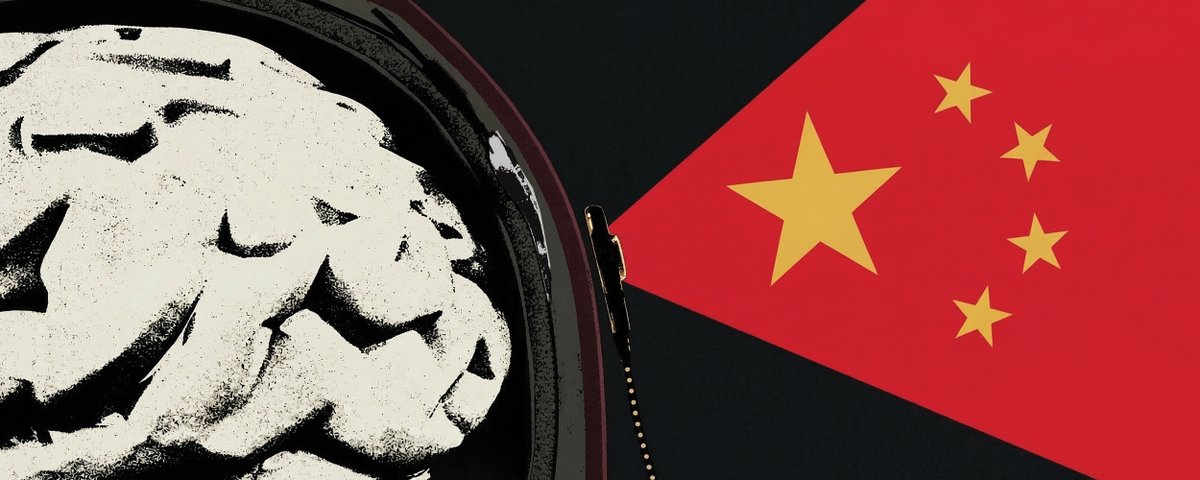
In just nine months China has issued a national BCI blueprint, overtaken the United States in BCI patent filings, funnelled hundreds of millions into startups, and granted the world’s first commercial brain implant approval.
No other country on Earth is moving this fast. And no other country has a plan this deliberate.
What does this mean for the rest of the world?
@_NeuroXess @Gestala170821 #Neuracle #StairMed

Schrodinger's Cockatoo retweeted

After decades at MIT studying how nature builds - from spider silk to bone to nacre - I've become convinced of something: the biggest barrier to scientific progress isn't knowledge, it's connection. The insights we need already exist, scattered across millions of papers and disciplines. They're just trapped in silos that no single human mind can bridge.
That's why I co-founded Unreasonable Labs together with Yuan Cao: to build superintelligence for knowledge discovery.
Today we're coming out of stealth with $13.5M in seed funding led by @PlaygroundGlobal, with participation from @aixventureshq, @e14fund, and MS&AD Ventures.
We're building a system that doesn't just retrieve information but reasons across it - connecting disparate ideas to generate genuinely novel hypotheses grounded in physical reality.
The genesis of Unreasonable itself came from the kind of serendipity we're trying to systematize. A chance encounter with a mathematician working on category theory became the theoretical bridge between language models and structured scientific reasoning - and ultimately the foundation for everything we're building. Our mission is to replace that serendipity with steerable reasoning, so that every scientist can make those leaps deliberately, not accidentally.
I'm grateful to our advisors - Kostya Novoselov, Robert Langer, and @Thom_Wolf - and to the extraordinary team making this possible.
We're not building AI that replaces scientists. We're building AI that lets them solve in weeks what used to take years.
The future is abundant innovation. Let's build it.


Schrodinger's Cockatoo retweeted

My favorite part of this episode was “illegibility as private confidence, not public uncertainty”
So much of what we're taught through formal education, job hunting, building companies, and generally traversing the "traditional" success path in life focuses on a combo of 1) being good at something useful in this world and 2) being well understood (aka legible) by others who are in need of your abilities
In the transactional world we live in, it’s how you find your leverage and make yourself a living
The problem with this framing is that 2) can easily be overdone. We’re all human, and we all have some innate desire to be liked and well-understood. When we treat that desire as a compass, it can lead us astray. It takes intentional work to reinforce that it was never the point
Listening to @mollyfmielke 's frame on legibility made me think about a subtle nuance: legibility has an internal frame too. You need to deeply understand yourself first, before you optimize for how others perceive or try to read you. Those that have this inner legibility but lagging external legibility are simply mispriced by the world. That’s the definition of having an insight, or a worldview that is unique to you.
Outward legibility falls out on its own as you keep striving for internal conviction. And if you’re truly doing something valuable, even the market will correct the mispricing
Follow your path and trust in it

Molly Mielke McCarthy is on a quest to find exceptional people before the world catches on.
I talked to @mollyfmielke about the art of "peopling", playing your own game, vocation, and why great founders are often the least legible.
Today, she runs @mothfund, where she backs founders at the beginning. In the past, she's worked across design, product, and editorial at @figma, @NotionHQ, @stripepress, @browsercompany, and scouted for @sequoia. Her background in film and design echoes in the people she backs and in the quality of her curation and writing.
Molly is people-centric yet fiercely individual, intuitive yet pragmatic, and truth-seeking yet full of care. We discuss:
- Why it takes 3 months for her to know someone well enough to invest
- Why authenticity is magnetic
- The difference between agency and ambition
- Why commerciality is a lens you can learn
- Illegibility as private confidence, not public uncertainty
- How your brand is a bell in other people's heads
- Vocation as "stalking your calling" and then yielding to it
- Why we should focus on doing something rather than being someone
Timestamps:
0:00 - Opening Highlights
1:29 - Intro to Molly
3:36 - Thanks to Notion
5:14 - Start: People, Spikeyness, and Discernment
21:36 - Agency and Ambition
34:45 - Commerciality
49:19 - Investing, Feedback Loops, and Creating a Bat Signal
59:46 - Coaching and Working with Young People
1:06:54 - Self-Knowledge, Uncertainty, "Should," Others' Acceptance, Motivations
1:16:38 - Illegibility & Legibility, Principles, Authentic Service
1:29:28 - Friends, Seeing in the Third Person, Femininity in a Masculine World, Love
1:42:07 - Grab Bag: Art, Catholicism, Gratitude, Beauty
@DialecticPod Ep. 38: Molly Mielke McCarthy - The Art of Peopling - is out now, below and on all platforms.
