

The design firm for the AI age.
Request a Brainstorm →
Joined August 2024
- Tweets187
- Following9
- Followers7K
- Likes655


Pinned Tweet
On Oct 29, Amazon's CEO said shopping through outside AI agents is "still not great, nor more convenient than coming to a retailer directly." Amazon blocks them and pushes its own. Walmart is building them a door.
Here is what every store has to decide.

Design your agent's states in minutes, exported straight to React.
1/ Six states: idle, thinking, working, waiting, blocked, done
2/ Describe your agents in a line or drop in up to five inspiration images
3/ Seven materials, from glass and jelly to clay and plush
4/ Tune the eyes and regenerate one agent without touching the rest
5/ Export a React component, a web component and PNGs, with no video files
Agents that show when they're working, waiting or stuck are agents people trust to run without supervision.
Grab the free skill below.

Brands building experiences that grow trust with customers will win in the age of agentic commerce.
Walmart sees a ~35% increase in average order value with Sparky orders.
Here's what they did to get there:
1. Tried checkout inside ChatGPT first. Walmart was a launch partner in 2025, and an executive later said those purchases converted three times worse than click-outs to Walmart's own site.
2. Built its own agent instead. Shoppers tell Sparky what they need in their own words, in the app, on the site and in stores.
3. Put Sparky inside ChatGPT and Gemini, so those conversations still run through Walmart.
4. In October it opened a beta for everyone else's agents. They shop through Sparky over MCP instead of scraping the site, each with its own profile and a spending limit the customer sets.
(Screenshot is from Anthropic's Walmart case study)


Some quick observations on Anthropic's IPO:
1/ The number of customers paying $100K or more grew 12x in a year, to over 11,900. And the existing ones are spending about 9x what they did 1 year ago (wild).
2/ The net loss is $23.3B, but $21.9B of that is a paper loss. They owe early investors shares, and those shares got more valuable, so accounting rules count it as a loss (has to do with convertible notes etc being exchanged)
3/ Revenue per employee is over $6.6M!
4/ They did $17B in revenue last quarter, and that's up more than 12x from a year ago.
5/ The stat they feature most is compute efficiency, where they say they get 4x more revenue per dollar of compute than in early 2025. ( I think this is a metric they defined themselves but not 100% sure)
6/ It's a public benefit corporation, so shareholders are buying into a company that's legally allowed to weigh other goals alongside their returns.
7/ You can request shares at the IPO price through Robinhood, SoFi, Schwab, Fidelity and E*TRADE, which I think is somewhat unusual for an IPO this size, but maybe it's a sign of the times?
8/ The whole roadshow is an 11 chapter video that anyone can watch, and it's cool that they shared it.
9/ The ticker is $ANT. It's expected to price on November 18 and start trading the next day.
10/ One of the case studies is about Sparky, Walmart’s shopping assistant, and they say orders through it are about 35% bigger. What’s interesting to me is that shoppers only ever see Walmart, and Anthropic is the plumbing underneath. Sidenote: I co-founded @MeetLCA an agency that builds experiences like this big companies/big startups so this trend is what I'm seeing too (demand for agent experience products)
11/ The founders' letter tells investors to "never let your company be worth a dollar more than it is actually worth." I haven't seen that in an IPO pitch before.
12/ About 250 customers pay them $10M or more a year, and over 1,900 pay $1M or more.
13/ They spent $9.9B on compute last quarter, which is more than half of revenue. $5B of that was bought on short-term deals that cost a lot more, which tells me demand is running ahead of what they planned for.
14/ All 7 co-founders are still at the company, and they lose about 1% of the people they want to keep each year.
15/ They recorded $1.1B in stock based compensation last quarter.
16/ They have about $96B in cash and have raised about $141B in total.
Note: this is not financial advice. Do your own research. I share things I find interesting about startups and building businesses in real-time.
Whether you're into AI or not, this is a historic moment for tech, AI and the USA.

3
351
Every business now has two doors: one for customers, one for their agents.
Being nice to agents, in practice:
1. Publish instructions for agents.
An llms.txt file or a skill tells a model what you do, what each action is for and when not to use it. Stripe says agents are nearly 40% of its documentation traffic.
2. Ship an MCP server.
An agent clicking through a site built for people can get stuck on a cookie banner. With MCP it calls you directly, and each tool's description is what it reads when deciding whether to use you.
3. Fail out loud.
"Nothing matched" or "that didn't go through" is something an agent can work with. A vague success message sends it back to its person with the wrong answer.
4. Keep the person in the loop.
Let the agent do the work, and ask the human before it spends money or sends something in their name.

I gave a talk a few months ago on building trusted agentic products. One of the concepts I spoke about was around both humans AND agents needing to trust you.
Seems that we're seeing this trend continue (and it's not even close to slowing down).
Be nice to agents, friends.
3
7
479
It's hard to think of a better distribution bet for a consumer brand than a ChatGPT plugin right now.


3
420
Anthropic just quietly dropped a Fable 5.2 prompting guide.
The most important takeaway is simple.
Before you give Fable any real work, audit and clean up anything your team created to babysit older models.
They're sitting in your prompts, skills, memory files and CLAUDE.md:
"Be careful."
"Never retry."
"Always use subagents."
"Keep sentences under 20 words."
On a model this capable, those lines override its judgment and run up costs it doesn't need.
The guide says some of them now raise cost, cause side effects or do nothing at all.
We call it prompt debt.
Give this to Fable 5.2 before anything else:
"You'll be working under the instructions in this project, so audit them for anything that will hold you back. Don't edit any files yet, because I want to review your calls first. You don't need my approval to read or list any file.
First, find the files that hold agent instructions: system prompts, CLAUDE.md and AGENTS.md files, skills, subagent definitions, memory files and notes. Skip dependency and build folders like node_modules, since they hold no instructions and would waste time and money. Then read those files.
Flag every line that:
1/ Pushes you to use subagents by default
2/ Writes a token budget into the prompt ("you have 40,000 tokens left")
3/ Tells you to think less ("answer directly, don't deliberate")
4/ Sets a hard writing limit, like a maximum number of words per sentence
5/ Says never, always or don't with no scope or reason
6/ Requires approval for a whole category, like "messaging anyone outside this chat"
7/ Is a caution left over from an old incident, especially one an agent wrote itself
8/ Tells you to treat your earlier answers as done
Keep anything that tells you what you can't know on your own: the goal, facts about us, real limits and what done means.
For each flagged line, give the file, the line, its number from the list, and your call: delete, keep, or rewrite with a scope and a reason (write the new line). Then list the actions that should never need my approval.
Finish the whole audit in one pass. If a file can't be read, note it and keep going. Write the report for someone who hasn't seen these files: start with the changes that matter most, in plain words."

Your product can show up on nearly 100 different AI surfaces.
Over half of them showed up in the last 60 days.

4
373
24 agent interactions created with @benjitaylor's Stageshow

We wanted to have some fun with the Late Checkout Plaza website, so we brought it to life, and created a 'halloween' mode complete with witches and trick-or-treaters.
Don't forget to bring a little fun to your world -
1
8
1,776
Agents are the 5th mega wave in shopping in 110 years.
1916: Shoppers serve themselves
1950: Shoppers pay with a card
1994: Shoppers buy online
2007: Shoppers buy on their phones
2026: Shoppers send an agent

On Oct 29, Amazon's CEO said shopping through outside AI agents is "still not great, nor more convenient than coming to a retailer directly." Amazon blocks them and pushes its own. Walmart is building them a door.
Here is what every store has to decide.
1
3
328
For anyone who wants to read the sources:
Jassy's comments on Amazon's Oct 29 earnings call, via Fortune: fortune.com/2026/10/29/amazo…
Amazon blocking Meta's Muse in September, via GeekWire: geekwire.com/2026/amazon-blo…
Walmart on building a way in for shopping agents: corporate.walmart.com/news/2…

108
Incumbent brands are sitting on four superpowers: cash, trust, data and distribution. Most of their leaders don't know how to use any of them yet.
That's #3 on @TheoTabah's list, and it isn't even the spiciest one.
10 things we're seeing with many leaders at incumbent brands:
1. They want to rethink their offer from the ground up, not just 'adding AI' to their existing product
2. Can't disrupt cashflow and existing biz, so they're thinking about an entirely new product offering outside of core product
3. Cash, trust, data, and distribution are the four superpowers incumbents have - most don't know how to capitalize on all (or any) of them. Cash is precious and still feels better in the bank. Trust is beginning to move. Data is messy. Distribution is great, but current customers don't know what they want or don't like AI.
4. Hire a few ambitious leaders at the VP level from 'big name' tech co's to drive change, but those leaders aren't equipped with the team to move fast and ship
5. Everyone wants durability, but none feel confident it's possible
6. They want to 'invent something new', but then reference existing patterns and companies as what they think they want
7. Coordination and cooperation across the team - evolving the way they work while innovating and keeping the train on the tracks - is really hard
8. Staying up to date with what matters is not feasible. Many miss important developments or get on them late - the space moves fast
9. Few understand that if you're building a tool, you're building for an agent (not a human), and you will eventually become plumbing. Products, agents, and new offers cannot be pure utility if you want durability and humans using you everyday (it can if you decide to be a muse connector or ChatGPT plugin / MCP in to the dominant AI apps)
10. Everyone's figuring it out. Even those with the most conviction are still questioning and rethinking things daily.
Welcome to the AI Age.
295
Walmart's Trent Addington says the average person won't give AI agents control "until they earn that trust."
Here's what that looks like at a store.

2
382
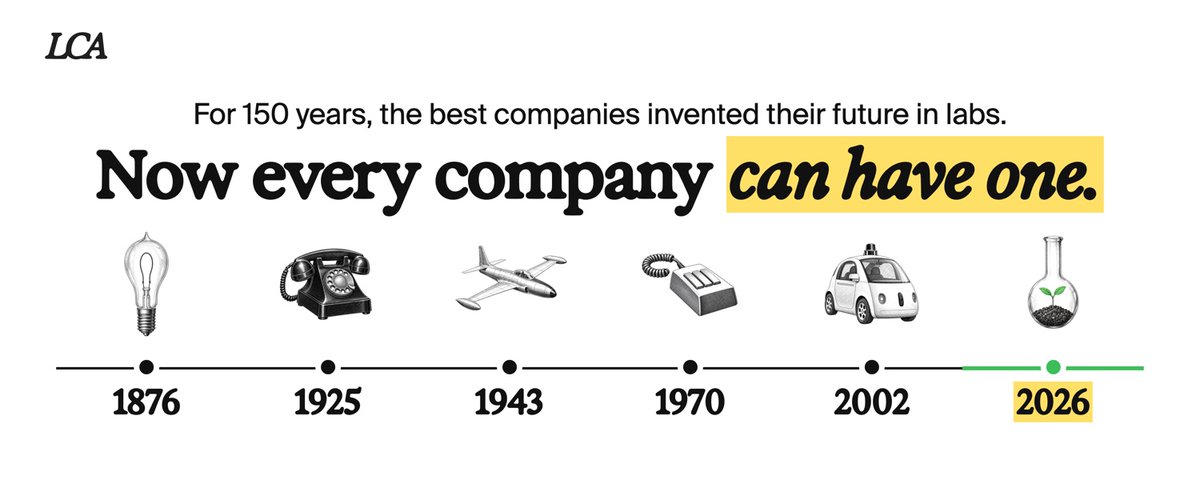
Another one for the labs timeline. Started as an experiment, now it's an industry standard.

Agent Skills started as an experiment in Claude Code. Many across the industry have come to adopt it, so we at Anthropic found it more fitting to donate it to the @AgenticAIFdn, next to MCP.
1
3
347
Checkout this week's post for the rest of the timeline, and how to run one inside a big company:
nitter.gq/meetLCA/status/2112951…
1
145