

Ph.D. Food Scientist decoding stock patterns || Not interested in calling tops and bottoms || My personal journal || Not Financial advice ||
Mars
Joined August 2019
- Tweets4.7K
- Following269
- Followers4.4K
- Likes6.8K




Pinned Tweet
YTD: +202%
- as of Oct 29,2026.
My portfolio peaked on Oct 6 !
Sharing this for one reason: the stocks weren't special. Mostly the same AI/semis names everyone owns and knows.
The hardest part wasn't the gains. After July, my account chopped sideways for months. I honestly felt like I was doing something wrong — like I was making no progress at all. I was trying some entries and my SL would get triggered in couple of days and then the stocks used to go back up..
Looking back now, I'm kind of proud of that stretch. I didn't chase, didn't force trades, didn't break my rules:
• Buy pullbacks ( but still above KMA’s), not breakouts ( you know our green line buys) - although I was buying breakouts in whole of April and may! But later slowly adopted to buying pullbacks.
• Cut every loss at −7% ( no matter what finx says about how good that stock is and how insanely they are going to grow)
• Sit out when the market isn't right( toughest job when I watch some accounts here post wins every day.. I used to feel so tempted to open a trade). I take feedback from my trades .. if two or three positions fail then that’s like stay away for me for few weeks. And even if I try new entries .. size would be relatively so less.
The chop didn't feel like progress. It was. It protected everything the good months had built.
Entries and exits > stock picking.
I still feel I need to improve a lot! I did not focus on any Non Ai names.
I wish I paid more attention to health care names and oil and gas names. I did not take them seriously. 😒
Stay safe! Protect your gains so when good environment comes.. you have energy and funds to deploy.
One good thing with this market is that .. atleast now you know very well whom to follow and whom to unfollow..
Spend time to go through your follow list and take action.. because when market is finally ready .. you need good signals on your time line.
Also after June I was pretty much constantly posting about the chop and how it has become hard penny environment from easy dollar environment… even last couple of weeks I have been posting about caution.
it would be great if you can share in comments if my posts or commentary helped anyone of you to stay cautious this year and protect some gains atleast or helped avoid some names that dropped heavy.
Thank you all for the support this year! 🫡

Ravi’s post got me curious and had me vibe charting with muse! 👀😂
Muse now has call option where you can talk and build things! It’s so cool check it out.
Coming to our post :
Thursday's we had a big drop in indexes. $SPY dropped 4.4% and $QQQ dropped 6.5%.
Shockingly about a dozen names have massive control on indexes.
SPY is 42.6% AI-related. QQQ is 75.5%.
And just 12 stocks do most of the work: $AAPL $NVDA $MSFT $AMZN $GOOGL $META $TSLA $AVGO $MU $AMD $ASML
The other 476 stocks in the S&P 500 — and 71 in the Nasdaq-100 — barely move the index.
BTW $SMH has only 25 stocks!
You don't own the market anymore. You own about a dozen names, and a lot of passengers.
Check out the images below for some stats.
Educational post · Not financial advice


Is the S&P 500 actually diversified?
The underlying math tells me otherwise.
Market cap weighting means a select few trillion dollar tech names dictate the direction of the entire index. When a sharp breakdown in $SMH alone can drag down the broader market you are no longer holding 500 independent companies. You are holding concentrated tech risk masked as a broad fund.
This structural vulnerability is exactly why blindly buying dips in a weak market is dangerous.
Unfortunately cash is outperforming most of the S&P positions.


We are in a correction. Sooner or later stocks will start to work again. Leaders will start to base and show us strength first.
So I want to talk about a concept I have heard in Mark Minervini's books and interviews — Progressive Exposure.
Part 1 · Increasing exposure
If you were cautious about the current environment and moved into cash completely — how do you get back in?
It's all about getting market feedback, and then slowly getting into the market. Small test trades first. If they work, you press. If the first feedback is No, you go back to cash — and the waiting game starts again, for the setups.
Part 2 · Raising cash
And how do you get back out? Nobody rings a bell. Your stops start hitting, leaders stall — that is the market giving you feedback again.
You cut the losers and you don't replace them. You keep selling into strength and protect the gains. Your cash rises, name by name. But if you keep buying new stocks, you can never raise cash — even when the market is telling you to.
Getting in and getting out are the same skill: listen to the feedback, and let it set your exposure.
It doesn't have to go from 25 to 50 and then full. The numbers just give you an idea. Your exposure simply increases or decreases as you get feedback from the market.
Million dollar sentence:
"Trade your largest when you are trading your best, and your smallest when you are trading your worst."
— Mark Minervini @markminervini
Paste this somewhere you will see it every day, and keep reminding yourself.
Because most people do the exact opposite. They lose some, and then they want to revenge trade and make it back — and end up losing even more.
Educational post · Not financial advice
#SwingTrading $MAG7 $NVDA $MU


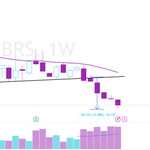
$CBRS Wow look at how well the measured move worked.
For trading IPO names.. the only indicator you need is IPO AVWAP.. & the time frame should be Weekly ( Monthly even better).
Just that.. nothing else.. !
Try removing all your indicators and drawings and put just Weekly TF and IPO AVWAP.
Look if it has distribution.. or accumulation in that IPO Base. Wait for price to close above the avwap and when the retest come's .. you grab it!


🎯

I think the next major opportunity in AI could come from the hyperscalers themselves.
$MSFT $GOOGL $AMZN $META
We're already seeing a major reset across the semiconductor and AI infrastructure space, with many names correcting 30-50% from their ATHs.
But here's what makes hyperscalers interesting to me:
- AI demand is already translating into strong cloud growth, particularly at Azure, Google Cloud, and AWS.
- These companies have something most AI startups don't: massive distribution, existing customers, and profitable businesses generating substantial cash flow.
- AI isn't just a new revenue opportunity. It can also improve advertising efficiency, enterprise productivity, cloud services, and operating margins.
- One of the biggest potential catalysts could be a slowdown in CapEx growth while revenue and earnings continue expanding. If that happens, we could see a meaningful improvement in free cash flow.
- They also have opportunities to lower infrastructure costs through custom silicon, better utilization, and more efficient AI models.
I do think quality semiconductor leaders will eventually recover and form new Stage 1 bases. Many are currently going through Stage 4 declines, and rebuilding those charts could take time.
But in the meantime, I think market leadership could rotate toward hyperscalers as investors increasingly focus on AI monetization, earnings growth, and free cash flow.
For me, the key metrics worth monitoring are cloud revenue growth, operating margins, CapEx intensity, free cash flow, and relative strength.
The key is identifying where institutional money is flowing next rather than assuming the previous leaders will immediately regain their leadership.
The next phase of AI investing could be less about who builds the infrastructure and more about who captures the most economic value from it.

$AMD Bouncing off from the green line weekly here!
Most of the big previous leaders are testing green line on weekly!
Like $MU, $DELL some more.
There are these other momo names that have already broken below. ( so that's a sign to ignore them)
If you are trying small swings in semis for mean reversions.. better to go with those holding above.


$MU Sitting right on the weekly Green line!
May be some mean reversion bounces coming.. to excite everyone?
But overall this is a broken chart.. not longing for ATH.. but could try a very small swing with tight SL.


$FROG Top on my focus list.
Last time it Shaked me off..
Looks like now with that wick.. it shook off lot more.. these kinda setups tend to run hard as it got its liquidity grab.
Now look at the wick.. This looks like a pure evil SL hunt to me.. There was a ton of consolidation past few months to the left and you can see it wicked below all of it and now closing above.
So I am really interested in this setup now again.. I will wait for the close today! If we are closing above blue line.. I am going in with small exposure as the market is not so great...


Stop Trying to Trade Every Style at Once
Read till the end if you find yourself chasing different strategies every single day and ending up confused all the time.
Most traders don't fail because they picked the wrong strategy.
They fail because they tried to run all of them at once.
There are many ways to make money in this market. But each one is a different job, and each demands a different kind of person.
DAY TRADERS — decisions in seconds, full focus, many small losses taken without emotion. Flat by the close. Intense, with no time to think things over.
SWING TRADERS — days to a few weeks. Patience to wait for the setup, discipline to cut it when it fails. You carry gap risk, and most days look like doing nothing.
POSITIONAL TRADERS — weeks to months, riding a trend. You sit through pullbacks and give back paper profits without leaving a trend that's still intact. Wider stops, smaller size.
LONG-TERM INVESTORS — months to years, backing a business. You endure deep drawdowns because your risk isn't the dip, it's the story breaking. Most days, nothing seems to happen.
Same market. Four different demands on your time, your emotions, and your risk appetite.
And on X, most of us follow all four. Every day they share opposite views on the same stocks — and each can be right, for their style. Absorb all of it at once, and you don't gain four perspectives. You just get confused.
Everywhere else, we understand this. You would choose the heart surgeon who has done that one operation ten thousand times — not the doctor who does a different job every day of the week. No city hands a bridge to a software engineer just because both are engineers.
Specialists win everywhere. Trading is no different.
I know, because in the beginning I tried everything at once. And that phase is fine — it's how you learn what each strategy looks like from the inside.
But if you are serious about this, a choice has to be made. Pick one strategy. Test the techniques inside it, keep what works, and build on it. Some traders spend an entire career on a single strategy — and ace it, because they never diluted it.
I do best with certain technical patterns, in certain market environments. So I wait for those, and let the rest pass. I also used to fear missing the bottom and wanted the exact low. Today I'm more comfortable buying higher, once price proves its strength. That shift took me years.
For me, I am a swing trader. I don't pick individual stocks for the long term — I DCA into the indexes and the Mag 7, which history has shown works best for me. My focus is swing trading, and getting better at it each day.
So my risk is planned like a swing trader's: gap-downs and earnings decided before I enter. If a stock breaks my marked level, I cut it and accept the loss. The mistake is refusing to cut, and borrowing a long-term investor's reasons to hold on. A swing should never become a long-term hold just because it went red.
Don't mix these strategies.
Find the one that is yours. Build on your strength. Improve at it daily.
And when a correction like this arrives — don't abandon it in the very week it is tested.
YTD performance of market as of Today!
Index benchmarks :
$SPY +9%
$QQQ +8%
$IWM +12%
$RSP +14%
$MAGS +2%
$IBIT −13%
$GLD −5%
As we are coming to the end of the year, this is how 2026 actually paid. Median name by theme, YTD:
Tankers & LNG +72%
Chips & Memory +70%
Energy +41%
Steel & Mining +36%
Healthcare +34%
Chips & memory was leading this all year. It was #1 until yesterday — today's drop slid it to #2.
But the chips are still way up on the year:
$SNDK +268%
$MU +148%
$AMD +99%
$TSM +20%
One day like today doesn't erase the year these names have had.
Names that led this market in 2026:
$MRNA +729%
$CDNA +318%
$TWST +297%
$TXG +270%
$SNDK +268%
$IOVA +204%
$PAYS +194%
$DELL +163%
$MU +148%
$FRO +116%
Themes are built from my watchlist, so they may not represent the whole sector. Not financial advice.


