
The Roman Telescope is a NASA mission that will study dark energy & exoplanets and serve the general astronomy community.
- Tweets1.3K
- Following71
- Followers80.6K
- Likes843









ALT This test image captures the very first photons of starlight to reach the Wide Field Instrument on NASA’s Nancy Grace Roman Space Telescope. It was taken as an initial performance assessment with the detector array still stowed as it was for launch, far from best focus. Roman’s primary science instrument has opened its eyes to the universe for the first time, revealing a sea of out-of-focus stars, each spread out over many thousands of pixels. The image, which zooms into one detector and zooms again to a single star in the insets, offers a baseline the Roman team will work from to align the telescope’s optics and tune the focus. The team will soon activate the instrument’s fine-guidance system, which will mean Roman can lock onto targets. They’ll also focus the observatory, which will shrink each star’s light to appear as a crisp point, rather than the broad, donut-like features seen here (which appear as expected given the instrument’s present configuration).

ALT A deep field view of space is superimposed with an orange outline of Roman's field of view, with six smaller images pulled out to the sides, showing individual galaxies observed by Hubble.

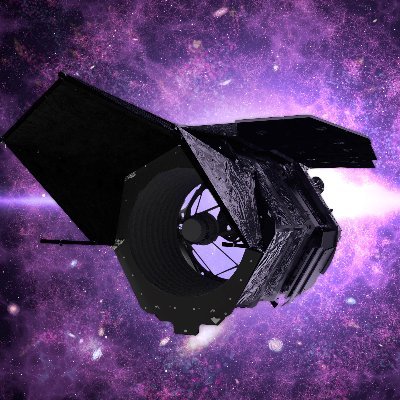
ALT An artist concept of the Nancy Grace Roman Space Telescope against a purple and black background. The telescope is a silver cylinder, with a panel of solar panels along the back like wings on an insect. A hood along the front is open to reveal a mirror, reflecting purple.

ALT Artist concept of Roman's array of 18 detectors, outlined in light blue against a navy blue background with stars. They are arranged in an arc, with six columns of boxes across and three rows down. A thin, white, arched line in the lower left of the graphic is labeled "Moon's apparent size." Blue text over the left-most column of detectors reads, "WFI 2700 x 1360 arcseconds. Two yellow boxes on the far left are labeled "NIRCam 260 x 130 arcseconds." And a white box on the left, below the yellow boxes, is labeled "WFC3 NIR 130 x 130 arcseconds."

ALT An image of the Pillars of Creation is split in two. The left side shows a towering pillar of gas and dust, mostly brown, jutting out against blue and green gas. The right side shows a couple star-studded, smaller pillars in dark brown and lined in blue, against starry black space. The labels "Visible" and "Infrared" are seen in the top left and bottom right corners, respectively.


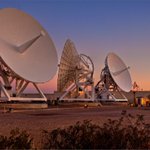
ALT Three large satellite dishes stand outdoors on metal supports, angled toward the sky during sunset. The ground is covered in gravel, a few shrubs sit in the foreground, and the sky fades from warm orange near the horizon to deep blue above.

ALT This image, titled “NASA’s James Webb Space Telescope; Deep Field SMACS 0723,” shows Webb’s mid-infrared view of the galaxy cluster on the left and near-infrared view on the right. The background of space is black in both. The mid-infrared image shows fewer sources. Galaxies and stars appear in blue, green, yellow, and red. The stars have short spikes created by the telescope’s optics. The near-infrared image looks sharper than the mid-infrared one and shows thousands of white and orange galaxies and bluish, spiky stars. Many long orange arcs curve around the image center. Some objects appear in both images. At bottom left are arrows indicating the image’s orientation in the sky. Below the image is a color key showing which MIRI and NIRCam filters were used and which visible-light color is assigned to each filter. The image is watermarked “Credit: NASA, ESA, CSA, STScI.”


ALT An illustration of a telescope spacecraft with a parabolic mirror floating in deep space.

ALT This certifies that "Nancy Roman has officially adopted one pixel from Nancy Grace Roman Space Telescope's first images." The number 2 is at the bottom, representing the unique pixel number assigned to Nancy Roman.

ALT This image displays the “shaped pupil” masks, each about the size of a U.S. quarter, used in the Nancy Grace Roman Space Telescope’s Coronagraph Instrument. These precisely engineered components modify the diffraction pattern of starlight to block glare and reveal faint regions surrounding stars. NASA/Chris Gunn


ALT A black-and-white infrared view of a SpaceX Falcon Heavy rocket as it lifts off into the sky with the Roman Space Telescope aboard. The background sky is dark and fluffy, gray clouds mark the bottom of the photo. The rocket and its trail glow bright white in the center of the photo. Credit: NASA/Joel Kowsky

ALT A certificate that is granted upon adopting a pixel in one of the first images taken by the Roman Space Telescope. This certificate is addressed to Nancy Roman. Credit: NASA