
The official X account for the NASA Hubble Space Telescope, managed and operated by NASA's Goddard Space Flight Center.
- Tweets8.5K
- Following44
- Followers8.9M
- Likes1.2K
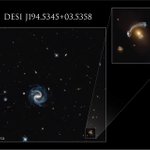
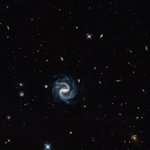



ALT A spiral galaxy with two distinct arms forming a backwards "S" shape is in the foreground, against a background of many other much smaller, more distant galaxies. In the right lower corner, a gravitational lens can be seen, with a large, distinctive arc to the upper left.

ALT A Hubble image of gravitational lens DESI J194.5345+03.5358 and a nearby spiral galaxy. The lens is magnified in a callout box. The lens has a spherical yellow galaxy at its center, with a large arc to the upper left of the galaxy and the same arc, flipped and much smaller, to the lower right of the galaxy.


ALT The shimmering colors visible in this NASA/ESA Hubble Space Telescope image show off the remarkable complexity of the Twin Jet Nebula. Lobes of material, in teal, orange and blue hues, stretch outward like elongated orbs from a central star system that shines bright white. Streams of gas jet outward from the center. Stars are visible in the background, dotting the black of space in yellow and white. Credit: NASA/ESA/Judy Schmidt

ALT A dark brown dust structure swathes across the center of a vista of glowing red gas, interspersed with bright stars.

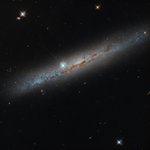
ALT An edge-on spiral galaxy. Its rusty-brown dust lanes bisect the galaxy lengthwise. Bright-blue points dot the galaxy and seem to be more dense on its left side. A bright foreground star shines just to the left of the galaxy's center. The background is black and dotted with distant galaxies and a smattering of foreground stars, which are easily identified by their diffraction spikes.

ALT A deep field view of space is superimposed with an orange outline of Roman's field of view, with six smaller images pulled out to the sides, showing individual galaxies observed by Hubble.


ALT A barred spiral galaxy packed with regions where stars are actively forming. Chandra X-ray data (magenta) highlights stellar nurseries and X-ray binaries scattered along dusty spiral structures brought to life by Hubble optical (white and gray) and Webb infrared (orange and red) observations.


ALT This image of the Crab Nebula, captured by Hubble’s Wide Field and Planetary Camera 2, shows the six-light-year-wide expanding remnant of a supernova explosion amidst a dark sky speckled with stars and other objects. The Crab is an oval-shaped cloud webbed with the tattered remains of the star, which consist mostly of hydrogen. These wispy strands of material appear yellow-orange towards the center of the nebula, darkening to a blue-green and then orange-brown near the edges. The interior of the remnant glows with blue light from electrons whirling at nearly the speed of light around magnetic field lines from a central neutron star, the crushed core of the original star. The image is watermarked “Credits: NASA, ESA, J. Hester and A. Loll (Arizona State University).”

ALT A pair of overlapping galaxies at the center of the image appear to form a leaping dolphin shape. More distant galaxies and stars dot the black background of space.



ALT A pair of galaxies undergoes an extreme gravitational transformation. On our left side of the frame is a ghostly galaxy with a pale white core and faint outer ring. On our right is a pale white sphere-shaped galaxy surrounded by a grainy neon blue cloud, flecked with purple dots. The cloud has a funnel-like shape, pointing toward its ghostly neighbor.

ALT An image of the Pillars of Creation is split in two. The left side shows a towering pillar of gas and dust, mostly brown, jutting out against blue and green gas. The right side shows a couple star-studded, smaller pillars in dark brown and lined in blue, against starry black space. The labels "Visible" and "Infrared" are seen in the top left and bottom right corners, respectively.

ALT A not-to-scale graphic titled "Wavelength" shows labeled bars that stretch to the spectrums of light Hubble (purple), Roman (blue), and Webb (orange) observe.

ALT A bright, composite image of spiral galaxy NGC 1097, viewed face on. The galaxy has gleaming cyan-blue and neon-purple arms spiraling around a central black hole, which is awash in glowing yellow X-ray light. At lower right, the ends of the neatly corkscrewing arms are diffused, spread around a neighboring satellite galaxy. The image is watermarked “Credit: X-ray: NASA/CXC/SAO; UV: NASA/Penn State Univ./Swift; Optical: Mark Hanson (used with permission); Image Processing: NASA/CXC/SAO/L. Frattare.”