

An AI-Powered platform that supercharges your research efficiency.
San Francisco, CA
Joined May 2022
- Tweets465
- Following365
- Followers2K
- Likes1.6K


OpenRead retweeted

The paper behind it:
Designing and developing new medicines is a very long, difficult, and expensive process.
A major part of this process involves "medicinal chemistry," where scientists design, create, and modify chemical compounds to find safe and effective drugs. Even though computer intelligence has started helping out, creating new drugs remains a massive bottleneck.
Researchers want to know if advanced artificial intelligence models can truly assist with complex decisions in drug discovery, such as balancing how potent a drug is against its potential side effects.
The performance varied greatly depending on the specific model and how much thinking time it was allowed. The top-performing model, GPT-6 Astra set to maximum effort, achieved the highest average score of 83.83%.
When comparing models at a shared high-effort setting, scores ranged widely from about 35% to over 83%. The researchers found that models struggled the most with correctly drawing and reconstructing complex molecular structures, whereas they performed more consistently when selecting candidates or making numerical predictions.
Furthermore, giving the models more time to "think" significantly improved their scores across the board.


OpenRead retweeted
People have spent a very long time trying to understand prime numbers, which are special building block numbers. A famous puzzle called the Riemann Hypothesis helps us guess how these prime numbers are spread out. A researcher and a computer helper named Claude worked together to try and solve this big puzzle.
They wrote down a massive computer file containing the full proof that the Riemann Hypothesis is true. The steps involved chaining together special wave-like math functions (called theta lifts) a specific number of times, equal to the square root of a number X, to make the difficult parts of the problem disappear.

OpenRead retweeted
Here's the report regarding Anthropic's IPO:
We see Anthropic as well placed to capture value in an AI world.
Results and findings:
Morningstar assigned Anthropic a Narrow Economic Moat rating driven primarily by its intangible research know-how and a structural cost advantage derived from an in-house multi-chip hardware abstraction layer, algorithmic compute multipliers, and multi-year infrastructure commitments. The base-case fair value was established at 92 per share, translating to an equity valuation of 1.7 trillion based on a projected 47% five-year compound annual growth rate in revenue. The bull and bear cases yielded fair values of 188 per share(3.4 trillion equity value) and 25 per share(500 billion equity value), respectively, reflecting a Very High Uncertainty Rating driven by volatile enterprise adoption trajectories and the longevity of scaling laws.

OpenRead retweeted

Here's the report regarding Anthropic's IPO:
We see Anthropic as well placed to capture value in an AI world.
Results and findings:
Morningstar assigned Anthropic a Narrow Economic Moat rating driven primarily by its intangible research know-how and a structural cost advantage derived from an in-house multi-chip hardware abstraction layer, algorithmic compute multipliers, and multi-year infrastructure commitments. The base-case fair value was established at 92 per share,translating to an equity valuation of 1.7 trillion based on a projected 47% five-year compound annual growth rate in revenue. The bull and bear cases yielded fair values of 188pershare(3.4 trillion equity value) and 25 per share(500 billion equity value), respectively, reflecting a Very High Uncertainty Rating driven by volatile enterprise adoption trajectories and the longevity of scaling laws.

OpenRead retweeted
Here's the report regarding Anthropic's IPO:
We see Anthropic as well placed to capture value in an AI world.
Results and findings:
Morningstar assigned Anthropic a Narrow Economic Moat rating driven primarily by its intangible research know-how and a structural cost advantage derived from an in-house multi-chip hardware abstraction layer, algorithmic compute multipliers, and multi-year infrastructure commitments. The base-case fair value was established at 92 per share, translating to an equity valuation of 1.7 trillion based on a projected 47% five-year compound annual growth rate in revenue. The bull and bear cases yielded fair values of 188 per share(3.4 trillion equity value) and 25 per share(500 billion equity value), respectively, reflecting a Very High Uncertainty Rating driven by volatile enterprise adoption trajectories and the longevity of scaling laws.

OpenRead retweeted
When people look at or experience nature:
1. Their brains show an increase in calm brain waves and a decrease in stress-related brain activity. openread.academy/en/paper/re…
2. Parts of the brain linked to stress, fear, and negative, repetitive thoughts (rumination) become less active.
3. Real, outdoor nature environments with multiple senses (sounds, sights, and smells) work much better and faster at making people feel relaxed than just looking at pictures or screens.
4. People who live near more green spaces over their lifetimes tend to have healthier brain structures and better thinking skills as they grow and age.

OpenRead retweeted
Paper title: Molecular and microstructural biomarkers of neuroplasticity in neurodegenerative disorders through preclinical and diffusion magnetic resonance imaging studies
Results and findings:
1. The brain relies on chemical messengers, minerals, and growth factors to strengthen connections between neurons through a process called long-term potentiation.
2. Brain plasticity happens at the microscopic level through the growth of new neurons, the rewiring of damaged axons, the branching of dendrites, and the helpful or harmful actions of support cells.
3. Deep brain structures, like the hippocampus, show a remarkable ability to generate new neurons, which is boosted by physical exercise and stimulating environments.
4. Advanced MRI techniques can successfully detect microscopic changes in brain tissue allowing scientists to track disease progression and brain repair over time in living animals.

OpenRead retweeted
Congratulations to Anne Carson!
Carson’s most important scholarly book:
Eros the Bittersweet: An Essay
Anne Carson showed that ancient Greek myths and poetry do not have to remain in the past: by mixing them with modern love, grief, sexuality, translation, essays, and experimental forms, she created new ways of writing about contemporary human experience.

OpenRead retweeted
Congratulations to Henri B. Kagan and Kenso Soai!
Henri B. Kagan's most renowned paper:
• Nonlinear effects in asymmetric synthesis. Examples in asymmetric oxidations and aldolization reactions
Kenso Soai's most renowned paper:
• Asymmetric autocatalysis and amplification of enantiomeric excess of a chiral molecule
Kagan discovered that in some reactions, making a catalyst only a little more “left-handed” or “right-handed” can make the product much more strongly one-handed than expected.
Soai discovered a chemical reaction in which a molecule helps make more copies of itself and can magnify an almost invisible preference for one mirror-image form into an overwhelmingly one-sided mixture.


OpenRead retweeted
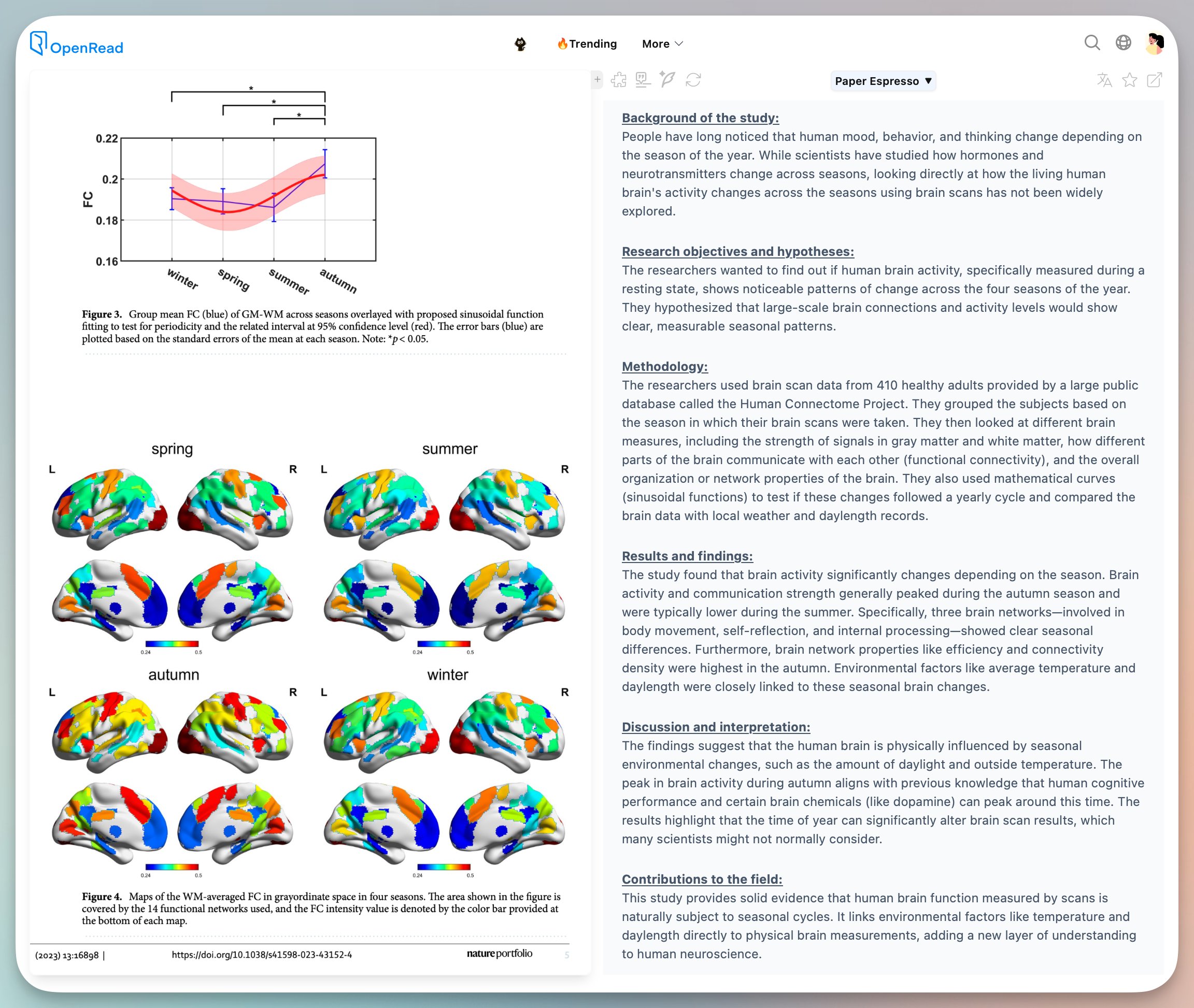
Results and findings of this paper:
The study found that brain activity significantly changes depending on the season. Brain activity and communication strength generally peaked during the autumn season and were typically lower during the summer. openread.academy/en/paper/re…
Specifically, three brain networks that involved in body movement, self-reflection, and internal processing showed clear seasonal differences.
Furthermore, brain network properties like efficiency and connectivity density were highest in the autumn. Environmental factors like average temperature and daylength were closely linked to these seasonal brain changes.
OpenRead retweeted
Results and findings of this paper:
The results showed that watching TikTok videos significantly degraded users' performance in the prospective memory task, with accuracy dropping to nearly random guessing levels. openread.academy/en/paper/re…
In contrast, none of the other conditions like Rest, Twitter, or YouTube, had a significant negative effect on prospective memory performance.
Furthermore, none of the conditions affected the ongoing lexical decision task. The cognitive modeling revealed that after a TikTok interruption, participants suffered from reduced decision efficiency, higher uncertainty, and a shift toward making less-informed, hasty choices when trying to recall their intended actions.

OpenRead retweeted
Results and findings of this paper:
73% to 82% of individuals with ADHD experience sleep disturbances and evening chronotypes (being "night owls"). openread.academy/en/paper/re…
Biological markers show that their internal clocks are delayed, with melatonin release delayed by about 45 minutes in children and 90 minutes in adults, alongside altered cortisol rhythms and weakened molecular clock gene activity.
Clinical interventions, such as melatonin supplementation and bright light therapy, successfully advanced their biological clocks and led to noticeable improvements in ADHD and mood symptoms.

OpenRead retweeted
Breakdown of this paper:
Background:
openread.academy/en/paper/re…
The study investigated whether 12 weeks of repeated hot water immersion (HWI) could produce vascular benefits comparable to aerobic exercise in inactive older adults with overweight or obesity. Previous research suggested that heat exposure can increase blood flow and arterial shear stress, mechanisms that may improve vascular function. However, its long-term effects in this higher-risk population, and whether they could match exercise, were unclear.
Results and findings:
Both exercise and HWI significantly improved brachial artery endothelial function, measured by FMD, and the improvement did not significantly differ between the two interventions. However, only exercise significantly improved femoral artery FMD, while HWI did not produce a significant change. Neither intervention significantly changed blood pressure, arterial stiffness (PWV), or most GTN-mediated responses. Overall, the findings suggest that HWI may provide some vascular benefits similar to exercise, particularly in the brachial artery, but exercise produced broader vascular adaptations.

OpenRead retweeted
Results and findings of this paper:
The study discovered a clear, curved pattern linking exercise and depression risk, with the biggest benefits happening at the lower end of the activity scale. openread.academy/en/paper/re…
Compared to people who did no exercise at all, adults who achieved just half of the recommended weekly exercise amount, roughly equal to about 75 minutes of brisk walking per week, had an 18% lower risk of depression.

OpenRead retweeted
Results and findings of this paper:
The researchers found that birth order didn't affect most personality traits. openread.academy/en/paper/re…
However, they did find that later-born children scored slightly lower on intelligence tests and on a measure of self-reported intellect, even after controlling for actual intelligence levels.

OpenRead retweeted
This study investigates the world's oldest living person at the time (who reached 117 years old) to see what makes her biology so unique. openread.academy/en/paper/re…
Results and findings:
1. Genetics: The supercentenarian had several rare genetic variants related to brain protection, immune health, and heart health. However, she also showed signs of typical aging, such as very short telomeres and mutations linked to blood cell aging.
2. Blood and Metabolism: She had an exceptionally efficient lipid (fat) metabolism, with very high levels of "good" cholesterol and very low levels of harmful fats and inflammation markers.
3. Microbiome: Her gut bacteria were rich in Bifidobacterium, a type of bacteria known to fight inflammation and support gut health, which matched her habit of eating yogurt daily and following a Mediterranean diet.
4. Epigenetics: Despite being 117 years old chronologically, several different biological clocks based on her DNA methylation showed that her tissues and cells "behaved" and appeared much younger (over 20 years younger) than her actual age.

OpenRead retweeted
Results and findings of this paper:
Physical activity and video gaming have completely different benefits. Spending time playing video games was associated with significantly better performance in thinking skills, but it was not related to mental health scores. openread.academy/en/paper/re…

OpenRead retweeted
Results and findings of this paper:
Morning coffee was associated with lower mortality
Among 40,725 US adults followed for a median of 9.8 years, people who mainly drank coffee in the morning had a 16% lower risk of death from any cause (HR 0.84) compared with non-coffee drinkers. openread.academy/en/paper/re…

OpenRead retweeted
Results and findings of this paper:
Compared with participants who engaged in light or moderate exercise, those who engaged in vigorous exercise had a much smaller increase in cortisol, lower peak cortisol levels, and returned to normal baseline levels much faster in stress tests. openread.academy/en/paper/re…
