

PakCrypt Community exists to develop people who can design, analyze, and prove cryptographic systems. As Pythagoras said in 500BCE "Number rules the universe."
Islamabad
Joined October 2023
- Tweets2.6K
- Following0
- Followers52
- Likes461






Pinned Tweet
🔐 2 competition tracks (Pro and Amo)
🏆 Rs. 7M+ total prizes in Crypto Competition, CTF and Ideas Cup
🌍 12+ International experts
🎓 IACR Cryptography Winter School
📍 NCCS, Air University, Islamabad
📅 24–27 Nov 2026
The first round is open online now.
Can you crack it?
👉 pakcrypt.org/pc26
#Cryptography #CyberSecurityPakistan
#CyberSecurity #InfoSec #Cryptography #CyberSecurityPakistan #Encryption
#PQC #Quantum #CyberDefense #DigitalForensics
#EthicalHacking #OSINT #NetworkSecurity
#ApplicationSecurity
The worm that learned to sign itself 🪱📦
Mini Shai-Hulud did not break the supply chain. It walked through the front door, with valid signatures.
WHAT HAPPENED:
On May 11, 19:20 UTC, 84 malicious versions were published across 42 @tanstack packages in 6 minutes. Within 48 hours, it spread to 172 packages and 403 malicious versions across npm and PyPI, hitting TanStack, Mistral AI, UiPath, Guardrails AI, OpenSearch. Total reach: 518M+ cumulative weekly downloads.
HOW:
No stolen npm token needed for TanStack. Attackers used a pull_request_target workflow to poison the Github Actions cache. When maintainers merged, the poisoned cache ran inside the trusted release pipeline. The worm scraped the OIDC token from runner memory and exchanged it for publish credentials.
Those TanStack packages carried VALID SLSA Build Level 3 provenance from Sigstore. The signature was real. The code was poison. Provenance proved the pipeline was legitimate. It did not prove the code was safe. Tracked as CVE-2026-45321, CVSS 9.6.
TeamPCP, tracked as UNC6780. On May 12, they open-sourced the worm.
If you only check signatures, you missed this. You must check the code, the workflow, and the identity, too.
Source: tenable.com/blog/mini-shai-h…
#CyberSecurity #InfoSec #SupplyChain #npm #PyPI #SLSA

51
🎙️ **We are closing in on the "Holy Grail" of cryptography. Fully Homomorphic Encryption (FHE) is inching from theoretical brilliance into deployable reality.**
For decades, the dream has been simple but elusive: process data *while it remains encrypted*. FHE makes this possible, allowing computations to be performed directly on ciphertext.
But moving from mathematical proof to real-world deployment is a monumental engineering challenge. Here is your technical deep-dive into the promise, the bottlenecks, and the roadmap for FHE. 🧵👇
**1️⃣ THE PROMISE: True Zero-Trust Cloud Computing**
Today, to process data in the cloud, it must be decrypted. This creates a fundamental vulnerability: the cloud provider (or an attacker who breaches them) has access to your raw, plaintext data.
FHE shatters this paradigm. It enables **end-to-end encrypted workflows** where:
☁️ Data is encrypted on the user’s device.
⚙️ Computations (search, machine learning inference, analytics) are performed *directly on the ciphertext* in the cloud.
🔓 Only the end-user holds the private key to decrypt the final, computed result.
The cloud provider processes the data but mathematically *never sees it*.
**2️⃣ THE BOTTLENECKS: Why Isn't It Everywhere Yet?**
The math behind FHE (like BGV, BFV, or CKKS schemes) is computationally brutal. We are currently facing two massive barriers:
📉 **Ciphertext Expansion:** Encrypting a few kilobytes of plaintext can result in megabytes of ciphertext. This creates massive storage and bandwidth overhead.
🐢 **Computational Slowness:** Homomorphic operations (especially "bootstrapping," which refreshes the noise in a ciphertext to allow further computation) are orders of magnitude slower than plaintext operations.
**3️⃣ THE ROADMAP: The "FHE Hierarchy of Needs"**
Researchers and engineers are now framing FHE development like Maslow’s hierarchy. We cannot jump straight to seamless apps; we must build the foundation first:
🔹 **Level 1 (Base): Efficiency & Key Reuse.** Optimizing polynomial multiplication, reducing bootstrapping overhead, and designing schemes that allow safe key switching and reuse without degrading security.
🔹 **Level 2: Hardware Acceleration.** Offloading FHE workloads to specialized hardware (FPGAs, ASICs, and GPU kernels) to achieve the necessary throughput for real-time applications.
🔹 **Level 3 (Peak): Usability & Developer Experience.** Building high-level compilers, SDKs, and frameworks that allow everyday software engineers to write FHE applications without needing a PhD in lattice-based cryptography.
**4️⃣ THE PAKCRYPT VISION: Architecting the Privacy-First Future**
This is the absolute frontier of privacy-enhancing technologies (PETs). At the **PakCrypt Symposium**, we are actively dissecting these exact challenges alongside leading international experts from Germany, Norway, China, and Turkey.
To the brilliant young Pakistani students, developers, and cybersecurity professionals reading this: **This is your greenfield opportunity.** The world desperately needs engineers who can optimize FHE compilers, design hardware accelerators, and build usable privacy-preserving applications.
🔗 🔗🔗🔗🔗🔗🔗🔗
📄 **IBM Research: Fully Homomorphic Encryption Explained:** research.ibm.com/blog/fully-…
🛠️ **Zama: The Developer’s Guide to FHE (Concrete Library):** zama.ai/fhe
#FullyHomomorphicEncryption #FHE #PrivacyEnhancingTechnologies #PETs #CyberSecurity #Cryptography #ZeroTrust #CloudSecurity #PakCrypt #TechPakistan
25
🦀💻 Hackers just brought Rust to the espionage party, and their new toolkit wants to cross air gaps. Defence networks, take a bow. 🫡
Zscaler ThreatLabz tracked a campaign against government and defence entities in India and Afghanistan. Here's the tea ☕
1️⃣ The toolkit: new Rust-based malware, including the RUSTYSHADE backdoor and RUSTYMOVE, a removable-media propagation tool. Rust is the cool new kid, and the attackers apparently wanted the hoodie. 🦀
2️⃣ The air-gap drama: RUSTYMOVE is reportedly built to bridge segmented or air-gapped systems. Translation: the "unplugged" network may not be as unplugged as the org chart claims. 🔌
3️⃣ The disguise game: lookalike domains impersonating ThePrint and India Today, plus a scheduled task named to look like a OneDrive updater. Fake news sites and fake Microsoft vibes. Peak "trust me, I'm a headline." 📰
4️⃣ The infrastructure: command-and-control runs through private GitHub repositories. Hiding C2 in a code platform is the cybersecurity version of hiding your diary inside a developer's repo. 🐙
5️⃣ The vibe check: this is part of a high-tempo campaign. In June, the same group was reportedly also targeting Indian government systems running BOSS Linux, the Bharat Operating System Solutions distribution. Homegrown OS meets uninvited guest. 🇮🇳
6️⃣ The caveat: the Pakistan link is vendor analysis, not official government confirmation. Attribution is detective work, and detectives sometimes get it wrong. 🕵️
if your "air-gapped" network has a USB port, it's not air-gapped, it's just sad. Monitor removable media, watch for scheduled tasks with suspiciously official names, and check the domain before you trust the headline. 🛡️
📖 The Hacker News: thehackernews.com/2026/09/tr…
📖 GBHackers: gbhackers.com/apt36-malware-…
#APT36 #TransparentTribe #Zscaler #CyberSecurity #InfoSec #India #Rust #ThreatIntel #OSINT

36
Q-DAY IS COMING. AND THE CLOCK JUST MOVED FORWARD.
For 30 years, Q-Day was a theoretical date in the future. Now Google is warning that quantum computers could break some encrypted systems by 2029.
------------------
1. WHAT IS Q-DAY?
Q-Day is the day a quantum computer has enough power and stability to break the encryption that protects almost everything online.
Michele Mosca, CEO of evolutionQ, puts it like this: "It is the day when people, perhaps adversaries, will have access to a quantum computer that can break cryptographic codes that are in use."
At that point, Mosca says, "everything is safe, safe, safe, and then suddenly it is not safe. It is a very drastic jump."
Financial transactions. Medical files. Emails. Location history. Crypto wallets. All of it could be unlocked.
------------------
2. WHY NOW?
Two things changed the timeline.
First, the Global Risk Institute's 7th Quantum Threat Timeline Report, based on 26 experts, says a full-scale, cryptographically relevant quantum computer is "quite possible" within 10 years and "likely" within 15.
Second, new research from Google, UC Berkeley, Stanford, and the Ethereum Foundation found a 20-fold reduction in the physical qubits needed to break elliptic curve cryptography (ECC), the encryption behind most blockchains and crypto.
Google called it a warning shot. Especially for crypto, where upgrading requires getting a decentralized network to agree.
------------------
3. THE ATTACK IS ALREADY HAPPENING
This is the part most people miss.
Adversaries may already be doing "harvest now, decrypt later."
Steal encrypted data today. Store it. Decrypt it later when the quantum computer is ready.
That means post-quantum protection only protects future data. It does not protect what was already stolen.
As researcher Catherine Mulligan says: "You can upgrade your software, but you cannot really upgrade your DNA."
Health records, genetic data, long-term secrets. Once harvested, they cannot be un-harvested.
------------------
4. WHY OUR CURRENT ENCRYPTION BREAKS
Most internet security, that little padlock in your browser, relies on RSA encryption.
RSA works because multiplying numbers is easy, but factoring them back is incredibly hard for a normal computer.
A quantum computer does not work like a normal computer. It uses qubits that can be 0, 1, or both at the same time through superposition. That lets it solve that factoring puzzle fast.
The Quantum Threat Timeline Report defines a cryptographically relevant computer as one that could break RSA in 24 hours.
------------------
5. WHAT IS BEING DONE?
There is good news, but it needs urgency.
NIST finalized post-quantum encryption algorithms in 2024, designed to withstand quantum attacks.
Google and Cloudflare are both now targeting 2029 to secure their systems with post-quantum cryptography.
The White House recommends 2035 as the target for entities to have adopted post-quantum cryptography.
And there is even quantum key cryptography, first conceived in the 1980s by this year's Turing Prize winners, which uses photons of light and the laws of physics, not just math, to create a secret key.
MIT researchers are also building ultra-efficient chips, 20 to 60 times more energy-efficient, to protect tiny devices like insulin pumps and pacemakers that cannot run heavy security protocols today. Imagine a hacked pump being told: "release lethal dosage."
------------------
6. WHY WE ARE STILL NOT READY
Just over 90 percent of businesses still lack a road map for quantum security, according to data cited by McKinse.
And cryptographic migrations normally take 10 to 20 years. This one will be more complicated and more costly.
As Dustin Moody at NIST says: "If everyone were to migrate on time, we would be in good shape, but the problem is that is not going to happen in the real world."
Worse, the real Q-Day may happen before we know it. Secret state labs, stealth companies, and malicious actors could be ahead of public research. Covert successes would stay invisible.
The report warns: "The real Q-day may occur before the world becomes aware of it."
And a 2023 Hudson Institute report estimated a quantum attack on the Fedwire Funds Service could trigger financial collapse and a six-month recession.
------------------
7. WHAT SHOULD YOU DO?
For most people: Nothing directly. You need to rely on your technology providers to handle this.
For businesses and small companies: Ask your providers one question.
"Have you taken care of the quantum threat?"
That is it. Start the migration now. Do not wait for Q-Day to be announced, because by then it will be too late.
Y2K was avoided because everyone worked hard to prevent it. This is our Y2K moment, except the deadline is moving closer, not further away.
Source: CNN, May 17, 2026
edition.cnn.com/2026/05/17/s…

ALT https://edition.cnn.com/2026/05/17/science/quantum-computing-cybersecurity-q-day
1
98
🎙️ The line between cybercrime and cyber warfare has been permanently blurred. The weaponization of commercial ransomware is no longer a fringe phenomenon; it is a core, calculated tactic of modern conflict.
Cyber-intelligence workshops analyzing the digital frontlines of the Ukraine conflict have observed a stark and alarming trend: state-aligned and paramilitary actors are increasingly integrating cheap, off-the-shelf ransomware kits directly into their military operational playbooks.
Here is your technical deep-dive into the rise of "Malware-as-a-Service" in warfare, the strategic advantages it provides to adversaries, and the global forecast for hybrid cyber threats. 🧵👇
**1️⃣ THE PIVOT: From Bespoke Malware to Commoditized Chaos**
Historically, state-sponsored Advanced Persistent Threats (APTs) relied on highly customized, expensive, and meticulously developed zero-day malware. However, since late 2022, observers have noted a tactical shift. Combatants are now "plugging in" commercial crypto-lockers and extortion frameworks directly into their campaigns. The barrier to entry for causing massive digital disruption has never been lower.
**2️⃣ THE MECHANICS: The Malware-as-a-Service (MaaS) Advantage**
Why spend months developing bespoke tools when you can subscribe to a ready-made weapon? Modern MaaS ecosystems provide hostile actors with:
💻 **Plug-and-Play Crypto-Lockers:** Highly optimized encryption routines that can be deployed rapidly across vulnerable networks.
💬 **Automated Extortion Portals:** Pre-built negotiation sites, leak blogs, and cryptocurrency payment gateways.
🔄 **Affiliate Models:** Allowing less technical "foot soldiers" to execute attacks while the core developers take a cut, creating a scalable, decentralized attack force.
**3️⃣ THE STRATEGIC IMPACT: Force Multiplication & Easing Burnout**
Developing and maintaining custom malware is resource-intensive and leads to rapid operator burnout among elite hacking units. By adopting off-the-shelf ransomware, state actors achieve immediate "boots on the ground" cyber capabilities. This allows them to:
🎯 **Delegate Disruption:** Free up elite APT operators to focus on high-value strategic intelligence gathering, while commoditized tools are used to sow widespread chaos.
🎯 **Plausible Deniability:** Using tools commonly associated with financial cybercrime muddies the attribution waters, complicating diplomatic and kinetic responses.
**4️⃣ THE GLOBAL FORECAST: Proliferation in Contested Zones**
The tactics tested and refined in Eastern Europe are a blueprint for the future. We must expect DIY and commoditized ransomware to proliferate rapidly in contested zones and geopolitical flashpoints worldwide. In these environments, the primary goal of the ransomware shifts from *financial extortion* to *psychological warfare, supply chain disruption, and the crippling of local municipal infrastructure*.
**5️⃣ THE GLOBAL DEFENSE MANDATE: Adapting to Hybrid Threats**
Defending against this evolution requires a paradigm shift in how we approach cybersecurity:
🌐 **Global Threat Intelligence Sharing:** Rapid dissemination of Indicators of Compromise (IoCs) and MaaS affiliate tactics across international CERTs and private sector ISACs.
💰 **Disrupting the Economics:** Aggressive tracking and sanctioning of the cryptocurrency wallets and money mules that fuel the MaaS ecosystem.
🛡️ **Resilience by Design:** Implementing strict network segmentation and immutable backups, ensuring that even if a commoditized ransomware variant breaches the perimeter, the blast radius is contained and operations can continue.
**THE BOTTOM LINE:**
To cybersecurity professionals, threat hunters, and policymakers worldwide: The battlefield has evolved. We can no longer treat ransomware solely as a criminal enterprise; in contested environments, it is a weapon of war. We must adapt our defenses, share intelligence relentlessly, and build systems that can withstand the commoditization of cyber destruction. 🌍🚀🛡️
🔗 **READ MORE **
📄 **Mandiant (Google Cloud) M-Trends Report: Ransomware in Conflict:** cloud.google.com/security/re…
🛡️ **ENISA Threat Landscape Report (Cyber Warfare & Ransomware Trends):** enisa.europa.eu/publications…
#CyberWarfare #Ransomware #MalwareAsAService #MaaS #ThreatIntelligence #InfoSec #HybridWarfare #CyberDefense #GlobalSecurity #CyberResilience #APT
reuters.com/legal/government…
1
77
YOUR PLANE IS NOT ABOUT TO CRASH. BUT YOUR COCKPIT THINKS IT IS.
"Terrain ahead. Pull up!"
That is a command pilots should only hear in a disaster movie. Now they hear it in real cockpits, at safe altitude, because of bogus GPS signals.
Welcome to the new normal of electronic warfare in the sky.
__________________________
1. WHAT IS HAPPENING IN THE COCKPIT?
Around 900 flights every single day are affected by GPS interference.
That number comes from Benoit Figuet at Zurich University of Applied Sciences, founder of SkAI Data Services, which has tracked incidents on GPSWise since 2024.
Pilots report phantom "pull up" warnings from the ground proximity system, map shifts where the plane jumps miles from its real path on screen, and on the runway, systems saying the plane is somewhere else entirely.
One commercial pilot, who asked not to be named, said cockpit displays have "become a work of fiction."
To silence false alarms, pilots sometimes hit the terrain inhibit switch, manually decouple clocks from GPS, and navigate on ground-based systems "like it is the 1970s."
__________________________
2. JAMMING VS SPOOFING
They sound the same. They are not.
Jamming: Disruption. Your GPS signal is blocked. You lose positioning.
Spoofing: Deception. Your system reports a false location. You think you are somewhere you are not.
As Captain Ron Hay, president of the International Federation of Air Line Pilots Associations, which represents over 160,000 pilots in 70+ countries, says: "The aircraft thinks that it is absolutely someplace else. The map does not match. The time does not match."
And the worst part: "When you are being spoofed, you can determine you are being spoofed, but you do not know where you are going to be spoofed."
__________________________
3. WHY IS GPS SO EASY TO BREAK?
GPS signals are incredibly weak by the time they reach us.
They travel over 20,000 kilometers from space. By arrival, they are comparable in strength to a couple of light bulbs.
That makes them easy to overpower with high-intensity radio signals on the same frequency.
The intended targets are usually drones and missiles. Commercial planes are collateral damage.
This vulnerability was long understood. It became a daily problem after Russia's invasion of Ukraine in 2022, when drones were widely deployed in combat for the first time.
Now disruption is endemic in conflict zones: the Middle East, including the region hit by the Iran war, the Baltic Sea, and the Black Sea.
But it is not only there. SkAI has also detected clusters in Asia: on the India-Pakistan border, around North Korea and South Korea, and in Myanmar.
__________________________
4. THE REAL DANGER: NORMALIZATION
Hay says fellow pilots encounter this on a regular basis.
"I have fellow pilots that encounter this on a regular basis. That is the true danger. It is becoming normalized," he said.
He fears pilots will lose trust in critical safety systems as they become desensitized to warnings.
The FAA said the same in its 2026 resource guide: As interference becomes more common, organizations and pilots may develop a higher tolerance for risk.
"Once trust in these systems is lost, it can be difficult to regain."
For passengers, Hay says this is not a reason to panic. It is an operational headache for pilots, airlines, and air traffic control.
Example: A plane crossing the Atlantic that hits interference near the Black Sea may be spaced further apart for safety, lose access to the North Atlantic track system, and be forced onto longer, less fuel-efficient routes. That means delays and disruption.
__________________________
5. WHEN IT TURNED DEADLY
GPS interference has already contributed to a catastrophe.
On December 25, 2024, an Azerbaijan Airlines flight from Baku to Grozny, Russia, crashed in Kazakhstan. At least 38 of the 67 people on board were killed.
According to a February 2025 preliminary report from Kazakhstan's Ministry of Transport, the pilots encountered electronic interference. They lost GPS and reported "pull up" warnings near Grozny, where fog made landing with beacons difficult.
After two failed landing attempts, they turned back to Baku. During the return, the aircraft lost primary control systems and tried an emergency landing.
In October 2025, Russian President Vladimir Putin said missiles fired by Russian air defenses at a Ukrainian drone had caused the crash.
But Figuet is clear: "GPS interference was not the primary cause of the crash. But because of GPS interference, they could not land where they were supposed to."
Ramsey Faragher, CEO of the Royal Institute of Navigation, agrees: "If it had not had the problems with its GNSS, it would have very, very, very likely landed an hour earlier."
__________________________
6. A DAILY NUISANCE IN FINLAND
【entity-Finnair¦canonical_name=Finnair】 calls it a daily nuisance.
Most flights departing southbound from Helsinki encounter GPS spoofing and jamming, says chief flight instructor Captain Aleksi Kuosmanen.
On April 6, Finair flight to Kirkenes, a town in northern Norway near the Russian border, had to make a second landing attempt after GPS interference on the first try.
Finland's Traficom received 421 reports of GPS interference in January and February this year alone. Last year, it received 1,704 reports.
In 2024, Finair even suspended flights to Tartu, Estonia, for a month while the airport improved ground-based landing systems.
Kuosmanen: "We are in a position to manage the situation, and the pilots are used to it. But I would not like to see this as a new normal."
Finland was among 13 EU members that pushed for action. That led to a European Aviation Action Plan in March, with short-term fixes like standard phraseology with air traffic control, and longer-term coordination with militaries on interference sources.
__________________________
7. IS THERE A FIX? NO SILVER BULLET.
Pilots are well trained. But technology has to catch up.
What is already helping:
- Live jamming and spoofing awareness maps from SkAI, integrated into electronic flight bags, so crews know where to expect interference
- IFALPA recommends a ground reset after every suspected flight to erase corrupted signals
- Better software filters to detect big jumps in position and time
- Isolating the GPS receiver from all other aircraft systems
- Controlled Reception Pattern Antennas that filter out spoofing signals
- Galileo, the European system, now lets users authenticate the data they receive
- Stronger signals from low Earth orbit. The European Space Agency's Celeste mission sent its first navigation signal on April 17, aiming for 11 satellites to test better positioning.
Faragher is frustrated: "It is disappointing that the hardware manufacturers have not fixed some of these problems by now."
He points to 9/11: When terrorists stormed cockpits, locks were installed on cockpit doors "within weeks."
"Given the right motivation, things can happen much more quickly."
For now, Kuosmanen says: "We are in a phase of waiting, waiting for new technology, and in the airline industry the change is not always that fast."
"New equipment, new system software requires a lot of testing before they can be set up. In the meantime, it is our job to make sure that our pilots are trained to competently handle these situations."
So next time your flight is delayed on a route near a conflict zone, it may not be weather. It may be that your plane's GPS is being lied to.
And your pilots are flying through fiction to keep you safe.
edition.cnn.com/2026/04/28/s…

ALT https://edition.cnn.com/2026/04/28/science/gps-jamming-plane-navigation-problems
1
634
AI wrote its first zero-day. Google caught it before launch 🤖🛠️
Google Threat Intelligence Group (GTIG) reported the first zero-day it believes was developed with AI. A criminal group planned to use it for mass exploitation. GTIG worked with the vendor to patch it and disrupt the campaign first.
A Python script bypassed 2FA on a popular open-source, web-based system admin tool. Important nuance: it still required valid user credentials. It did not crack passwords. It abused a logic flaw.
Not memory corruption. Not bad input filtering. A high-level semantic logic flaw. The developer had hardcoded a trust assumption that contradicted the app's own 2FA enforcement logic. Exactly the kind of bug fuzzers miss, and LLMs are good at spotting by reading intent.
HOW GTIG KNEW IT WAS AI:
The code gave itself away. Educational docstrings, textbook Pythonic format, detailed help menus, a clean ANSI color class, and a hallucinated CVSS score. Fingerprints of LLM training data.
This was NOT APT45. APT45 is a separate DPRK group in the same report, observed sending thousands of repetitive prompts to analyze CVEs and validate PoCs. The zero-day was by an unnamed prominent cybercrime group. GTIG also said neither Gemini nor Anthropic Mythos was used.
For every zero-day we can trace back to AI, there are probably many more out there, said GTIG chief analyst John Hultquist. The next one will not leave a hallucinated CVSS in the code.
cloud.google.com/blog/topics…
#CyberSecurity #InfoSec #AI #AISecurity #ZeroDay

2
46
🎙️ The era of clunky, high-latency multi-signature wallets is officially over. Threshold ECDSA has crossed the chasm from theoretical mathematics to practical, deployable reality.
For years, Multi-Party Computation (MPC) and threshold cryptography were bottlenecked by heavy communication overhead. But recent breakthroughs have changed the game entirely.
Here is your technical deep-dive into how modern threshold ECDSA works, why it’s a paradigm shift, and what it means for the future of digital custody. 🧵👇
**1️⃣ THE BREAKTHROUGH: The DKLS18/19 Advantage**
Traditional multi-party ECDSA required excessive round trips, making it impractical for real-time, high-throughput systems. Enter the advancements pioneered by Doerner, Kondi, Lee, and Shelat (DKLS 2018/2019).
This isn't just an incremental optimization; it’s a fundamental architectural shift. By leveraging highly optimized **Oblivious Transfer (OT)** protocols and clever **unique-hash-prefix Fiat-Shamir** transformations, researchers have drastically slashed computational and communication overhead.
**2️⃣ THE MECHANICS: How It Achieves Blazing Speed**
The magic lies in the protocol design. The new 2-of-n ECDSA protocols reduce the signing process to a highly efficient, pipelined **3-message, 5-round handshake**.
* **Oblivious Transfer:** Allows parties to compute joint functions over their private key shares without ever revealing the shares to each other.
* **Unique-Hash-Prefix Fiat-Shamir:** Converts interactive zero-knowledge proofs into non-interactive ones securely, preventing signature malleability and ensuring the mathematical integrity of the distributed signature.
**3️⃣ THE REAL-WORLD IMPACT: Beyond Just "Faster"**
Speed is only half the story. The true value of modern threshold ECDSA lies in its robust security properties:
🔐 **Proactive Security (Refreshable Keys):** Participants can periodically refresh their individual key shares *without* changing the master public key. If a device is compromised, the old share becomes mathematically useless, neutralizing long-term key leakage risks.
⚖️ **Formal Security Proofs:** We are no longer relying on "heuristic security." These modern protocols come with rigorous, mathematically proven security guarantees in the Universal Composability (UC) framework.
🏦 **Enterprise & DeFi Ready:** Distributed Key Management Systems (DKMS) can now operate with the speed and user experience of a single signature, while retaining the fault tolerance and security of a distributed network.
**4️⃣ THE PAKCRYPT VISION: Building the Next Generation**
This is the absolute cutting edge of applied cryptography. At the **PakCrypt Symposium**, we don’t just observe these global advancements; we actively dissect them alongside leading international experts from Germany, Norway, China, and Turkey.
To the brilliant young Pakistani students, developers, and cybersecurity professionals reading this: **The future of secure digital infrastructure needs you.** Multi-Party Computation and threshold cryptography are the bedrock of Web3, secure voting, and next-gen enterprise security. Master these concepts. Participate in national-level events and hackathons. Let’s ensure Pakistan is not just consuming this technology, but actively building world-class cryptographic solutions. 🇵🇰🚀🔐
🔗 **READ MORE & DIVE DEEP:**
📄 **The Seminal DKLS Research (IACR ePrint):** "Two-Party ECDSA from Hash Proof Systems and Efficient Instantiations" – eprint.iacr.org/
🛡️ **Practical Guide to MPC & Threshold Signatures:** A comprehensive industry primer on Multi-Party Computation in digital asset custody – medium.com/chainlink/what-is…
#ThresholdCryptography #ECDSA #MultiPartyComputation #MPC #CyberSecurity #Cryptography #InfoSec #PakCrypt #TechPakistan #BlockchainSecurity #CryptoResearch

1
86
North Korean hackers entered their AI era, and the receipts are terrifying.
Open-source reporting says DPRK-linked crews used AI to scale phishing, malware development, and social engineering in 2025 — helping them steal $2B+ in crypto in just the first nine months of the year. Then in early 2026, two DeFi attacks — Drift Protocol and KelpDAO — reportedly accounted for 76% of all crypto hack value, netting ~$577M.
this isn’t just “hackers in a basement.” It’s industrial-scale, AI-assisted, nation-state revenue generation aimed at DeFi protocols, exchanges, and weak human onboarding.
if your security model is “trust me bro” plus a Discord mod, you’re basically speedrunning insolvency.
Read: 🔗 trmlabs.com/resources/blog/n… 🔗 chainalysis.com/blog/crypto-…
#NorthKorea #DeFi #CyberSecurity #AI #CryptoTwitter #OSINT

27
🎙️ **The line between kinetic warfare and cyber warfare has been permanently erased. In modern conflict, the digital grid is not just a support system; it is the primary battlefield.**
Recent reports from Kyiv reveal a chilling escalation: state-sponsored hackers are now targeting civilian and government IT infrastructure with the same systematic brutality as physical power grids. In October 2026 alone, approximately 10 major data centers in Kyiv were struck in coordinated campaigns.
But this is not just a regional conflict; it is a global blueprint for the future of critical infrastructure defense. Here is your technical deep-dive into the realities of modern cyber warfare, the rise of AI-driven defense, and the urgent lessons for every nation and organization. 🧵👇
**1️⃣ THE THREAT MODEL: Systematic Digital Attrition**
State-sponsored Advanced Persistent Threats (APTs) are no longer just conducting espionage. Their objective is systemic disruption. By targeting data centers, cloud providers, and core IT infrastructure, attackers aim to:
💥 Cripple government services and emergency response logistics.
💥 Degrade civilian morale by disrupting banking, communications, and utilities.
💥 Create cascading failures across interconnected supply chains.
The targeting of 10 data centers in a single month demonstrates a shift from opportunistic hacking to sustained, resource-heavy digital siege warfare.
**2️⃣ THE DEFENSIVE SHIELD: AI as the Force Multiplier**
When attacks occur at machine speed, human-led incident response is mathematically insufficient. Ukraine’s key agencies are now actively repelling attacks using **AI-driven cyber defense systems**. This represents a paradigm shift in Security Operations:
⚡ **Automated Threat Hunting:** AI models continuously parse petabytes of network telemetry to identify subtle, novel attack patterns (zero-days) that bypass traditional signature-based detection.
⚡ **Real-Time Anomaly Detection:** Machine learning establishes dynamic baselines for network traffic. When an APT attempts lateral movement or data exfiltration, the AI flags the behavioral anomaly instantly.
⚡ **Autonomous SOAR Response:** Upon detection, AI-driven Security Orchestration, Automation, and Response (SOAR) platforms can automatically isolate compromised subnets, revoke suspicious credentials, and reroute traffic to maintain service continuity without human intervention.
**3️⃣ THE GLOBAL LESSON: Cyber Readiness is National Security**
The tactics tested on the digital frontlines of Eastern Europe are being documented, refined, and exported globally. Every ministry, healthcare network, financial institution, and utility provider worldwide faces this exact threat model.
The mandate is clear: **Cyber readiness must be elevated to the same priority as physical security.** This means mandatory Zero-Trust architectures, immutable offline backups, and rigorous, continuous incident response drilling.
**4️⃣ THE GLOBAL CALL TO ACTION: Building the Next Generation of Defenders**
The world is facing a severe deficit of elite cyber defense talent. We need more than just IT support; we need cryptographic engineers, AI security researchers, threat hunters, and resilient systems architects.
______________________
To the students, developers, and cybersecurity professionals worldwide: **This is the defining challenge of our generation.** Master the intersection of artificial intelligence and cybersecurity. Participate in global CTFs, contribute to open-source security tools, and advocate for robust digital infrastructure policies. The future of global stability depends on the resilience of the systems we build today. 🌍🚀🛡️
🔗 **READ MORE :**
📄 **CISA: Securing Critical Infrastructure from Cyber Threats:** cisa.gov/topics/cybersecurit…
🛡️ **Mandiant (Google Cloud) M-Trends Report on State-Sponsored Threats:** cloud.google.com/security/re…
#CyberWarfare #CriticalInfrastructure #AIinCybersecurity #ThreatIntelligence #InfoSec #CyberDefense #ZeroTrust #APTs #GlobalSecurity #CyberResilience
reuters.com/science/russia-u…
1
117
Fake nuclear alerts hit BOTH Ukraine and Russia 📱🚨 No missiles were launched. The alerts were hacked.
Overnight Nov 1-2, attackers hijacked official emergency alert apps in both countries and blasted millions with false warnings of nuclear, chemical, and air attacks.
WHAT HAPPENED IN UKRAINE:
Just before 11pm Nov 1, Ukraine's Air Alert app sent 122 fake alerts in ~7 minutes. Messages warned of radiation, chemical threats, street fighting in Kyiv, and a Russian Oreshnik missile incoming. Ukraine's Air Force said the app was hacked and: There is no radiation threat.
WHAT HAPPENED IN RUSSIA:
Hours later, Russia's Emergencies Ministry app was hit. Fake alerts told Russians nuclear warheads had been launched at ALL regions and to stock up on 3 weeks of food and hide in basements. Messages were laced with profanity.
This is psychological warfare via the trust layer. When the alert you rely on to survive can be faked, the next REAL alert gets ignored.
Source: aljazeera.com/news/2026/11/2…
#CyberSecurity #InfoSec #Ukraine #Russia #Cyberwar

VAPOR PANDA just gave "AI-powered intrusion" a new meaning. One operator. Multiple AI agents. 200+ organizations. 14+ countries. An 11-day window. Here's what CrowdStrike found 👇
━━━━━━━━━━━━━━━━
🎯 WHAT HAPPENED
Starting Oct 17, 2026, CrowdStrike OverWatch spotted an adversary, tracked as VAPOR PANDA, running an agentic framework called ARTEX. Targets included foreign ministries across Latin America, Europe, Asia and the Middle East, US semiconductor, defense and think tank orgs, and telecom providers.
This isn't one break-in. It's many intrusions running in parallel, steered by a single human who mostly intervened at decision points.
Think project manager, except the team is made of LLM agents, they never ask for a raise, and they don't take lunch ☕
━━━━━━━━━━━━━━━━
🧠 THE ARCHITECTURE
ARTEX runs a main agent that coordinates planner and worker sub-agents. They share a graph of facts, findings and goals, and push each engagement from initial access through host recon to lateral movement.
When a path fails, they switch to another. It's the same loop a good pentester runs, minus the coffee.
The engine was mostly the Chinese-origin DeepSeek model, plus a second commercial LLM CrowdStrike couldn't confirm. In one intrusion, the planning agents consumed roughly 1.4 billion input tokens. Multiply that across the operation and you see the scale.
The controller also intermittently exposed tooling, target files and full agent transcripts. The transcripts show the operator issuing instructions in Chinese, labeled "human instruction" and timestamped in China Standard Time. OPSEC did not get the memo 📋
━━━━━━━━━━━━━━━━
🔓 THE PLOT TWIST: NOTHING EXOTIC
The techniques are well-established. Here's what the agents actually did:
→ US pharma #1: unsigned SAML assertion + XXE → cloud metadata service → a role that could issue admin commands to thousands of instances → enterprise admin
→ US pharma #2: web shells → unauthenticated orchestration service → root in a production container environment → LAPS passwords read → resource-based constrained delegation abused to impersonate a privileged account
→ Greek government: a 2022 directory export with keys likely never rotated → forged admin token → mailboxes read → VPN configs lifted from sent mail + a VPN key from a May 2024 email leak → internal network
No novel exploit chains here. Just the stuff we keep promising to fix next sprint: unrotated keys, unsigned SAML, leaked configs, forgotten servers.
The AI didn't need to be a genius. It needed to be tireless and parallel, and to try every door in the building.
Bad hygiene doesn't just exist anymore. It scales.
━━━━━━━━━━━━━━━━
🐕 THE FALCON PROBLEM
At one global pharma org, the operator told the agents to find Windows machines in the domain without the Falcon sensor, judging by tasklists and folder contents.
The operator used 猎鹰, Chinese red-team slang for Falcon.
So they ran a sensor-coverage check, then concentrated follow-on activity on the unprotected hosts. It's the cyber version of a burglar checking which houses don't have dogs.
Sensor gaps are attack surface. Visibility isn't optional.
(Yes, the vendor wrote this. Read its assessments critically, but the hunting markers are worth your time.)
━━━━━━━━━━━━━━━━
📊 SCALE CHECK
✔ 200+ organizations targeted
✔ 14+ countries from one controller in 11 days
✔ 9 orgs with confirmed post-exploitation: BLOODALCHEMY backdoor deployed, credential spraying, recon
✔ At least 12 more hit with password spraying or credential scanning
✔ Telecom providers compromised in the US, Belgium and the Philippines
✔ First observed AI-driven tooling for an adversary that has targeted government and think tank orgs since 2021
━━━━━━━━━━━━━━━━
🔮 WHAT'S NEXT
CrowdStrike judges it highly likely that actors will keep adopting agentic frameworks like ARTEX over the next 12 months, pairing them with commercial LLMs. ARTEX also appears in a separate campaign that industry tracks as Storm-0940, which suggests the framework is spreading across multiple actors.
The multi-provider setup is deliberate: no single vendor to get cut off by. That's resilience engineering, just for the wrong team.
━━━━━━━━━━━━━━━━
🛡️ WHAT TO DO TODAY
🔑 Rotate signing keys, pre-auth keys and service creds after any suspected exposure, including keys sitting in old backups and directory exports. Yes, that 2022 export.
🔐 Enforce SAML signature validation. Unsigned assertions should get bounced at the door.
☁️ Require IMDSv2 and scope cloud roles to the instances they actually need. One role should not command thousands of machines.
🧱 Patch internet-facing appliances, especially long-lived Linux boxes. That "temporary" 2019 server is load-bearing now.
🛡️ Deploy real-time EDR everywhere, including the servers you swear aren't internet-facing. "Not exposed" is not a control.
🔎 Hunt for ARTEX markers: command lines containing artx or artex strings, artx-prefixed cloud roles, art18- admin comments, and files under C:\ProgramData\artx5v
━━━━━━━━━━━━━━━━
The bottleneck in cyber was never creativity. It was patience. AI just removed the bottleneck. Your unrotated keys are about to get a lot more attention. 🗝️
Source: CrowdStrike Threat Hunting & Intel, "VAPOR PANDA Uses AI-Driven ARTEX to Scale a Global Espionage Campaign" (Oct 29, 2026)
#ThreatIntel #AISecurity #CyberSecurity
crowdstrike.com/en-us/blog/v…
🎙️ Read closely, because the foundational rules of digital trust just changed. Quantum threat is looming and NIST’s Post-Quantum Cryptography (PQC) standards are officially LIVE.
In mid-2025, the National Institute of Standards and Technology (NIST) released the first quantum-safe FIPS specifications. We are no longer theorizing about quantum resistance; we are actively deploying it.
Here is a comprehensive technical breakdown of the new standards, the math behind them, and the strict migration timelines you need to know. 🧵👇
**1️⃣ THE NEW GOLD STANDARDS: FIPS 203, 204, and 205**
NIST has finalized the first three critical specifications to replace our vulnerable RSA and ECC infrastructure. If you are in cybersecurity, you need to know these by heart:
🔹 **FIPS 203 (ML-KEM / formerly Kyber):** The standard for Key Encapsulation Mechanisms. It secures the symmetric keys used to encrypt data in transit.
🔹 **FIPS 204 (ML-DSA / formerly Dilithium):** The primary standard for Digital Signatures. It will be the workhorse for verifying software updates, certificates, and identities.
🔹 **FIPS 205 (SLH-DSA / formerly SPHINCS+):** The conservative backup for Digital Signatures.
**2️⃣ THE MATH: Lattice vs. Hash-Based Cryptography**
Why these specific algorithms? Because they rely on entirely different mathematical problems that even Shor’s Algorithm cannot crack.
📐 **Lattice-Based (FIPS 203 & 204):** Rely on the hardness of finding the shortest vector in a high-dimensional lattice (Module-LWE). They offer an excellent balance of small key sizes and fast computation, making them highly efficient for everyday internet traffic.
🧮 **Hash-Based (FIPS 205):** Rely purely on the security of the underlying hash function. While they produce much larger signature sizes, they are mathematically conservative. If there is a hidden flaw in lattice math, hash-based signatures remain our ultimate safety net.
**3️⃣ THE MANDATE: The Road to 2035**
Agencies and global regulators are no longer suggesting a "wait and see" approach. The directive is clear: **Start migration immediately, with a hard goal to complete the transition by ~2035.**
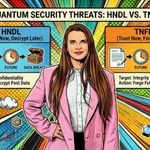
Why the urgency? Because of **Harvest Now, Decrypt Later (HNDL)**. Adversaries are stealing encrypted data today. If your data needs to remain secret for more than 10 years, it is *already* at risk. You must implement **Crypto-Agility** now—building systems that can seamlessly swap out classical algorithms for PQC without requiring a total infrastructure rewrite.
**4️⃣ THE PAKCRYPT VISION: Leading the Transition**
This is the exact frontier we are tackling at the **PakCrypt Symposium**. We are bringing together top international minds from Germany, Norway, China, and Turkey to demystify these standards.
To the young students and cybersecurity professionals reading this: **This is your moment.** The world needs PQC engineers, cryptographers, and security architects. Equip yourselves with these skills, participate in national-level events, and let’s ensure you are not just a consumer of this technology, but a global leader in the post-quantum era. 🔐🚀
🔗
📄 **NIST PQC Official Page & Standards:** csrc.nist.gov/projects/post-…
🛡️ **CISA Quantum Computing Cybersecurity Timeline:** cisa.gov/quantum-computing-c…
#PostQuantumCryptography #PQC #NIST #CyberSecurity #Cryptography #QuantumComputing #InfoSec #FIPS #PakCrypt #TechPakistan #FutureOfTech

2
56
🎙️ The perimeter is dead. The cloud is the new battleground, and the rules of engagement have fundamentally changed.
Cybercriminals are no longer just probing for vulnerabilities; they are launching coordinated, destructive campaigns directly at cloud infrastructure. Recent data shows these destructive attacks have soared by nearly **87%**.
Microsoft’s core directive is now the industry standard: **Assume the breach is inevitable.** Resilience can no longer be bolted on; it must be baked into the very DNA of your stack.
Here is your technical deep-dive into the Zero-Trust imperative, the mechanics of cloud resilience, and how we must architect for survival. 🧵👇
**1️⃣ THE THREAT: Why the Cloud is the Primary Target**
The shared responsibility model is often misunderstood. While cloud providers secure the *infrastructure*, customers are solely responsible for securing *in* the cloud. Attackers are ruthlessly exploiting:
☁️ Over-permissioned identities and stale service accounts.
☁️ Misconfigured storage buckets and exposed management APIs.
☁️ The "implicit trust" legacy of flat network architectures.
When they get in, they don’t just steal data; they deploy wipers and destructive payloads to cripple operations entirely.
**2️⃣ THE PARADIGM SHIFT: "Assume Breach" Architecture**
Waiting for a perfect defense is a losing strategy. The "Assume Breach" mindset means designing systems under the assumption that an adversary is *already* inside your network. The goal shifts from purely "keeping them out" to "minimizing their impact and ejecting them instantly."
**3️⃣ THE ZERO-TRUST PLAYBOOK: Practical Execution**
Zero Trust is not a product you buy; it is an architectural framework. Implementing it requires strict adherence to three pillars:
🔐 **Identity as the New Perimeter:** Enforce strict Conditional Access, hardware-backed MFA, and Just-In-Time (JIT) privileged access. No user or service gets implicit trust, regardless of their network location.
✂️ **Micro-segmentation:** Divide cloud environments into isolated zones. If an attacker compromises one workload, lateral movement is mathematically and logically blocked, containing the blast radius.
🛡️ **Immutable Backups & Distributed Design:** Architect for continuity. Utilize write-once-read-many (WORM) storage for backups and design distributed, multi-region services so that a localized destructive attack cannot take down the entire business.
**4️⃣ THE SPEED IMPERATIVE: Shrinking Attack Timelines**
The window between initial compromise and catastrophic impact has shrunk from days to mere minutes. Human-led incident response is too slow. Defenders must deploy:
⚡ **Automated XDR/SIEM:** To correlate telemetry across identities, endpoints, and cloud workloads in real-time.
⚡ **SOAR Playbooks:** To automatically isolate compromised instances, revoke suspicious tokens, and trigger containment protocols without waiting for human approval.
🔗 **READ MORE **
📄 **NIST Special Publication 800-207: Zero Trust Architecture:** csrc.nist.gov/publications/d…
🛡️ **Microsoft’s Comprehensive Zero Trust Deployment Guide:** learn.microsoft.com/en-us/se…
#ZeroTrust #CloudSecurity #CyberDefense #InfoSec #AssumeBreach #CyberResilience #PakCrypt #TechPakistan #CyberSecurity #MicrosoftSecurity #CloudArchitecture
ibm.com/think/topics/zero-tr…
1
30
🎙️ Ransomware has mutated. It is no longer just a tool for financial extortion; it has become a digital billboard for geopolitical warfare.
We are witnessing a chilling evolution in Advanced Persistent Threat (APT) tactics. State-aligned actors are now deploying "Ransomware-as-a-Broadcast," using the chaos of encrypted files not to demand a payout, but to deliver a political manifesto.
Here is your technical deep-dive into the mechanics of this hybrid threat, the stealthy attack chains being used, and how global defenders must adapt. 🧵👇
________________
**1️⃣ THE ACTOR & THE WEAPON: MuddyWater’s "DarkBit"**
Iran-linked APT groups, historically tracked as Seedworm or MuddyWater, have long been known for espionage and disruptive attacks. Recently, they have weaponized a variant dubbed "DarkBit."
Unlike traditional cybercriminal syndicates, MuddyWater’s primary objective here is *not* financial gain. The encryption is a means to an end: forcing the victim to read a political message while simultaneously crippling their operations.
__________
**2️⃣ THE ATTACK CHAIN: Mastering "Living off the Land" (LotL)**
The true danger of this campaign lies in its stealthy, low-signature execution. The attackers bypass traditional perimeter defenses by abusing legitimate tools and neglected infrastructure:
🕸️ **Phase 1: The IoT Foothold:** Attackers leverage compromised, Mirai-infected routers or IoT devices. These devices are often overlooked by enterprise security teams, providing a quiet, persistent foothold inside or adjacent to the target network.
🌉 **Phase 2: The Stealthy Tunnel:** Instead of dropping a custom backdoor, operators use **Plink** (the command-line version of PuTTY). By initiating a reverse SSH tunnel from the compromised internal machine to an attacker-controlled server, they bypass inbound firewall rules. This creates a stealthy, encrypted proxy directly to internal Remote Desktop Protocol (RDP) services.
💥 **Phase 3: The Broadcast:** Once lateral movement is achieved and privileges are escalated, DarkBit is deployed. It encrypts critical data, but the accompanying "ransom note" contains no Bitcoin wallet or negotiation link—only political propaganda and ideological demands.
_______________
**3️⃣ THE PSYOP ILLUSION: Why "Ransomware" is the Wrong Label**
Labeling this purely as "ransomware" is a dangerous misnomer. It tricks defenders into applying financial cybercrime playbooks to a geopolitical disruption event.
The "ransom" is a fiction. The attackers have no intention of providing a decryption key. The encryption is simply a destructive payload (a wiper in disguise) designed to maximize operational downtime and amplify the psychological impact of the political message.
______________________
**4️⃣ THE GLOBAL DEFENSE MANDATE: Breaking the Chain**
Defending against LotL-driven, politically motivated destruction requires shifting focus from the final payload to the initial vectors:
🚫 **Strict Egress Filtering:** Firewalls must be configured to block unauthorized outbound SSH (Port 22) and RDP (Port 3389) traffic. If a compromised internal host cannot phone home to establish a Plink tunnel, the attack chain breaks.
🔒 **IoT Network Segmentation:** Mirai-infected routers must never share a network segment with critical IT or OT systems. Implement strict VLAN isolation and Zero Trust Network Access (ZTNA) for all edge devices.
🔍 **Behavioral Anomaly Detection:** Since Plink and RDP are legitimate tools, signature-based EDR will miss them. Defenders must deploy User and Entity Behavior Analytics (UEBA) to flag anomalous process trees (e.g., a web server suddenly spawning a command-line SSH client).
______________________
**5️⃣ THE GLOBAL CALL TO ACTION: See Beyond the Payload**
To threat hunters, SOC analysts, and incident responders worldwide: **Context is your most powerful weapon.**
When you see a ransom note, do not automatically assume a financial motive. Analyze the TTPs (Tactics, Techniques, and Procedures). Who benefits from this disruption? Map the infrastructure. We need defenders who can connect the dots between a seemingly random IoT compromise and a coordinated, state-sponsored psychological operation. The future of cyber defense depends on our ability to see the full picture. 🌍🚀🛡️
_________________________
🔗 **READ MORE & DIVE DEEP:**
📄 **Mandiant: MuddyWater / Seedworm APT Group Profile & TTPs:** mandiant.com/resources/blog/…
🛡️ **CISA: Mitigating Living off the Land (LotL) Techniques:** cisa.gov/news-events/cyberse…
#CyberWarfare #ThreatIntelligence #APT #LivingOffTheLand #LotL #Ransomware #InfoSec #CyberSecurity #ThreatHunting #GlobalSecurity #MuddyWater

3
152
Hackers turned French supermarket freezers into OVENS 🥶🔥
Not a metaphor. Overnight Oct 11-12, attackers hijacked internet-exposed refrigeration controllers at hundreds of French supermarkets and cooked the cold chain.
Fridges and freezers were forced to 50°C (122°F) for ~6 hours. Stores had to throw away all affected food. Some units overheated and sparked small fires.
Attackers forced the systems into continuous defrost.
They pushed the setpoint to 50°C and stretched the defrost cycle from 1 hour to 8 hours, so alarms went off later and damage piled up.
Most hit units were end-of-life Danfoss AK-SM 800 and AK-SC 355. No patches left. Some current AK-SM 800A units were also hit on outdated firmware. The controllers were reachable from the internet.
This was not data theft. This was physical sabotage of food. CERT-FR told operators to take these controllers OFF the internet or filter access tightly. Losses ran into tens of millions of euros.
Your freezer should not need a firewall. Now it does.
Source: thehackernews.com/2026/10/at…
#CyberSecurity #InfoSec #IoT #ICS #France

3
49
The countdown to "Q-Day" isn't science fiction anymore. It’s an engineering reality.
Experts warn that future quantum computers could break RSA and ECC in hours—or even minutes. When that happens, the public-key cryptography securing our digital world becomes instantly obsolete.
Here is the full narrative of the quantum threat, the blast radius, and the urgent roadmap to secure our future. 🧵👇
**1️⃣ THE THREAT: Why RSA & ECC are on Borrowed Time**
Today’s internet relies on public-key cryptography (RSA, ECC). These algorithms are secure because they rely on mathematical problems—like integer factorization and discrete logarithms—that would take classical computers millions of years to solve.
Enter Quantum Computing.
Using **Shor’s Algorithm**, a sufficiently powerful quantum computer with enough stable logical qubits can solve these exact mathematical problems exponentially faster. What takes millennia for classical machines takes mere minutes for quantum ones.
**2️⃣ THE BLAST RADIUS: What Breaks When Quantum Arrives?**
If RSA and ECC fall, the foundational trust of the modern internet crumbles overnight:
❌ **HTTPS/TLS:** Secure web browsing and data-in-transit encryption are shattered.
❌ **VPNs & SSH:** Secure remote access and network tunnels are compromised.
❌ **Digital Signatures & PKI:** Code signing, SSL certificates, and identity verification lose their root of trust.
⚠️ **The Hidden Danger:** You don't need to wait for Q-Day to be vulnerable. Adversaries are actively executing **"Harvest Now, Decrypt Later" (HNDL)** attacks. They are stealing and storing encrypted data *today*, waiting for quantum hardware to mature so they can decrypt it tomorrow.
**3️⃣ THE ANTIDOTE: NIST’s Post-Quantum Cryptography (PQC)**
We cannot wait for quantum computers to mature to act. The solution is already here. NIST has finalized its first Post-Quantum Cryptography standards, relying on entirely different mathematical foundations (like lattice-based cryptography) that even quantum computers struggle to solve.
The new gold standards include:
🔹 **ML-KEM (formerly Kyber):** For secure key encapsulation and encryption.
🔹 **ML-DSA (formerly Dilithium) & SLH-DSA:** For robust, quantum-resistant digital signatures.
**4️⃣ THE PLAYBOOK: How to Migrate NOW**
Migrating to PQC isn't just a "find and replace" in your codebase. It requires a strategic, enterprise-wide overhaul:
🔍 **Discover:** Conduct a deep inventory of all cryptographic assets, libraries, and dependencies.
📊 **Assess:** Identify where classical RSA/ECC are used and evaluate your specific quantum risk profile.
🏗️ **Architect:** Design for **Crypto-Agility**. Build systems where cryptographic algorithms can be swapped out seamlessly without rewriting the core application.
🔄 **Migrate:** Implement **Hybrid Schemes** (combining classical + PQC algorithms) as a transitional bridge to ensure security during the migration phase.
**THE BOTTOM LINE:**
The quantum threat is no longer a theoretical debate for academics; it is a critical, immediate cybersecurity imperative. The time to build quantum-resistant infrastructure is *before* the quantum computers are fully online.

1
2
58
🧵 if you do not know Shafi Goldwasser, you are living in stone age of crypto.
She is co-inventor of zero-knowledge proofs, Turing Award winner, and now one of the people asking whether you can trust an AI model at all. 🔐🤖
Born in New York City in 1959, raised in Tel Aviv. Carnegie Mellon for undergrad (1979), then Berkeley for her MS (1981) and PhD (1984), advised by Manuel Blum. Her PhD work was on probabilistic encryption, and she later shared the 2012 Turing Award with Silvio Micali. Those ideas became the foundations of modern cryptography. 📜
Her top 3 AI x crypto moves:
1️⃣ Undetectable backdoors (FOCS 2022). With Kim, Vaikuntanathan, and Zamir, she showed a malicious trainer can plant a backdoor in a classifier that no bounded observer can detect, under standard crypto assumptions. The backdoored model can look robust while every input has an adversarial example. Yikes. 😬
2️⃣ Detection vs. mitigation (2025). With Gluch, she took a cryptographic lens to adversarial inputs at inference time and showed that detecting them and mitigating them are equivalent for classification tasks. That changes what "defense" even means.
3️⃣ Trust engineering. Her research program covers verification protocols for ML models and data sources, privacy in training and inference, and robustness against adversaries. She also co-founded Duality Technologies, a privacy-tech company.
Why she matters in age of AI? 🤔
→ The tools she helped invent, like zero-knowledge proofs, are the same ones people now use to verify AI without trusting the vendor.
→ She's saying the quiet part out loud: some backdoors may be provably undetectable. Audits built only on tests are weaker than we assumed.
→ When AI becomes infrastructure, trust is the product. The people who define trust mathematically will matter a lot.
NGMI if you're trusting a model you didn't train, test, or verify. Follow the person who helped define what a proof is. 🧠
🔗 people.csail.mit.edu/shafi
🔗 www2.eecs.berkeley.edu/Facul…
📄 arxiv.org/abs/2204.06974 (Planting Undetectable Backdoors in ML Models)
#Cryptography #AI #MachineLearning #AISafety #ZeroKnowledge

APT28 just stopped spying and started trying to BREAK the aid routes to Ukraine. And they did it with zero-days + memes hidden in images.
This is PRISMEX - new malware framework tracked since Sept 2025, blew up Jan 2026.
**WHO / WHAT:**
Pawn Storm / APT28 / Fancy Bear / Forest Blizzard - GRU's most aggressive crew active since 2014.
New suite: PRISMEX - named because it spreads payload ACROSS the entire image.
Components:
→ PrismexSheet: Excel dropper with obfuscated VBA, hides payload IN its own binary via stego
→ PrismexDrop: Dropper, persistence via COM hijacking
→ PrismexLoader: Proxy DLL that extracts code from PNGs using "Bit Plane Round Robin" technique - legit looks like a normal image
→ PrismexStager: Final implant = Covenant Grunt (open-source .NET C2) talking to Filen.io cloud storage over encrypted channel
Translation: Fileless, no obvious files on disk, hides in images, lives in legit cloud, bypasses EDR.
**THE ZERO-DAY DRAMA - THIS IS SUS:**
They chained 2 vulns:
CVE-2026-21509: Microsoft Office OLE bypass - Shell.Explorer.1 COM object (CLSID: EAB22AC3...). Crafted RTF auto-browses WebDAV and executes remote .lnk with NO click beyond opening doc, bypasses Protected View.
CVE-2026-21513: MSHTML zero-day in ieframe.dll - hyperlink handling calls ShellExecuteExW outside sandbox via nested iframes.
Timeline:
- Dec 12, 2025: Domain registration for WebDAV C2 starts = 2 WEEKS before CVE-2026-21509 disclosure (Jan 26, 2026) → advance knowledge
- Jan 30, 2026: LNK exploit hits VirusTotal
- Feb 10, 2026: Microsoft patches CVE-2026-21513 → 11-day zero-day in wild
**WHO THEY HIT:**
Not random gov. They hit the backbone that moves aid:
Ukraine: gov agencies, hydrometeorology (weather data for artillery / drone ops), emergency services, transport hubs, intl aid routes
NATO allies:
→ Poland: rail logistics
→ Romania, Turkey: maritime transport
→ Czech, Slovakia: ammo initiative logistics partners
→ Slovenia: transport
Trend Micro: "strategic focus on supply chains, weather services, and humanitarian corridors represents a shift toward operational disruption that may presage more destructive activities" - wiper commands already observed.
**WHY THIS IS DIFFERENT:**
This is evolution of NotDoor ecosystem. Previous APT28 was steal docs. Now it's position to disrupt + potentially wipe.
Spear-phish lures: "Hydro-meteorological Warnings", "Invitation to Military Training Programme", "Weapon Smuggling Alerts" - hyper-targeted to military.
If you secure logistics, rail, maritime, weather orgs, or anything touching Ukraine aid - you are in scope even if you're in NATO.
**BLUE TEAM HOMEWORK:**
Hunt for:
- RTF → WebDAV → .lnk chain
- COM hijacking + Filen.io traffic
- PNGs with hidden payloads (bit plane analysis)
- Covenant Grunt beacons
Patch CVE-2026-21509 & 21513 NOW. Block WebDAV outbound if you can.
Deep dive - don't take my word for it:
→ Trend Micro technical report (best): trendmicro.com/en_gb/researc…
→ Summary + CVEs: cybersecurity-help.cz/blog/5…
→ Hacker News overview: thehackernews.com/search/lab…
Supply chain is the new frontline. And it's not just SolarWinds anymore, it's rail tracks.
#APT28 #FancyBear #PawnStorm #PRISMEX #ZeroDay #ThreatIntel #NATO #Ukraine #SupplyChain #InfoSec #DFIR #COMHijacking #Steganography
