

Twitter account for Physics (within the School of Maths & Physics) at University of Portsmouth UK
Portsmouth, England
Joined October 2018
- Tweets3.8K
- Following44
- Followers221
- Likes789








Physics Portsmouth UK retweeted

The three-body problem is a classic and notoriously difficult question in physics and mathematics. It asks: How do three objects, such as stars, planets, or moons, move under the influence of each other’s gravity? Unlike the simpler two-body problem, which has precise and predictable analytical solutions (like the Earth orbiting the Sun in an ellipse), the three-body problem quickly becomes chaotic and unpredictable.
This complexity arises because each object's motion constantly affects, and is affected by, the other two. These gravitational interactions form a tangled and unstable system. In fact, there's no general formula that can solve all three-body scenarios exactly. This was first demonstrated in the 19th century by Henri Poincaré, whose work laid the foundations for chaos theory.
While exact solutions remain elusive, scientists have discovered certain special cases where the motion is stable or periodic. One well-known example is the Lagrange points, where three bodies can maintain a stable triangular configuration. However, such neat solutions are rare.
Today, thanks to powerful computers, researchers can simulate three-body systems with remarkable accuracy, helping us study triple-star systems, exoplanets, and asteroid dynamics. Yet even small changes in the starting conditions can lead to dramatically different outcomes, highlighting the sensitive dependence on initial conditions that defines chaotic systems.
The three-body problem is actually a specific case of the broader n-body problem, where n can be any number of interacting bodies. As n increases, the complexity and unpredictability rise even further.
The three-body problem serves as a vivid example of how simple laws of nature, like Newton’s law of gravity, can produce behavior that is intricate, unexpected, and profoundly difficult to predict.

Physics Portsmouth UK retweeted

“Physics should be taught with the majesty and beauty it deserves.”
— Elon Musk
Physics Portsmouth UK retweeted

Quantum Entanglement ✍️
Quantum entanglement is when two or more particles become so deeply connected that the state of one instantly determines the state of the other, no matter how far apart they are. This strange connection baffled even Einstein, who called it "spooky action at a distance." While it can’t be used to send information faster than light, entanglement plays a key role in quantum technologies like super-secure communication and powerful quantum computers.


New 2D quantum sensor breakthrough offers new opportunities for magnetic field detection sciencedaily.com/releases/20…
7
New quantum visualization technique to identify materials for next generation quantum computing sciencedaily.com/releases/20…
8
Physics Portsmouth UK retweeted

This month’s #NASAScience image features Cassiopeia A, one of the most studied supernova remnants. Using data from @chandraxray and @NASAWebb, researchers have uncovered previously unseen structures within the stellar debris, offering new insights into the complex aftermath of a massive star’s explosion.
Explore the science: go.nasa.gov/4jGzkQU

ALT A circular-shaped nebula with a complex structure. On the circle’s exterior, particularly on the left side of the image, are curtains of material glowing orange like fire. Interior to this outer shell is a ring of mottled filaments in bright pink, studded with clumps and knots. A greenish loop extends from the upper right of the ring into the central cavity. Translucent wisps of blue, green, and red appear throughout the image.
Physics Portsmouth UK retweeted
Last year, Earth was hit by the largest geomagnetic storm in 20 years. You may have seen aurora in the night sky as our upper atmosphere was bombarded by charged particles from the Sun.
Explore what @NASASun researchers learned from the storm: science.nasa.gov/science-res…
Physics Portsmouth UK retweeted
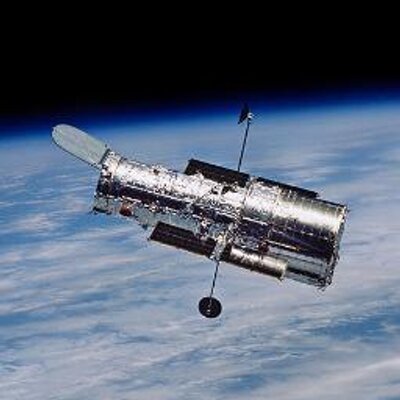
For decades, astronomers believed that one day, our Milky Way Galaxy would collide with our nearest major galactic neighbor, Andromeda.
Now, with the latest Hubble data and computer simulations, our galaxy's fate isn't as certain: go.nasa.gov/4kN9Kul

Ultra-thin lenses that make infrared light visible sciencedaily.com/releases/20…
6
Physics Portsmouth UK retweeted

Auroras from space always draw crewmembers to the Cupola. I love how this one illuminated our Dragon, and I also love the dance of satellites on the left in the latter part of the video. It’s interesting how the aurora creeps along the top of the atmosphere as it comes up over the horizon. I have added traveling to see auroras from Earth to my bucket list!
Physics Portsmouth UK retweeted

It's showtime! 🍿
Grab some popcorn and head outside for June's night sky sightings, featuring our solar system's finest — Venus, Mars, Jupiter, Mercury, and Saturn — and views of our galaxy during the Milky Way Core Season. Details: go.nasa.gov/43Hbmil
Physics Portsmouth UK retweeted

this is a real photograph, and it looks like a sketch for a sci fi novel

Tabletop particle blaster: How tiny nozzles and lasers could replace giant accelerators phys.org/news/2025-06-tablet…

6