

Emeritus Chemistry Professor, PhD, DSc Geochemistry. 386 publications peer-reviewed journals. 2 Books, Former Executive Dean & Chief Research Scientist CSIRO
Sydney
Joined January 2016
- Tweets19.2K
- Following397
- Followers3.1K
- Likes7.9K




Prof Mick Wilson 1 retweeted

Excellent 👌👍

It’s extraordinary how selective these environmental arguments are. Apparently, eating meat is destroying the planet, but the environmental damage caused by producing plant-based foods barely gets a mention.
Take avocados. Research has estimated their water footprint at around 1,400 litres per kilogram, with intensive cultivation in parts of Mexico linked to deforestation and pressure on local water supplies.
Or soya. Its cultivation has contributed to habitat destruction in South America. Tofu doesn’t magically arrive on supermarket shelves without land, water, agricultural machinery, processing and transport.
And what about the insects? Industrial crop production involves pesticides, harvesting and habitat destruction, killing countless insects and other animals. We don’t have a reliable global figure, but pretending plant-based agriculture is free from animal deaths is absurd.
Then there’s the health argument. Many vegan burgers, sausages and meat substitutes are ultra-processed products containing added salt, flavourings and other ingredients. A 2025 study found that people consuming the highest proportion of nutritionally poor, ultra-processed plant-based foods had a 46% higher incidence of coronary heart disease than those consuming the lowest proportion. That’s an association, not proof of causation, but hardly something to ignore.
And those dramatic water figures? They routinely combine rainfall, irrigation and water needed to dilute pollution, as though they were all equivalent to taking drinking water from someone’s tap. They’re not.
None of this means animal agriculture has no environmental impact. Of course it does. But replacing one simplistic narrative with another, while ignoring biodiversity, soil health, food processing, nutritional value and local growing conditions, isn’t environmental science.
If we’re serious about sustainability, we should be talking about how food is produced, not pretending that everything labelled ‘plant-based’ is automatically healthy, ethical or environmentally harmless.


Prof Mick Wilson 1 retweeted

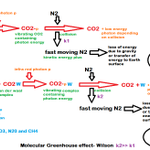
This also explains why, over geological time, shifts in the positions of the continents (plate tectonics) lead to changes in oceanic circulation and, consequently, in climate, far more so than CO₂.

El Niño weather events have pulsed through the world's oceans for millennia. They are not new, nor are they a modern abnormality.
There have been around 27 El Niño events since 1900, each following broadly similar patterns of intensity. There is no sound reason to expect the current cycle to be any different. Treating a routine, well-understood natural oscillation as an artificial aberration ignores the long-established history of planetary rhythms.
Predicting exact rainfall distribution weeks or months ahead remains virtually impossible. No one can dictate atmospheric behavior in advance. Yet we have become accustomed to a style of forecasting that frames every routine shift - no matter how minor - as an unprecedented crisis.
El Niño is a foundational component of the global climate engine, balancing heat across the Pacific, the largest ocean on Earth. Rainfall drives agriculture, fills reservoirs and sustains life. Extended cold and aridity, by contrast, carry far greater risks to human society.
Earth's climate moves in recurring cycles. As seasons change and ocean currents shift, each El Niño varies slightly in character, but they all fit comfortably within the baseline of natural variability - a system that has experienced these exact fluctuations countless times over centuries.
While modern thermal modeling can detect shifts in sea surface temperatures months in advance, it can't map local rainfall with certainty. The actual weather an El Niño delivers - be it gentle, drought-breaking rain or an intense storm sequence - only becomes clear in real time. True measurement belongs in the aftermath, not the preamble.
El Niño is not a sudden anomaly; it is a recurring chapter in Earth’s seasonal story. Forecasting serves us best when it treats the climate for what it is: a complex, living system that reveals its true nature in its own time.
IMAGE: The Pacific Ocean in motion: a vast, complex thermodynamic system balancing Earth’s energy through deep-time natural rhythms.


Prof Mick Wilson 1 retweeted
The IPCC carbon cycle is where the #climatescam starts. "Revisiting the Carbon Cycle" is a great paper that I wrote with Veyres and Maurin (2025).
Just 4 more downloads to score 7000 !
Please support with a retweet.
Thanks.
researchgate.net/publication…


Prof Mick Wilson 1 retweeted

😂😂😂
Australia Post has started selling giant “WE ARE HOME” banners for customers tired of collecting parcels they took the day off to receive.
The bright red banners stretch four metres across and can be read from a passing delivery van.
“I watched him photograph the banner,” one customer said, “then got a notification saying ‘Sorry we missed you’.”



Prof Mick Wilson 1 retweeted

Taken from her audience and stage at the peak of her career, Ronnie survived years of torment and abuse. What stands out in her story is not only what she endured, but what she reclaimed: her sense of self, her work, her stage and her joy…


