Chief Scientist @BerkeleyEarth. Physics PhD & data nerd. Usually focused on climate change, fossil fuels, & air quality issues.
Zurich, Switzerland
Joined January 2017
- Tweets22.2K
- Following883
- Followers78.7K
- Likes13.3K


Pinned Tweet
It's a hard time for everyone. I work for a small non-profit, @BerkeleyEarth, and we need your help.
We fund our work with grants & donations. If you like our work on climate change, and have a bit spare, perhaps consider making a donation.
Thank you.
donate.berkeleyearth.org/
El Niños lead to reduced precipitation in the Amazon, which leads to wildfires.
As the current record-breaking El Niño progresses over the next several months, we're likely to see things in the Amazon get significantly worse before they get better.

The Amazon is burning again. Air pollution is getting worse, people’s health is at risk, and the worst may still be ahead.
scitechdaily.com/the-amazon-…

The riots in France have multiple complex economic and social causes, but I have to wonder whether the scorching hot summer contributed some to the discontent.
In a country where most homes and businesses lack air conditioning, this last summer would have been insufferable.

Does extreme heat necessarily lead to rioting? No, of course not.
But prolonged heat makes people miserable, and that can enflame existing tensions arising out of poverty, inequality, perceived injustice, etc.
Heat isn't the main issue, but it can intensify existing problems.
Anger arising during a miserable summer doesn't necessarily fade just because temperatures cooled.
The French protests began a month ago led by students upset about the poor conditions in public schools.
Among many complaints, one is the excessive heat.
time.com/article/2026/10/02/…

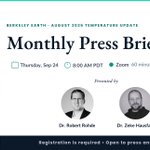
Join us tomorrow at @BerkeleyEarth for our monthly weather and climate update.
A record-breaking El Niño is rumbling and the rest of 2026 is poised to challenge records.
8 AM PT / 11 AM ET / 5 PM CET
docs.google.com/spreadsheets…
Geared for journalists, but all are welcome.

Is broad permitting reform a mixed bag? Of course it is.
You'll make things that you want easier. But, you'll also make things you don't want easier.
Nevertheless, unless you are in favor of doing nothing at all, such reform is probably still worth pursuing.
Dr. Robert Rohde retweeted

“The instrument changes were partly motivated by a push to narrow the satellites’ applicability to weather forecasting, rather than conducting climate research as well. Among the instruments that were nixed: a tool to monitor air quality, including hourly monitoring of wildfire smoke; as well as one meant to study water quality and ocean currents, along with harmful algae blooms.”

The Trump administration’s cuts to weather satellites will set the country back nearly a decade, experts say. The loss of data used to observe, forecast and research extreme weather could prevent the US from making major advances in weather prediction in the coming years. cnn.it/4k6eD4o

Dr. Robert Rohde retweeted

Yikes. "After a week of contentious deliberations and some displays of temper, the IPCC suspended its 65th session without an agreement on either a timeline for the remainder of its Seventh Assessment Cycle or even a budget for the coming year." enb.iisd.org/intergovernment…

The current record-breaking El Niño has suppressed hurricane activity in the Atlantic to almost nothing, while giving the Eastern Pacific its most active year on record.
These shifts are a normal response to El Niño, but still striking how extreme they've been this year.

I can’t get over how active this hurricane season has been in the Eastern Pacific. It’s already the basin’s most active season ever recorded, and we have another Category 4 hurricane on the way this weekend. There’s also a growing signal for another major hurricane (Category 3+) by late October.
We could end up with 10 or more Category 4 or 5 hurricanes in a single season.
This is truly a generational hurricane season, one we may not see surpassed for decades, all while the Atlantic is on track for its second-quietest season on record.
A consequence of this year's record strong El Niño.


Why is it only now that we are seeing a surge in Ukrainian attacks on Russian refineries and data centers?
Has Ukraine been holding back? Did it take years for Ukraine to develop an effective capacity to hit those targets? Or is it that Russian defenses have been degraded?
Exactly this.
A public execution isn't a deterrent for terrorists. It's a reward.
We should be better than this.

WE COUNT THE ENEMIES WE KILL. WE RARELY COUNT THE ONES WE CREATE.
Nidal Hasan was a patient on my floor in the surgical trauma ICU at Brooke Army Medical Center.
I wasn't there when he arrived. I had just left for my deployment to Mosul, Iraq. But the nurses and doctors who cared for him were my peers and my friends, and I know exactly what that required of them, because every one of us had done some version of it before. Before anyone tells me what strength looks like, understand what that work demands.
I have cared for a drunk driver who wiped out an entire family and landed in our ICU himself. I have cared for gang members who shot up a block while children were stepping off a school bus, then ended up on our unit with bullets of their own. I have kept alive people who murdered their own families and failed at taking their own lives. And in Iraq, I saved the lives of the very enemy fighters who had just tried to kill us and miraculously survived our response.
Every one of those patients got our best. Not because we felt anything for them, but because of who we were. You set aside anger, grief, prejudice and every personal feeling you have, because a life in front of you is a life in front of you. That's the oath. That's the duty.
So when Hasan came through those doors, my colleagues did what we had always done. They preserved the life of a man who murdered thirteen people and would have killed them too, given the chance. He killed those men and women in one of the very same buildings many Soldier's like myself have been in when I was stationed at Fort Hood.
He is alive today because they did their jobs. That was not sentiment. It was a hard, tangible expression of the values this country claims to stand for. Our principles had to mean something even when the person benefiting from them had violated everything we believed in.
Now the Pentagon plans to livestream his execution by firing squad on Dec. 3, and our leaders apparently believe turning his death into a public spectacle will demonstrate American strength. I think it demonstrates how little they understand the enemy they claim to be fighting. We kept Nidal Hasan alive, now our leaders want to make him a martyr.
Hasan walked into Fort Hood expecting to die. He believed his death would be rewarded. At his trial, he called no witnesses and offered no defense, and his own court-appointed lawyers worried he was seeking execution. He failed at martyrdom once. Now we're about to hand it to him, in high definition, for every extremist with an internet connection to replay, manipulate and celebrate.
We supply the footage. They supply the meaning.
Long after the politicians finish congratulating themselves, that video will still exist. Their moment of bravado becomes somebody else's recruiting material for decades. And this failure to think past the immediate display of power reaches far beyond one execution. We count the enemies we kill. We rarely count the enemies we create.
Look at the school in Minab, Iran, where multiple investigations attributed the strike that killed more than 100 children and their teachers to us. You cannot bury people's children beneath the rubble of their classrooms and expect a speech about American intentions to decide how they remember you. No denial brings those children home. No claim of good intentions makes their parents forget whose weapons killed them.
If those were our children, we would remember for the rest of our lives. We would demand accountability. Many of us would want vengeance. We would tell their stories to the next generation. We know this because we did exactly that after September 11.
Why do we imagine other people love their children less, grieve less deeply, or remember less clearly?
We have developed a horrifying talent for creating more terrorists than we will ever stop. We inflict suffering, evade responsibility, and then act as though the anger that follows came out of nowhere.
Think back to the first time you saw one of those al Qaeda videos of an American being beheaded. Remember the sickness in your stomach. Remember the rage. Remember thinking that only savages would film a killing and send it out for the world to watch. Now ask yourself what the rest of the world will see when the camera is ours.
Terrorist organizations stage executions for the cameras. Authoritarian regimes make death a public spectacle to feed fear and rage. Watching our own leaders reach for those same tools should force us to confront how much of ourselves we are surrendering in the name of defeating them.
The line separating us from the people we condemn has to live in our conduct. A flag cannot hold it for us. Neither can a uniform, a title, or a declaration that we are the good guys.
On that ICU floor, on a bloody street in Mosul, and in trauma bays across this country, people like my colleagues hold that line every day under circumstances most will never face. They keep monsters alive because their duty and their humanity are bigger than their hatred of what those monsters have done.
Execute him if that's the sentence. But do it the way a confident nation does; quietly, lawfully, and without giving him the stage he always wanted. Let him be forgotten.
I expect our leaders to show at least as much discipline as the nurses who had to care for him.
They keep telling us they are defending what makes America different. Every day, they make that difference harder to see.
Robert W. Burns III is the editor and publisher of The Space Coast Rocket, an Army veteran and a retired trauma nurse. The views expressed in this column are his own.

Dr. Robert Rohde retweeted

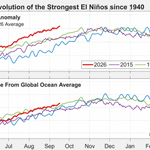
This year's El Niño continues its climb into uncharted waters; Niño3.4 region anomalies are now at a 3.4C above normal (how fitting!), higher than any prior El Niño event on record.
September monthly Niño3.4 anomalies also set a record at 2.9C (beating 2015 and 1877's 2.75C).

I was never a part of IceCube, but as a graduate student I was a bit IceCube adjacent. I worked with and shared office space with multiple members of the IceCube team.
It's nice to see their efforts being rewarded and recognized. Congratulations, everyone.
Congratulations to Halzen and everyone who contributed to the 40 year journey of transforming the ice sheet below the South Pole into the world's largest neutrino detector.

BREAKING NEWS
The Royal Swedish Academy of Sciences has decided to award the 2026 #NobelPrize in Physics to Francis Halzen “for decisive contributions to the IceCube Neutrino Observatory and the discovery of high-energy neutrinos of astrophysical origin.”

Dr. Robert Rohde retweeted

There's a degrowther meme that making it easier to build new clean energy, mobility, etc.. doesn't work, because it just adds to the global energy pie. That the only thing that works is directly limiting the supply of fossil.
This is false on the merits, as Zeke explains with real data below.
It's also close to a practical impossibility, and politicially counterproductive:
1. Fossil supply (especially for oil and coal, a bit less so for gas) is effectively unlimited and geographically diverse, with much of it coming from countries that depend on it for their primary income. Stop oil drilling in the US, and you'll get more in other places. It's whack-a-mole.
2. The only lasting way to reduce emissions is to reduce *demand* for fossil fuels, by making clean energy, transport, and industry cheaper and better options. Scaling cleantech does this. Removing permitting barriers helps clean energy more than fossil energy.
3. If you put too many barriers in place for using fossil fuels, without making it possible to build clean alternatives, the price of energy goes up. Voters hate that. You get a backlash. Price of living is a much more politically salient issue than climate. I say this as a climate activists for the last 15 years.
The only scalable and lasting way to reduce fossil fuels emissions is to make the clean alternative, cheaper, better, and at least as easy to build.
Permitting reform in the US does that. If you want to win on climate, this is an essential.

Ed Boyden, whose seminal work helped to cofound the field of optogenetics while still a PhD student, sadly just missed out on a Nobel Prize for his accomplishments.
The assistant professor whose lab he did part of that work in was among the three winners.

WHERE'S ED BOYDEN?
Oh. He was only a PhD student when he co-invented optogenetics and performed the first demonstration, so he gets no credit. Instead his advisor gets all the credit.
From National Academy of Sciences: Boyden, "in parallel to his PhD, as an independent side project, co-invented optogenetic control of neurons."
One of the worst snubs in Nobel history IMO!