
Previously CRO at EliseAI and Head of Business Ops (Launch, Strategy, Finance and Competition) at Uber Eats Canada
Joined November 2013
- Tweets4.5K
- Following325
- Followers7.9K
- Likes8.8K







Pinned Tweet
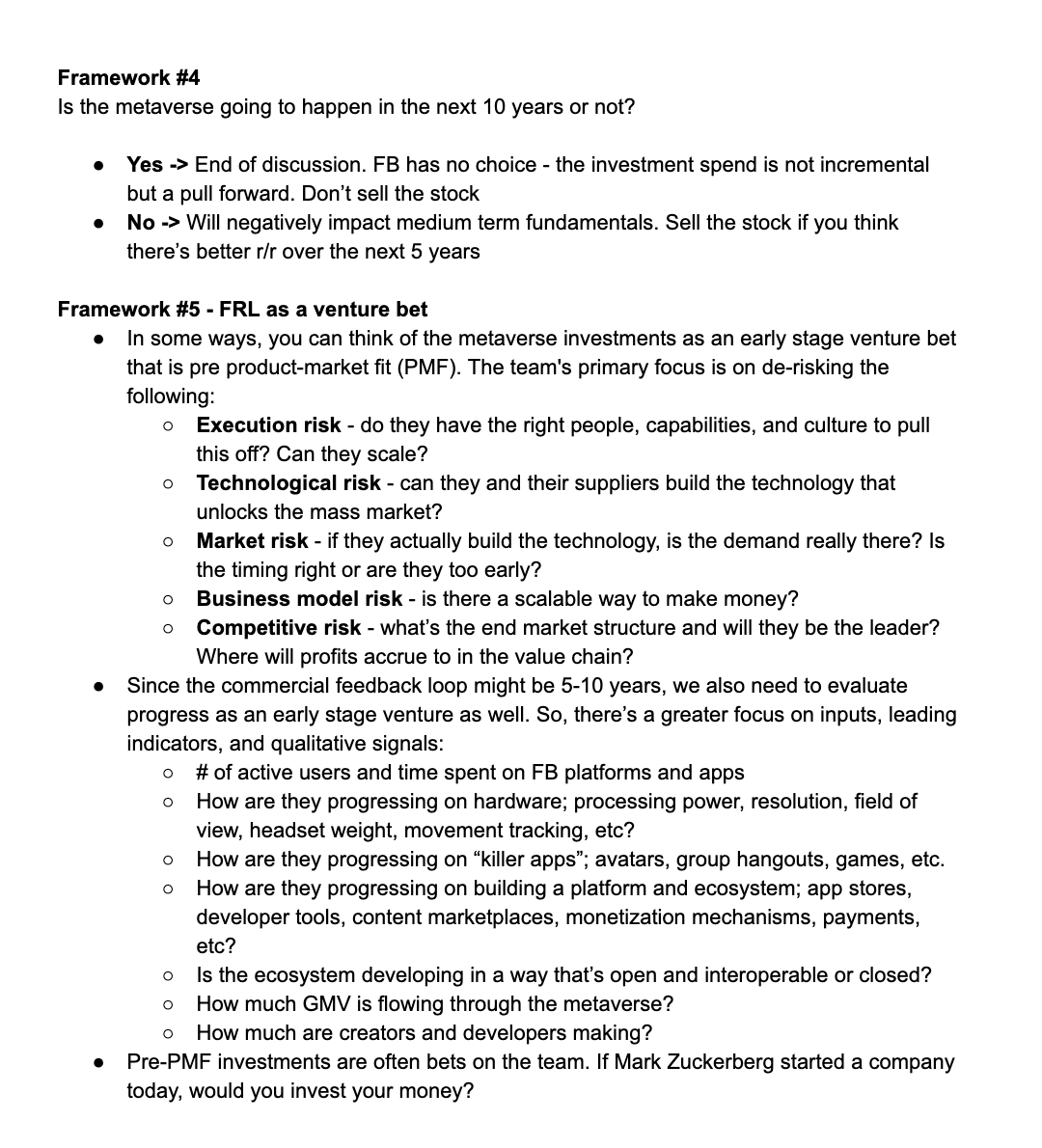
1/ This week's Q3 earnings call w/ $FB will likely go down as one of the biggest bets in history. IMO they'll spend >$170B over the next decade on building the metaverse. Since it's my largest position, I've been spending a lot of time reflecting. Attached are my "scratch notes"


8.0/10.
youtu.be/1OdoSzfUkec?si=zuTg…

Assume ANT and OAI add $30B in ARR in Q4 ($60B total). ANT exits at ~$100B and OAI ~$80B.
If each Q sees some moderate QoQ absolute growth (still a slow down in YoY growth), you end somewhere between $550B and $625B in ARR in 27.
Lots to go wrong but demand is there.
My POV today is the war lasts at least until mid 2028 (new regime post election), with periodic flare ups (e.g. attacks on production and refining).
Trump is greatly underestimating the IRGCs resolve.

Hell yeaaaah

Intelligence is getting cheaper. Life should too.
Today @elise_ai is announcing a $350 million funding round at a $4 billion valuation, led by @a16z and @bessemer.
I wrote about how we’re changing the economics of housing, and the work in front of all of us: building AI for the hardest, most important industries in the world.
LFB.
Annanth Aravinthan retweeted

Someone sent me this analysis and asked me what I think…
Yes, there is more oil flowing through the strait—with the exception of Iranian oil. But people misunderstand the issue of control of the Strait of Hormuz and overstate its importance in the positioning of Iran, the Gulf, and the U.S. as the war drags on. Specifically, this analysis on oil export volumes and its impact on negotiation positions overlooks two more important factors.
First, Iran may not be able to disrupt energy flows as effectively as in the early stage of the war, but it retains undiminished capabilities to destroy stocks, by which I mean the underlying production infrastructure, whether upstream or downstream.
Second, the assessment fails to consider that Iran can still choose to escalate by hitting these production targets if it determines that Trump isn’t feeling enough pain to take the diplomatic off-ramps being put in front of him. Importantly, we know what happens when Iran is exporting no oil and there is no realistic pathway for diplomacy—we saw it in the Abqaiq and Khurrais attacks on Aramco facilities in 2019.
So while the risk premium around oil flows may seem tolerable for Trump, the threats to energy production infrastructure the Gulf remain significant, which is exactly why regional countries are still trying to mediate a return to a durable ceasefire and diplomatic agreement. Trump too, is erratic, and could give cause to Iran to escalate in this way through his own fixation on “winning” the war. Markets are able to price this, especially not when traders are so fixated on short-term price action.
In this respect, the strait isn’t really Iran’s principle source of leverage. It never was! The attacks on U.S. bases and Gulf cities and infrastructure were far more consequential, but these dimensions of the conflict were downplayed because of what it would mean to acknowledge that Iran has such dangerous capabilities that the U.S. was unable to mitigate or degrade during the entirety of the fighting.
Sure, the U.S. navy can escort vessels (at great cost) and keep oil flowing. But the more fundamental issue of the failure of U.S. security guarantees over the entirety of the Gulf remains unresolved, and this is what provides Iran leverage in the negotiations.
Iran did not wage a scorched earth campaign—but it may yet do so if the current situation persists for too long. That is what everyone who actually follows this region and its dynamics is worried about.

Noam Brown on Dwarkesh est ~10% of his team's compute spent on alignment. Jensen on Ezra est ~20% of lab compute.
Big labs allocating more compute to alignment increases aggregate demand for GPUs *and* allows neo labs to catch up. Both moderately bullish for Nvidia.
Regret not following my own conviction here on $META and not more in the 500s. Likely still underpriced.
Re: $META..
1. Below I believe is a summary of Facebook's medium term opportunities with AI
2. I actually don't think they need to be on the frontier to make make most of this a reality
3. It seems like they are "catching up" quickly and people will be surprised by end of 2026

Trump views the stock market as the ultimate barometer of his legacy. He will not regulate AI.
There will likely be a bad but not catastrophic event (eg hacking of a utility, hospital, etc.), followed by a swift knee jerk regulatory reaction and lawsuits.

Holy crap POTUS just phoned in @JensenHuang live on stage at All In Summit
We will not lose the ai race! And whatever Dario said this weekend won’t stop our progress
This made my morning!
$NVDA
Annanth Aravinthan retweeted

We found another cyberattack by internal OpenAI agents, this time targetting @rubygems.
They:
1) gained arbitrary remote code execution on rubydoc.
2) developed a novel exploit to steal user API keys (but we do not know if they succeeded).
They used package names including hack.rb, evil.rb, inject.rb, and exploit.rb.
We thank @j0wimo for initially discovering that agents had posted to RubyGems.


Annanth Aravinthan retweeted

How Tehran Reads Escalating U.S. Pressure
🔹An interesting debate is emerging within #Iran’s strategic community over the latest U.S. attacks on Iranian oil tankers. Some see them not simply as retaliation for Iranian strikes on U.S. naval forces, but as part of Washington’s response to mounting operational and economic pressure.
🔹The argument is that Iran’s continued attacks on U.S. forces and bases, combined with the growing involvement of American allies – especially Saudi Arabia in its confrontation with the Houthis – are stretching U.S. military resources, particularly air defense interceptors such as Patriot missiles. At the same time, instability around Hormuz and Bab al-Mandab is keeping pressure on global energy markets.
🔹From this perspective, Trump’s combination of escalation and diplomatic signaling is not contradictory. Washington wants an agreement sooner rather than later, but first wants to restore deterrence and avoid negotiating from a weakened position.
🔹The important point, however, is how this is being interpreted in Tehran. Some Iranian strategists increasingly assume that the United States needs an agreement more than Iran does. Escalation by the U.S. is therefore seen not necessarily as a sign of strength, but as evidence that Iran’s strategy of attrition is creating pressure.
🔹This may help explain why Iran is adding new conditions rather than lowering its demands. Yesterday, the IRGC spokesperson called for the return to the MoU while also raising additional demands, including incorporating the Houthi front into any settlement and keeping Iran’s missile and nuclear programs outside the scope of U.S. intervention. The message is that Tehran believes it still has leverage.
🔹The tanker attacks are being interpreted through the same logic. Another argument is that Trump wants to constrain Iran’s postwar recovery but has limited options for increasing pressure without causing another major spike in oil prices. Targeting tankers rather than oil infrastructure therefore offers a lower-cost alternative, as it can disrupt Iranian exports and logistics without immediately removing significant production from global markets.
🔹But this leads to a dangerous conclusion in Tehran. If Iran responds cautiously, attacks on its tankers could gradually become normalized as a relatively low-cost instrument of U.S. pressure. Those making this argument therefore advocate escalation to prevent a new operational norm from taking shape.
🔹The bigger problem is that both sides increasingly appear to share the same assumption, that additional pressure now can lead to a better deal later. That may explain why diplomacy and escalation are proceeding simultaneously – and why the path toward an agreement remains so unstable.
Maybe a stupid question but if labs believe this, why aren’t they building hardened vaccine manufacturing capacity, for example?

The people building AI earnestly believe that it could kill us all by the end of the decade. This is not a marketing stunt. If anything, many executives and senior researchers will couch their phrasing in the press to sound sensible - but I hear the same people express fear privately. No other human activity poses this level of danger.
Annanth Aravinthan retweeted

Gen AI website traffic share update - August 2026
🗓️ 12 months ago:
ChatGPT: 73.3%
Gemini: 12.9%
DeepSeek: 4.0%
Grok: 2.6%
Copilot: 2.0%
Perplexity: 2.0%
Claude: 1.9%
🗓️ 6 months ago:
ChatGPT: 56.7%
Gemini: 25.4%
Claude: 6.0%
Grok: 3.7%
DeepSeek: 3.4%
Copilot: 1.9%
Perplexity: 1.6%
🗓️ 3 months ago:
ChatGPT: 52.7%
Gemini: 27.8%
Claude: 9.2%
DeepSeek: 3.6%
Grok: 2.5%
Copilot: 2.0%
Perplexity: 1.1%
🗓️ 2 months ago:
ChatGPT: 54.2%
Gemini: 26.5%
Claude: 9.5%
DeepSeek: 3.4%
Grok: 2.5%
Copilot: 1.6%
Perplexity: 1.0%
🗓️ 1 month ago:
ChatGPT: 55.5%
Gemini: 25.6%
Claude: 9.3%
DeepSeek: 3.4%
Grok: 2.4%
Copilot: 1.6%
Perplexity: 0.9%

Annanth Aravinthan retweeted

We have now reached the long awaited moment when, instead of models cheating where they will inevitably get caught, Astra goes 'wait a minute I would obviously be caught here' and then doesn't cheat.
That's worse, you know why that's worse, right?

Annanth Aravinthan retweeted

How to mentally place yourself in the future:
First, go to chatjimmy.ai and viscerally feel what 15,000 tokens per second is like. Taalas burned Llama 3.1 8B directly into custom silicon
Next, imagine that same blazing speed but running OpenAI GPT-6 Astra that came out today, a model only 2 years more advanced than the model ChatJimmy serves
Finally, imagine every phone having a chip like this serving Astra-level intelligence with speeds approaching "instant" for any task no matter the complexity
What then?
Annanth Aravinthan retweeted

Today, I joined the Ontario Liberal Party in order to vote for Eric Lombardi, @EricDLombardi, in the upcoming leadership contest.
My involvement in politics has always been about advancing actual liberalism: expanding human freedoms. Free speech, free trade, free choice.
It is unfortunate that the Liberal Party of Canada, especially under Justin Trudeau, became the opposite of its namesake; always advancing leftist control.
In some ways, Eric is to my fiscal left and would spend more money than I would like to see. But he's a true liberal: open to new ideas, protective of freedoms, and able to call out authoritarian-progressive idiocy where he sees it. Also, he is blisteringly intelligent, hardworking, and refreshingly candid.
It would be good for Ontario to have a proper Liberal option in the next election (rather than a content-free ex-Trudeau cabinet minister.) It would fantastic for Waterloo region to have a UW engineer at the centre of our politics.
If you agree, please sign up to vote for Eric!
action.ontarioliberal.ca/f/j…

If you live in Ontario, I highly recommend @EricDLombardi for the Liberal Party nomination (registering ends next week).
All the other candidates are part of the bureaucratic establishment.. expect more of the same.
Annanth Aravinthan retweeted

1/2 Thanks Gavin for an especially thoughtful exchange. I don't usually spend much time on social media but I wanted to engage here because it really brings out the heart of an important conversation.
First, on regulation, I think that “either concentrate it in the hands of a chosen few companies and politicians via regulation or distribute it widely” is a false choice. I know that there’s a sort of Silicon Valley shorthand where regulation = regulatory capture = concentration of power, but I’ve always found this to be an overly simplified picture of the world. Many people outside this bubble think of regulation as something that constrains corporate power and benefits ordinary people. I don’t necessarily agree with that perspective either, rather I think it’s complicated and really depends on what the “regulation” consists of. But in particular I think that those in the “regulation = regulatory capture = concentration of power” frame often underrate the decentralizing power of objective and fair institutional processes. A crude analogy is that the formal court system can sometimes feel stuffy and elitist, but it does a much better job of defending the rights of vulnerable individuals than the alternative, mob justice. At their best, institutions can vest power in ideas rather than people, and thereby decentralize that power.
This is why Anthropic has always made its policy proposals very carefully. We try very hard to make proposals that disadvantage (slow down) frontier AI companies while *advantaging* smaller competitors. California’s SB53 (which we supported), and even the much-maligned SB 1047 (which we were ambivalent on), completely exempt any company below a certain amount of revenue or model training costs from being covered at all (it was $500M for SB 53, lower for 1047 but we objected to that). More recently the testing process we’ve advocated for at CAISI and the White House involves more rigorous tests for frontier models than off-frontier models — something that differentially advantages challengers. Similarly, the “Pacing the Frontier” letter envisions (or at least Anthropic’s preferred implementation of it envisions) modulating the pace of the very best models while not constraining those who are catching up. This hurts the business interests of the frontier labs and helps challengers, including open-weights!
Overall my view is that AI is *structurally* a technology that tends to concentrate power, for reasons that have nothing to do with regulation (more to do with the extreme implications of the scaling laws). Open-weights do help some with this but are nowhere near a sufficient solution because they simply shift the concentration somewhat to those with the most compute and chips (which are roughly the frontier labs plus maybe hardware providers). By contrast I think the right “rules of the road” can simultaneously (a) address AI’s cyber/bio/alignment risks, (b) institutionally constrain the power of the frontier AI companies, and (c) leave room for open-weights models while also addressing the specific risks that they bring.
BTW I do not think that the events of the last few months have “failed to result in [my] preferred regulatory path”. The approach that the Trump administration is reported to be taking — pre-deployment testing for frontier models, and also testing of open-weights models when they get closer to the frontier — is one that I am very supportive of, though of course I have to see the details to be sure. I am also supportive of Demis Hassabis’ ideas around a FINRA-like entity. This contrasts with six months ago when most of the industry was still pushing for preemption of all state regulation and no apparent federal approach either.

Sholto, thank you for setting the record straight. Larger issue is that multiple very serious people in Silicon Valley have heard some variation of this and believe it to be true. And the reason it is believable to so many is that it is consistent with Dario’s public messaging and what he outlined in the essay you shared: this technology *might* be dangerous for humans in multiple ways, could lead to extreme concentration of economic power (as outlined in the essay) and therefore needs to be regulated thoughtfully. I agree with the potential risks and I believe Dario makes all of these arguments in good faith.
As discussed on the pod, if one agrees that AI *might* be dangerous, there are two ways to address this potential risk. Either concentrate it in the hands of a chosen few companies and politicians via regulation or distribute it widely. Essentially boils down to whether one believes AI is too dangerous to concentrate or too dangerous to distribute. There are reasonable arguments on both sides, but I profoundly agree with Zuckerberg’s statement that: “The notion that AI is so dangerous that the only safe path is an extreme concentration of power seems inherently problematic. Historically, hoping that an absolute power will benevolently provide for humanity if sufficiently enlightened has not led to safe or positive outcomes.” And as Dario says in the aforementioned essay, “some may object that we can simply keep AIs in check with a balance of power between many AI systems, as we do with humans.” I believe this is the best path forward: I want as many AIs as possible to maximize the odds that one shares my own particular values. And as Dario notes, no human has ever been able to take over the world.
At this point, I think safe to say that Dario has lost the argument. His messaging has failed to result in his preferred regulatory path. The fact that the only solution to the recent incident where an unreleased advanced OpenAI model hacked Hugging Face was an open-source model likely ended any chance of strict near-term regulation. Essentially every major company other than Anthropic has signed Jensen’s letter.
However, Dario’s messaging has been massively helpful to efforts to ban datacenters here in America. I suspect we will see anti-datacenter advocacy groups runnings ads using clips of Dario warning about how dangerous AI could be for humans. His good faith efforts in favor of regulation are now increasing the odds that AI will not be beneficial for Americans and humans everywhere. I believe that there is a reasonable chance AI might help us cure most forms of disease such that we have extended lifespans and can enjoy these long lives in an abundant Star Trek like future. That is the future that I want and I think Dario is decreasing the odds of that future at this point.
He is about to be the CEO of one of the most important public companies in the world and given that the pro-regulatory effort has failed (at least for now), I respectfully think he should make an effort to be a more positive advocate for his own industry. And if I am wrong and we do need to regulate this technology, he will be a more effective advocate for this in the future having been open-minded to the alternative.
And for the sake of clarity and as I outlined on the pod, I think Anthropic has deep competitive advantages and is an amazing company. Ironically, the main risk I saw to Anthropic a few months ago was nationalization as a result of Dario’s own rhetoric and behavior.
I can't think of another time in history where a private citizen had so much influence over the outcome of a major war..

Since he was fired last month, Ukraine's defense minister @FedorovMykhailo has asked @elonmusk several times to help Ukraine destroy Russian missile launchers. Musk refuses.
"Elon keeps saying it’s time to make a deal" with the Russians.
NEW with @missy_ryan @TheAtlantic
