

20 yrs of experience in commercial quantum computing at D-Wave
Vancouver
Joined February 2023
- Tweets196
- Following55
- Followers1.3K
- Likes263





Exciting research is on the agenda at INQA 2026 on November 2nd! While I won't be attending, I'm excited for my D-Wave colleagues who will be sharing their work with the quantum research community.
Rahul Deshpande will be presenting “Quantum Simulation on Quantum Annealers — Beyond Quench Dynamics,” highlighting new research into topological materials. I recently had a chance to sit down with him, and the work is fascinating.
Chris Rich will also be hosting a Hands-on Workshop with D-Wave Quantum Computers, offering an opportunity to explore quantum programming with a knowledgeable D-Wave expert. Attendance is limited to just 50 participants, so be sure to register by tonight!
Looking forward to hearing about the discussions and discoveries.
#INQA2026 #QuantumComputing #QuantumRealized
inqa.ijs.si/program/

Exciting announcement today about our collaboration with LG CNS at #QubitsAsia. I’m sure this will create some great opportunities for enterprises throughout South Korea.
#QubitsAsia #QuantumComputing #QuantumRealized

Today, at Qubits Asia in Seoul, D-Wave CEO Dr. @Alan_Baratz and LG CNS CEO, Shingyoon Hyun, announced a new collaboration to advance quantum computing adoption for enterprise optimization in South Korea and international markets.
D-Wave and LG CNS, a leading AI transformation company in South Korea, signed a non-binding memorandum of understanding focused on applying D-Wave’s annealing quantum computing technology to complex optimization challenges, with the goal of moving applications from proof of concept into production.
The companies intend to combine D-Wave’s annealing quantum computing technologies with LG CNS’s industry expertise, mathematical optimization capabilities and systems integration experience to develop applications for customers in manufacturing, telecommunications, finance and retail.
Learn more: dwavequantum.com/company/new…


Who knew Swiss chocolates could be such an effective icebreaker for quantum computing? My colleague, Jessica, brought some to #BVLCX, and they proved a powerful draw. But once we got through the candy wrappers, conversations turned to business: “What is quantum computing, and how can it help my company with supply chain management?”
What struck me was how much the conversations had changed. More professionals were familiar with D-Wave and our customers’ use cases. Rather than asking introductory questions, they sought us out to understand how quantum computing could work within their organizations. Three questions came up repeatedly:
1. What does the journey from discovery to production of a hybrid-quantum solution look like?
It begins with identifying challenges suited to quantum computing, followed by testing against real-world scenarios and measuring value in time, cost, or effort. Once a quantitative ROI is demonstrated, businesses can move to a pilot and ultimately full production deployment.
2. How is a hybrid-quantum solution implemented in business operations?
Most often, through the cloud. Quantum computing as-a-service works like a cloud subscription that accepts complex problems and returns high-quality solutions quickly. Businesses can introduce hybrid-quantum optimization into existing workflows without replacing their IT infrastructure. Internal business information can remain within existing systems because identifying details are not included in problem specifications sent to the cloud. With the Leap™ quantum cloud service’s track record of 99.9% availability and uptime, I’ve found this approach particularly appealing to CIOs.
3. How can you tell when a problem is a good fit for a hybrid-quantum solution?
Hybrid-quantum solutions are applied to workforce scheduling, vehicle routing, and production scheduling. These applications involve coordinating physical resources, whether people, vehicles, or equipment, and assigning them to tasks. These assignments involve choices made in whole units, unlike electricity or digital funds, which can be divided into smaller portions. Each assignment affects choices available for remaining resources. For example, once a delivery is assigned to a driver at a specific time, it cannot be assigned to another driver, and that driver cannot be in two places at once. Navigating these decisions is challenging for classical computers, which often have an easier time optimizing divisible resources where decisions can be made independently. Understanding the distinction also helps us appreciate the capabilities of classical-only optimization.
These conversations with supply chain professionals were a pleasure. This year's BVL CX showed growing interest in putting quantum computing to work, and I'm looking forward to seeing where these discussions lead. Many thanks to everyone who stopped by, and a special shout-out to the Swiss chocolate makers.
#QuantumComputing #DWave #SupplyChain #logistics #Berlin


Last week, I spent a few busy days at #BVLCX in Berlin, having great conversations at the D-Wave booth with business leaders navigating increasingly complex supply chain challenges, from changing tariffs and sourcing strategies to managing global operations.
One question that keeps coming up is whether quantum computers are really ready for business, and it's been exciting to see the positive response when people learn that quantum-powered applications are already running in production and can be integrated into existing business workflows today.
It was great to be there with the D-Wave team sharing how quantum computing and our hybrid solvers are delivering practical business value. Thanks to everyone who stopped by our booth to connect with the team and learn more about how our quantum technologies are being used today.
#QuantumComputing #DWave #SupplyChain #logistics #Berlin
Two weeks ago, I spoke to supply chain professionals in Nashville, Tennessee. It was clear that they’re facing headwinds in maintaining speed, agility, and resilience in their dynamic value chains.
This week, I'm looking forward to returning to BVL CX in Berlin to speak about how quantum-powered optimization is helping businesses address these challenges today. I'll share practical examples of how organizations are using hybrid-quantum technology to improve routing, scheduling, resource allocation, and operational efficiency. The goal is to help professionals in supply chain management turn these challenges into opportunities.
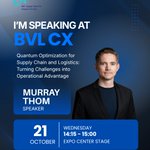
If you're attending #BVLCX, visit us at our booth, and I hope you'll join me for my talk:
Quantum Optimization for Supply Chain and Logistics: Turning Challenges into Operational Advantage
📅 Wednesday, Oct. 21
⏰ 14:15–15:00
📍 Expo Center Stage
I look forward to some great conversations about where quantum computing can deliver value in your operations today.
#QuantumComputing #DWave #Supplychain #logistics #berlin


Quantum Error Awareness can be a complicated topic, and we're always looking for new ways to make it easier to understand. I really enjoyed seeing how our D-Wave team brought these concepts to life through animation.
Have a look and let me know what you think:
#QuantumComputing #QuantumErrorCorrection #DWave
Effective quantum error correction is essential to scale gate-model systems, which are expected to be capable of solving useful, real-world problems in areas such as quantum chemistry, fluid dynamics, and materials science. At D-Wave, we believe error awareness is a critical step in overcoming that challenge.
Error awareness is a unique capability made possible by D-Wave’s dual-rail gate-model architecture, combining error detection and real-time control to provide visibility into errors as they occur and the ability to respond to them during computation.
Learn more here: dwavequantum.com/learn/blog/…
#QuantumComputing #GateModel #QuantumErrorCorrection
This week, I had the opportunity to participate in an @AWS and @Deloitte executive panel during SEMICON West, where we discussed how agentic AI and quantum computing are creating new opportunities for the semiconductor industry. Special bonus – it was in the Gotham Club at Oracle Park, home of the San Francisco Giants!
During the panel, I shared some of the patterns of opportunity for quantum optimization that we’re seeing in the semiconductor industry, particularly in electronic design automation (EDA), wafer flow optimization, and global supply chain management. As a panel, we were also able to compare some of the adoption patterns for agentic AI and quantum computing applications.
For semiconductor companies, quantum computing represents a dual opportunity: a market to serve and a technology to leverage. Established manufacturers are well placed to help with the industry’s challenges in materials development. Seeing where it delivers value and return on investment can help inform their decisions about what role they want to play in this growing industry.
I left the evening with a deeper appreciation for the challenges that semiconductor executives and their teams are working to solve. Thanks to everyone who joined the discussion, and a special thanks to the organizers for the custom baseball card. After 24 years in quantum computing, I think this might be my first rookie card! ⚾
#SEMICONWest #QuantumComputing #DWave #Semiconductors


I've just published some reflections from CSCMP EDGE 2026 in Nashville, where I had a wonderful opportunity to connect with supply chain professionals, industry leaders, and students.
One theme stood out across many of the conversations: optimizing for efficiency alone is not the objective. Businesses increasingly need speed, agility, and resilience to respond to changing conditions.
From Roberto Canevari's keynote on Estée Lauder's dynamic value chain to a thoughtful question from a University of Arkansas student, I was reminded that technology is only part of the solution. Bringing people, processes, and technology together is what makes the difference.
I share a few observations on these conversations, the growing role of quantum-powered optimization, and a lesson or two from my own logistical challenges in Nashville.
Thanks to everyone who made EDGE such an engaging event.
#CSCMPEDGE #SupplyChain #QuantumComputing
linkedin.com/pulse/my-observ…

There’s no better place to talk about the future of supply chains than being surrounded by the people who manage them every day, so I’m happy to be arriving at CSCMP EDGE 2026 with some exciting news to share.
Today, D-Wave and the University of Arkansas are announcing a new partnership to establish a quantum supply chain initiative fund at the Sam M. Walton College of Business. The goal is to bring quantum computing closer to the operational challenges facing the industry while creating opportunities for students to learn about the technology and gain practical experience applying it.
The next advantage for supply chains will come from making better decisions, faster, at a scale classical methods struggle to reach. The Sam M. Walton College of Business is in an incredible position to prepare the industry for that shift. Through this initiative, we will give students and researchers hands-on experience applying quantum optimization to real challenges in retail, supply chain management, and contested logistics.
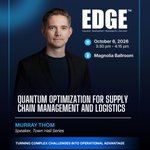
I’ll be continuing that conversation tomorrow at CSCMP - Council of Supply Chain Management Professionals, sharing how quantum computing is being applied in supply chain management, transportation, and logistics, and why these applications matter as supply chain networks become increasingly complex.
Quantum Optimization for Supply Chain Management and Logistics
📅 Tuesday, Oct. 6
⏰ 3:30–4:15 p.m.
📍 Magnolia Ballroom
If you’re at CSCMP EDGE, I hope to see you there. I’m looking forward to hearing about the hard problems this community is working to solve and sharing what we’re seeing from quantum computing in practice.
#QuantumComputing #SupplyChain #Logistics #CSCMP

In case you missed it, Andrei Petrenko and I gave a webinar last month exploring a new toolbox for gate-model quantum computing. I gave an entry-level introduction to error correction, which is essential for gate-model quantum computers, and I shared how error-detection technology can open new possibilities for making error correction more efficient on the path to fault-tolerant quantum computing.
If you’re interested in where gate-model quantum computing is headed, check out the video:
youtube.com/watch?v=kQJo7Wd-…

Check out my latest article: From Discovery to Production: A Four-Step Framework for Quantum Adoption linkedin.com/pulse/from-disc… via @LinkedIn

The latest episode of Quantum Matters is live, featuring a conversation I've been looking forward to for a long time. For our season finale, I sit down with Dr. Robert Schoelkopf, Chief Scientist at @dwavequantum and a pioneer of gate-model quantum computing.
Rob helped invent the transmon qubit that became the industry standard. We talk about the latest innovation in his search for a better qubit, the dual-rail qubit, which detects its own errors at the device level, plus his honest take on quantum hype and where fault-tolerant systems will make their first big impact.
▶️ Watch or 🎧 Listen here: link.cohostpodcasting.com/cd…
#QuantumRealized #QuantumComputing #FaultTolerantGate
Murray Thom retweeted

Today, D-Wave announced that it has achieved a major hardware breakthrough for quantum error correction, advancing the path to practical, fault-tolerant gate-model quantum computing.
In a paper published in @Nature, "An entangling gate for dual-rail erasure qubits," D-Wave details a new two-qubit entangling gate, a fundamental building block of quantum computation, designed to support efficient quantum error correction. The research demonstrates approximately 99.9% fidelity during two-qubit operations with fast gate times of about 500 nanoseconds, combining fast superconducting operations with high-fidelity performance, while preserving the native hardware-level error hierarchy.
Simulations presented in the paper show D-Wave’s dual-rail architecture could reduce logical error rates by as much as a factor of 10 for each increment in error correction, significantly lowering the physical qubit overhead required for fault-tolerant quantum computing. The results address one of the industry’s most consequential challenges by reducing the immense quantum and classical hardware overhead typically required to detect and correct quantum errors as systems scale.
Explore the highlights in our press release: bit.ly/4wjO6U0
Wow! Things are starting off with a bang at @Ai4Conferences in Las Vegas today! Other exhibitors are stopping me to ask about #QuantumComputing
Come by our booth (730) to meet the team and learn more about the intersection with #AI
And come out to my talk:
Exploring AI Energy Efficiency and Model Performance with Quantum Computing
📆 Thursday Aug 6
⏰ 12:20pm
📍 Venetian Ballroom E
#QuantumRealized #BeyondClassical #EnergyEfficient @dwavequantum
The latest episode of the Quantum Matters podcast is now live! In this episode I discuss the rapidly evolving intersection of quantum computing and high-performance computing with Professor Dr. Kristel Michielsen, Director of the Jülich Supercomputing Centre. ▶️ Watch or 🎧 Listen here: link.cohostpodcasting.com/cd…
#DWave #QuantumRealized #QuantumComputing #HPC #JSC #JUNIQ #JUPITER #Innovation #AI #Optimization
The latest episode of Quantum Matters is live, and this one features my good friend Dr. @trevorlanting, Chief Development Officer at @dwavequantum.
▶️ Watch or 🎧 Listen here: link.cohostpodcasting.com/cd…
Building a quantum application platform that supports real-world applications goes well beyond scaling qubit counts in the quantum computers themselves. There’s an entire ecosystem of technologies required to bring useful quantum computing to the world: the cloud infrastructure, software, calibration, control systems, cryogenics, and fabrication that all have to work together before users submit their first problem.
In this episode, I speak with Trevor about what goes into bringing these machines online and making them available to users. We get into how applications, software, and hardware evolve together at D-Wave, and we discuss the critical reasons for our dual-platform approach of developing both annealing and gate-model systems to address more of our customers’ toughest problems.
Trevor has been building these systems for over 18 years, and his perspective on what it actually takes to deliver customer value with quantum computing is one you won’t want to miss.
#QuantumRealized #QuantumComputing #BeyondClassical
Murray Thom retweeted
D-Wave is one of only two companies positioned to the Leaders Category in the @IDC MarketScape: Worldwide Quantum Computing 2026 Vendor Assessment.
We believe the report recognizes our commercial momentum, enterprise-ready hybrid platform, broad production deployments, and dual-platform strategy spanning quantum annealing and gate-model quantum computing.
Learn more: dwavequantum.com/company/new…
#QuantumComputing #Innovation #DWave #IDCMarketScape
Murray Thom retweeted
What does it actually take to build a commercially viable, fault-tolerant quantum computer?
It's a question that goes well beyond increasing qubit counts. As D-Wave Chief Development Officer Dr. @trevorlanting explains, the path forward depends on advances in architecture, error correction, control electronics, and system design working together.
Learn more from Trevor here: linkedin.com/company/40310/a…