

Interested in Labor, Macro and Spatial|PhD student @DukeEcon | "Micro and Macro Perspective of Labor Market" Virtual Reading Group at Duke
Joined October 2020
- Tweets620
- Following1K
- Followers829
- Likes324



Pinned Tweet
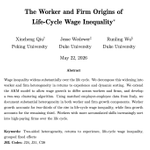
(1/13) 🚨 New paper alert 🚨
"The Worker and Firm Origins of Life-Cycle Wage Inequality" (with @XinchengQiu and Jesse Wedewer @DukeEcon)
Draft available here: 🧵⬇️
jessewedewer.com/Qiu_Wedewer…

Runling Wu retweeted

We are hiring for 2 AP positions in Economics at Cal State Fullerton. Check out our great group of people. Please RT.
aeaweb.org/joe/listing.php?J…,,
Runling Wu retweeted

Excited to share a new working paper with @sndurlauf and Alexander Shapoval! We study six generations of families in Liaoning province to see how the footprints of major crises in the late Qing dynasty can be traced in intergenerational mobility dynamics. #EconJobMarket

In the last 130 years of China’s Qing Dynasty, aggregate intergenerational mobility increased.
A working paper from our postdoc and job market candidate @Butaeva_K, with @sndurlauf & Alexander Shapoval, reveals a more complicated story.
Keep reading🧵⬇️
bit.ly/3VAXLsE

Runling Wu retweeted

🚨Understanding Migration Responses to Local Shocks
New version of paper with @borusyak and Brian Kovak!
1/6 Many papers find that local labor demand shocks have sizable effects on wages and employment, but surprisingly small or imprecise effects on local population.

Runling Wu retweeted

New paper! 📄
If you get a job at a better paying firm, your take home pay goes up. How much more do you spend?
It matters because the answer tells us whether gaps in pay between firms translate into gaps in living standards. 1/9
Runling Wu retweeted

🚨
Announcing OpenCensus, a new project with
@EzraKarger
We are transcribing the historical US censuses and releasing them as open data
2.6 million people so far in 1940, browse here:
opencensus.us

Runling Wu retweeted

🤠WE ARE HIRING
👩🏫Check out our positions for a tenure-track Assistant Professor and an Assistant Teaching Professor of Economics.
🐎Join us in this exciting moment for our department and University.
🔗TT: aeaweb.org/joe/listing.php?J…
🔗Teaching: aeaweb.org/joe/listing.php?J…

Runling Wu retweeted

Had a fantastic time teaching a mini-course on 𝗠𝗮𝗰𝗵𝗶𝗻𝗲 𝗟𝗲𝗮𝗿𝗻𝗶𝗻𝗴 𝗳𝗼𝗿 𝗗𝘆𝗻𝗮𝗺𝗶𝗰 𝗘𝗰𝗼𝗻𝗼𝗺𝗶𝗰 𝗠𝗼𝗱𝗲𝗹𝘀 at @DukeEcon!
Thanks to @DanielYiXu @dix_rafael @CosminIlut David Berger for hosting.
🚀All slides+code are available here github.com/yangycpku/Machine…

Runling Wu retweeted

Excited to launch the revamped GRID website!
grid-database.org/
GRID now covers 26 countries across 5 continents, with a brand-new visualization tool to explore income inequality, income risk, and mobility across countries, demographic groups, and over time.
Follow us on X: @GRIDdatabase
And on LinkedIn: linkedin.com/company/1435571…
Please retweet and help us spread the word!


Today, GRID gets bigger and better.
grid-database.org/
Decades of GRID data are now interactive.
Our coverage has grown by 14 countries, our research has expanded, and the website has been completely redesigned.
This is our biggest update yet. Here's the overview. 🧵

Runling Wu retweeted

Online job postings overstate labor market concentration by nearly a factor of three.
That's the headline of a new NBER working paper with Michael Dalton and @ProfLisaBKahn . We match near-universal Burning Glass postings to the representative JOLTS and reweight them to line up with actual vacancies.
The reason is simple: small and mid-sized establishments post online far less often, so measured HHIs look much too concentrated. Findings on the level and cyclicality of skill demand, by contrast, survive the adjustment — large employers account for most openings and are well covered.
So: if your result rests on small employers, the coverage gap matters.
nber.org/papers/w35697

Runling Wu retweeted

We document workers' substantial job loss fears due to AI in a large-scale, multi-wave survey. These fears matter even without realized large-scale displacement, because it informs people's consumption, job search, and occupational choice. 🧵 below

1/ New AI paper update with @FilipJole, @VitorMelo, and @BrendanDMoore:
“Job Loss Fears in the First Years of Generative Artificial Intelligence”
Workers are deeply worried that AI will take their jobs. So far, the labor market data tell a different story. 🧵

Runling Wu retweeted

Updates on the PhD macro textbook project: It will be out from OUP in Nov.
You can pre-order now at OUP global.oup.com/academic/prod… or Amazon amazon.com/Macroeconomics-Ma….
We took down the draft from the book website, but the slides are here phdmacrobook.org/slides/ for all chapters.
Runling Wu retweeted

We are hiring on the seasoned market at the Atlanta Fed:
HH finance: aeaweb.org/joe/listing.php?J…
Labor (even better if you can do both applied with admin data + you know macro-labor) aeaweb.org/joe/listing.php?J…
Macro (and macro-finance, financial intermediation) aeaweb.org/joe/listing.php?J…
Runling Wu retweeted

New massive tax on skilled immigration dropped this morning:

The $103,265 charge would apply to all petitions for H-1B workers subject to an annual cap on the program.
news.bloomberglaw.com/daily-…

Runling Wu retweeted

The White House is poised to announce a large new tax on international students who stay to work in the US after graduation.
In a new paper out today at @rfberlin.bsky.social, I analyze the sweeping impacts of this tax on students, US universities, and US firms—>
Runling Wu retweeted

החשיבות של מעבר חופשי בין מעסיקים עולה מהמחקר של @J_ArellanoBover ושלי לגבי עולים מברית המועצות בשנות ה90.
academic.oup.com/jeea/advanc…

Runling Wu retweeted

🚨Workshop Alert🚨
Send us your macro-devo/micro-to-macro papers to this amazing workshop in Uruguay on December 11-12
Keynote: Ezra Oberfield
Deadline: October 1st
Submission link: paperflows.app/ridge-decembe…


Runling Wu retweeted

Using new data on 1.2 million students at 60 coeducational US colleges (1915–1943) to study how colleges shape who marries whom and the next generation's education, from Ran Abramitzky, @seperez84, and @joepricebyu nber.org/papers/w35602

Runling Wu retweeted
LinkedIn histories aren’t fixed; 19 percent of users edit past jobs. These “time-travel” edits track job moves and reveal rising AI language after 2022, and fading DEI mentions after 2025, from @I_Am_NickBloom, @GideonMoore, Lisa K. Simon, and Caelan Wilkie-Rogers nber.org/papers/w35546

Runling Wu retweeted

My Cambridge Element titled “Addressing Population Ageing in China: Public Policy and Institutional Innovations” has entered the production process. Will be open access the first two weeks when it comes out. Link will be posted here. Please DM me if you like an early view.


One of the most illuminating articles I ever read

Excellent reading (in 🧵) for younger researchers—two papers with near-identical core results, framed in very different ways.
Kudos to @jasonmfletcher for the thoughtful discussion, it would be cheap, easy (and viral) to say "prestige is the only thing that matters in econ."

