

Software Developer @jazzpk Proud father
Islamabad, Pakistan
Joined September 2010
- Tweets947
- Following457
- Followers98
- Likes939


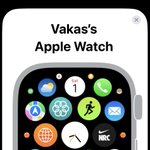









Will Modular Ultra be available for original Apple Watch Ultra #AppleEvent #AppleWatchUltra2
Vakas ᯅ retweeted

🧠🤖 The future of brain-machine interfaces and AI?
NEW patent by Apple published this week: EEG-integrated AirPods.
Abstract: A wearable electronic device includes a housing, and an electrode carrier attached to the housing and having a nonplanar surface. The wearable electronic device includes a set of electrodes, including electrodes positioned at different locations on the nonplanar surface. The wearable electronic device includes a sensor circuit and a switching circuit. The switching circuit is operable to electrically connect a number of different subsets of one or more electrodes in the set of electrodes to the sensor circuit.
Patent US-20230225659-A1:

Vakas ᯅ retweeted

Fun fact, through the 45 minutes it took for Apple to introduce the Vision Pro Headset, they said the words "Virtual Reality" exactly 0 times. Here's a fun video on the words Apple never says on stage:
youtu.be/kvN5_GXlg2Y

Vakas ᯅ retweeted

Vision Pro mega-thread 1/5:
My advice for designing and developing products for Vision Pro. This thread includes a basic overview of the platform, tools, porting apps, general product design, prototyping, perceptual design, business advice and more.
Disclaimer: I’m not an Apple representative. This is my personal opinion and does not contain non-public information.
Overview:
Apps on visionOS are organized into “scenes”, which are Windows, Volumes, and Spaces.
Windows are a spatial version of what you’d see on a normal computer. They’re bounded rectangles of content that users surround themselves with. These may be windows from different apps or multiple windows from one app.
Volumes are things like 3D objects, or small interactive scenes. Like a 3D map, or small game that’s not immersive.
Spaces are fully immersive experiences where only one app is visible. That could be full of many Windows and Volumes from your app. Or like VR games where the system goes away and it's all custom content. You can think of visionOS itself like a Shared Space where apps coexist together and you have less control. Whereas Full Spaces give you the most control and immersiveness, but don’t coexist with other apps. Spaces have immersion styles: mixed, progressive, and full. Which defines how much or little of the real world you want the user to see.
User Input:
Users can look at the UI and pinch like the demo videos show. But you can also reach out and tap on windows directly, sort of like it’s actually a floating iPad. Or use a bluetooth trackpad or video game controller. You can also look and speak in search bars, but that’s disabled by default for some reason on existing iPad and iOS apps running on Vision Pro. There’s also a Dwell Control for eyes-only input, but that’s really an accessibility feature. For a simple dev approach, your app can just use events like a TapGesture. In this case, you won't need to worry about where these events originate from.
Spatial Audio:
Vision Pro has an advanced spatial audio system that makes sounds seem like they’re really in the room by considering the size and materials in your room. Using subtle sounds for UI interaction and taking advantage of sound design for immersive experiences is going to be really important. Make sure to take this topic seriously.
Development:
If you want to build something that works between Vision Pro, iPad, and iOS, you'll be operating within the Apple dev ecosystem, using tools like XCode and SwiftUI. However, if your goal is to create a fully immersive VR experience for Vision Pro that also works on other headsets like Meta's Quest or PlayStation VR, you have to use Unity.
Apple Tools:
For Apple’s ecosystem, you’ll use SwiftUI to create the UI the user sees and the overall content of your app. RealityKit is the 3D rendering engine that handles materials, 3D objects, and light simulations. You’ll use ARKit for advanced scene understanding. Like if you want someone to throw virtual darts and have them collide with their real wall, or do advanced things with hand tracking. But those rich AR features are only available in Full Spaces. There’s also Reality Composer Pro which is a 3D content editor that lets you drag things around a 3D scene and make media rich Spaces or Volumes. It’s like Diet-Unity that’s built specifically for this development stack.
One cool thing with Reality Composer is that it’s already full of assets, materials, and animations. That helps developers who aren’t artists build something quickly and should help to create a more unified look and feel to everything built with the tool. Pros and cons to that product decision, but overall it should be helpful.
Existing iOS Apps:
If you're bringing an iPad or iOS app over, it will probably work unmodified as a Window in the Shared Space. If your app supports both iPad and iPhone, it’ll look like the iPad version.
You can use the Ornament API to make little floating islands of UI in front of, or besides your app, to make it feel more spatial. But that’s not something all existing apps get automatically. Ironically, if your app is using a lot of ARKit features, you’ll likely need to ‘reimagine’ it significantly as ARKit has been upgraded a lot.
If you’re excited about building something new for Vision Pro, my personal opinion is that you should prioritize how your app will provide value across iPad and iOS too. Otherwise you're losing out on hundreds of millions of users.
Unity:
You can build to Vision Pro with the Unity game engine, which is a massive topic. Again, you need to use Unity if you’re building to Vision Pro as well as a Meta headset like the Quest or PSVR.
Unity supports building Bounded Volumes for the Shared Space which exist alongside native Vision Pro content. And Unbounded Volumes, for immersive content that may leverage advanced AR features. Finally you can also build more VR-like apps which give you more control over rendering but seem to lack support for AR Kit scene understanding like plane detection. The Volume approach gives RealityKit more control over rendering, so you have to use Unity’s PolySpatial tool to convert materials, shaders, and other features.
Unity support for Vision Pro allows for tons of interactions you’d expect to see in VR, like teleporting to a new location or picking up and throwing virtual objects.

Vakas ᯅ retweeted

watchOS 10 is the most significant update for Apple Watch since its introduction. In “Meet watchOS 10”, I share an in-depth look at how we designed the new user interface and how you can use the same design principles to make great apps of your own. developer.apple.com/videos/p…
Vakas ᯅ retweeted
I spent 10% of my life contributing to the development of the #VisionPro while I worked at Apple as a Neurotechnology Prototyping Researcher in the Technology Development Group. It’s the longest I’ve ever worked on a single effort. I’m proud and relieved that it’s finally announced. I’ve been working on AR and VR for ten years, and in many ways, this is a culmination of the whole industry into a single product. I’m thankful I helped make it real, and I’m open to consulting and taking calls if you’re looking to enter the space or refine your strategy.
The work I did supported the foundational development of Vision Pro, the mindfulness experiences, ▇▇▇▇▇▇ products, and also more ambitious moonshot research with neurotechnology. Like, predicting you’ll click on something before you do, basically mind reading. I was there for 3.5 years and left at the end of 2021, so I’m excited to experience how the last two years brought everything together. I’m really curious what made the cut and what will be released later on.
Specifically, I’m proud of contributing to the initial vision, strategy and direction of the ▇▇▇▇▇▇ program for Vision Pro. The work I did on a small team helped green light that product category, and I think it could have significant global impact one day.
The large majority of work I did at Apple is under NDA, and was spread across a wide range of topics and approaches. But a few things have become public through patents which I can cite and paraphrase below.
Generally as a whole, a lot of the work I did involved detecting the mental state of users based on data from their body and brain when they were in immersive experiences.
So, a user is in a mixed reality or virtual reality experience, and AI models are trying to predict if you are feeling curious, mind wandering, scared, paying attention, remembering a past experience, or some other cognitive state. And these may be inferred through measurements like eye tracking, electrical activity in the brain, heart beats and rhythms, muscle activity, blood density in the brain, blood pressure, skin conductance etc.
There were a lot of tricks involved to make specific predictions possible, which the handful of patents I’m named on go into detail about. One of the coolest results involved predicting a user was going to click on something before they actually did. That was a ton of work and something I’m proud of. Your pupil reacts before you click in part because you expect something will happen after you click. So you can create biofeedback with a user's brain by monitoring their eye behavior, and redesigning the UI in real time to create more of this anticipatory pupil response. It’s a crude brain computer interface via the eyes, but very cool. And I’d take that over invasive brain surgery any day.
Other tricks to infer cognitive state involved quickly flashing visuals or sounds to a user in ways they may not perceive, and then measuring their reaction to it.
Another patent goes into details about using machine learning and signals from the body and brain to predict how focused, or relaxed you are, or how well you are learning. And then updating virtual environments to enhance those states. So, imagine an adaptive immersive environment that helps you learn, or work, or relax by changing what you’re seeing and hearing in the background.
All of these details are publicly available in patents, and were carefully written to not leak anything. There was a ton of other stuff I was involved with, and hopefully more of it will see the light of day eventually.
A lot of people have waited a long time for this product. But it’s still one step forward on the road to VR. And it’s going to take until the end of this decade for the industry to fully catch up to the grand vision for this tech.
Again, I’m open to consulting work and taking calls if your business is looking to enter the space or refine your strategy. Mostly, I’m proud and relieved this has finally been announced. It’s been over five years since I started working on this, and I spent a significant portion of my life on it, as did an army of other designers and engineers. I hope the whole is greater than the sum of the parts and Vision Pro blows your mind.

Vakas ᯅ retweeted

Did apple just lowkey launch a v1 brain-machine-interface into the Vision Pro?
One of their ex designers just tweeted this:
“One of the coolest results involved predicting a user was going to click on something before they actually did. That was a ton of work and something I’m proud of. Your pupil reacts before you click in part because you expect something will happen after you click. So you can create biofeedback with a user's brain by monitoring their eye behavior, and redesigning the UI in real time to create more of this anticipatory pupil response. It’s a crude brain computer interface via the eyes, but very cool”


Vakas ᯅ retweeted

I created an iOS shortcut that allows you to replace Siri with ChatGPT.
It’s super simple:
- Install extension
- Enter OpenAI API key
- Add to home
- Tell it what you want
Here’s a video of Hey GPT in action.
It blows Siri out of the water.
Install: icloud.com/shortcuts/8bcc297…
Vakas ᯅ retweeted

Despite macroeconomic challenges, Jazz continued to lead the market with an unabated focus on driving digital inclusion while enhancing the quality of services for its customers.
Read More: propakistani.pk/2023/03/16/d…

Vakas ᯅ retweeted

Despite macroeconomic challenges, Jazz's unabated focus on driving digital inclusion while enhancing the quality of services for its customers by investing over Rs. 52 billion under its ‘4G for all’ ambition in FY 22, taking its overall investment in Pakistan to US$10.4 billion.

Despite macroeconomic challenges, Jazz continued to lead the market with an unabated focus on driving digital inclusion while enhancing the quality of services for its customers.
Read More: propakistani.pk/2023/03/16/d…

Vakas ᯅ retweeted

Congrats to @clipdropapp for getting acquired by Stability AI!
Still can't get over this mindblowing tech 🤯
Vakas ᯅ retweeted

It’s finally working! 😍🥳
#ChatGPT for Siri!!! Dive into a real conversation and talk about everything you want . @LoriGPT remembers the context and is available right within the Siri interface. 😱😍
