
Reasoning @OpenAI 🍓 @UCBerkeley PhD '23 | @Harvard '20
San Francisco, CA
Joined March 2022
- Tweets104
- Following222
- Followers25.1K
- Likes1K







Pinned Tweet
1/N I’m excited to share that our latest @OpenAI experimental reasoning LLM has achieved a longstanding grand challenge in AI: gold medal-level performance on the world’s most prestigious math competition—the International Math Olympiad (IMO).

Alexander Wei retweeted

We’re releasing a broad range of new mathematical results produced by an internal frontier model.
We’ve been consulting with the independent Advisory Group on Mathematics and Artificial Intelligence at the Institute for Advanced Study, and we have drawn on their advice and public recommendations to inform how we release these results.
github.com/openai/math

Alexander Wei retweeted

In our Nature paper, we introduce the first superhuman Stratego AI, which we built using general techniques that we developed for RL & test-time compute under imperfect information. 1/N

at the end of the day, AGI is just one problem among many. excited to see what you build next! 🐐

Alexander Wei retweeted

The Navier Stokes solution was the result of a collaboration of ~10,000 (!) agents working together. Over the past year, we’ve been training models to collaborate through multiagent RL. It’s been amazing to see how much better the models have become at this: it seems clear now that one of the most effective ways to solve hard problems is to give models huge amounts of unstructured parallel test-time compute and let them decide how to work together.

We’re sharing a solution to the Navier-Stokes Millennium Prize Problem, one of the deepest problems at the frontier of mathematics.
The proof was produced by a group of agents, using an OpenAI next-generation model significantly more capable than GPT-6 Astra.
The problem concerns whether the description of smooth three-dimensional fluid motion modeled by the Navier-Stokes equations can break down. It has remained unresolved for roughly 90 years.

Alexander Wei retweeted

My team worked very hard on the setup, infra, and the runs that resulted in this breakthrough. Many sleepless nights for many people in my team, and across OpenAI. It was a honor and pleasure.
It's incredible and humbling to witness how far Artificial Intelligence has come. Dario's phrase "country of geniuses" in a datacenter has never felt more apt.
It's also important to recognize & honor the long line of human mathematicians whose work built the foundation of this result. In particular, huge kudos to Levent and Tristan!
Overall, I wish the announcement of the results had gone without all the drama. There was no bad intention on anyone's side as far as I know. The drama distracts from the mathematics discovered & the actual science.
We’re sharing a solution to the Navier-Stokes Millennium Prize Problem, one of the deepest problems at the frontier of mathematics.
The proof was produced by a group of agents, using an OpenAI next-generation model significantly more capable than GPT-6 Astra.
The problem concerns whether the description of smooth three-dimensional fluid motion modeled by the Navier-Stokes equations can break down. It has remained unresolved for roughly 90 years.
AI settled a Millennium Prize Problem today. It should feel surreal.

This past week at OpenAI has been the most humbling experience of my life. We all feel the weight of what’s coming.
When I joined OpenAI earlier this year, I speculated that AI might write an Annals paper in 2027—and maybe, just maybe, solve a Millennium Prize Problem in 2028. That was considered very bullish at the time. The first happened in May; the second, this September.
What a surreal time to be alive!
Alexander Wei retweeted

I would like to clarify a few things:
1) The screenshot is my reaching out to Levent to coordinate our releases. I hope it’s clear from the message that we came in with the best possible intentions.
2) I never ever asked for Levent to be removed from authorship of his own work (as indicated by my text). I was surprised to learn during the call with Tristan that they had only solved Euler and not Navier-Stokes; after learning this we brainstormed possible paths forward. One option we discussed was that Tristan could be the lead author on a rewrite of OpenAI’s Navier-Stokes proof. It is in that context that I said “it would be simpler if Levent was not an Anthropic employee” because I felt it would be inappropriate for an Anthropic employee to author OpenAI’s work. Importantly it was admitted that internal Anthropic models had been used in their proof of Euler blowup; I therefore felt I could not consider Levent to be an independent academic. Another option I wanted to propose (but got cut short) is to offer access to our internal model so that they could try to finish their proof and bridge the gap between Euler and NS. Again I did not know how to navigate giving access to internal OpenAI IP to an Anthropic employee.
3) To reiterate it plainly: as my text clearly indicates, and as I said during our call, OpenAI's intention was to do everything possible to celebrate their mathematical achievements and the heroic efforts that they made on Euler. In the call I was immediately met with a litany of slander, including direct threats that if we were to announce Navier-Stokes he would immediately go to the press with a barrage of unfounded accusations. I refuted all these accusations but he replied “there is nothing you can do, I simply do not trust you”. I was confused why one would turn an incredible source for celebration (of their achievements!) into such bickering, which is when I said that I did not understand why one would risk their career [over unfounded accusations]. Genuinely, at that moment, I was trying to care for him and do a last ditch attempt to get a chance to give them all the credits that they deserve. I deeply apologize for this extremely poor choice of words, it is the opposite of what I was trying to convey. (I should say that I retracted them on the spot by the way.)
4) Overall, on a personal level, it was incredibly difficult to have these conversations. Levent refused to attend any of the meetings despite my repeated asking. As Sholto Douglas said, there will need to be coordination between Anthropic and OpenAI in the future; I felt I was doing a proxy negotiation with Anthropic while the Anthropic employee refused to directly participate.

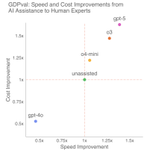
While a resolution to Navier-Stokes is the highlight of today, this plot is really the headline result to me.
Our ongoing training run demonstrates unprecedented performance on mathematics research, as measured by our model's estimated performance on a collection of **open** math problems.
Of course, to settle Navier-Stokes, we took this model and also scaled test-time compute allll the way up.
This model represents a step-function improvement on many benchmarks, and its training is ongoing.
Our internal model group arrived at the Navier–Stokes solution in 88 hours, using around 10,000 coordinating AI agents.
Throughout the effort, we maintained the strict safeguards—including monitoring and isolation—that we apply to all our frontier evaluations.

Alexander Wei retweeted

Seb is a really sweet guy with great intentions, am so happy for him that his week long collaboration with myself and others worked out, but very sad that we didn't get to finish it in the way we wanted. More to say tomorrow.

A series of false and inflammatory allegations against me are currently circulating on social channels. To clarify, I came into the discussion following academic norms, and I'm disappointed that it has come to this. Anyone who knows me knows that academic standards are of the highest importance to me. Will have more to say tomorrow.


Alexander Wei retweeted
Announcing that GPT-6 Astra has pushed the prime gap to 186, with Lean formalization!
I was 9 when I first heard the twin prime conjecture. Its elegance and Yitang Zhang’s legendary story have always stuck with me. A truly surreal night, being the first to see our model make progress, pushing 246 all the way down to 186, on a problem I’ve revered since I was a kid.
For me, it felt like witnessing a new era of intelligence being born, made possible by everyone at @OpenAI!

Alexander Wei retweeted

As part of the GPT-6 Astra launch, we announced that Astra had given an improvement to the longest gap between primes by roughly a log log n factor; the first such improvement since the 1930's! (More recent progress by subsets of Ford, Green, Konyagin, Maynard and Tao and more recently by GPT 5.6 Sol were by logloglog n factors.) (1/4)
Alexander Wei retweeted

I want to prevent a race into unmonitorability kicked off by confused reporting. The depth of the computation graph for our present frontier models, including Astra, is within a factor of two of GPT-4.
OpenAI has worked to preserve and utilize chain-of-thought monitoring since our very first reasoning models. We deeply care about this technique, as it can give us a view into how model alignment generalizes from its training distribution. I do think it is fragile and unfortunately trending in a negative direction, for reasons not contingent on architecture changes that I will write about soon. But there are things we can do to strengthen it, and it's a core goal of our current research program.
Alexander Wei retweeted

Yesterday, my OpenAI collaborator and I gave a detailed talk on the Huggingface incident, our models creating "the message board", model misalignment, and more.
youtube.com/watch?v=87DyyMV0…
I hope it can answer a lot of the questions folks have, and we will release a full detailed postmortem at a later time!

It is remarkable—and takes a moment to process—how quickly the next generation of models will accelerate our research, and breathe new life into old problems.
This was an incredible project done by an incredible team (and model) in just a week. Ad Astra we go ✨

Alexander Wei retweeted
yes, nonsofic groups exist: this statement is one of many new beautiful results proved by Astra, our next major model.
We're releasing 10 such Astra proofs, complete with lean certificates and CoT walkthroughs for each of them. The results are wide-ranging, from von Neumann algebras (disproof of Connes' Rigidity Conjecture) to better bounds for high dimensional sphere packing, for circuit complexity, for monochromatic triangles in multicolored graphs, and more.
More thoughts here: openai.com/index/ten-advance…

A delightful two-page proof of the Cycle Double Cover Conjecture, from a model you can access at home!

Alexander Wei retweeted
What happened when one of our models found a counterexample to an 80-year-old Erdős conjecture?
Researchers @alexwei_, @HongxunWu, and @wjmzbmr1 shared the story on the OpenAI Podcast with @AndrewMayne and explained how mathematicians and models can work together to make new discoveries.
Alexander Wei retweeted

1/ Today, an internal @OpenAI model has refuted Erdős’s unit distance conjecture — a research result that one could recommend “acceptance without any hesitation” to the Annals of Mathematics, one of the most prestigious journals in mathematics.
We came across it in a side quest to push our model on the hardest problems.
Today, we share a breakthrough on the planar unit distance problem, a famous open question first posed by Paul Erdős in 1946.
For nearly 80 years, mathematicians believed the best possible solutions looked roughly like square grids.
An OpenAI model has now disproved that belief, discovering an entirely new family of constructions that performs better.
This marks the first time AI has autonomously solved a prominent open problem central to a field of mathematics.